

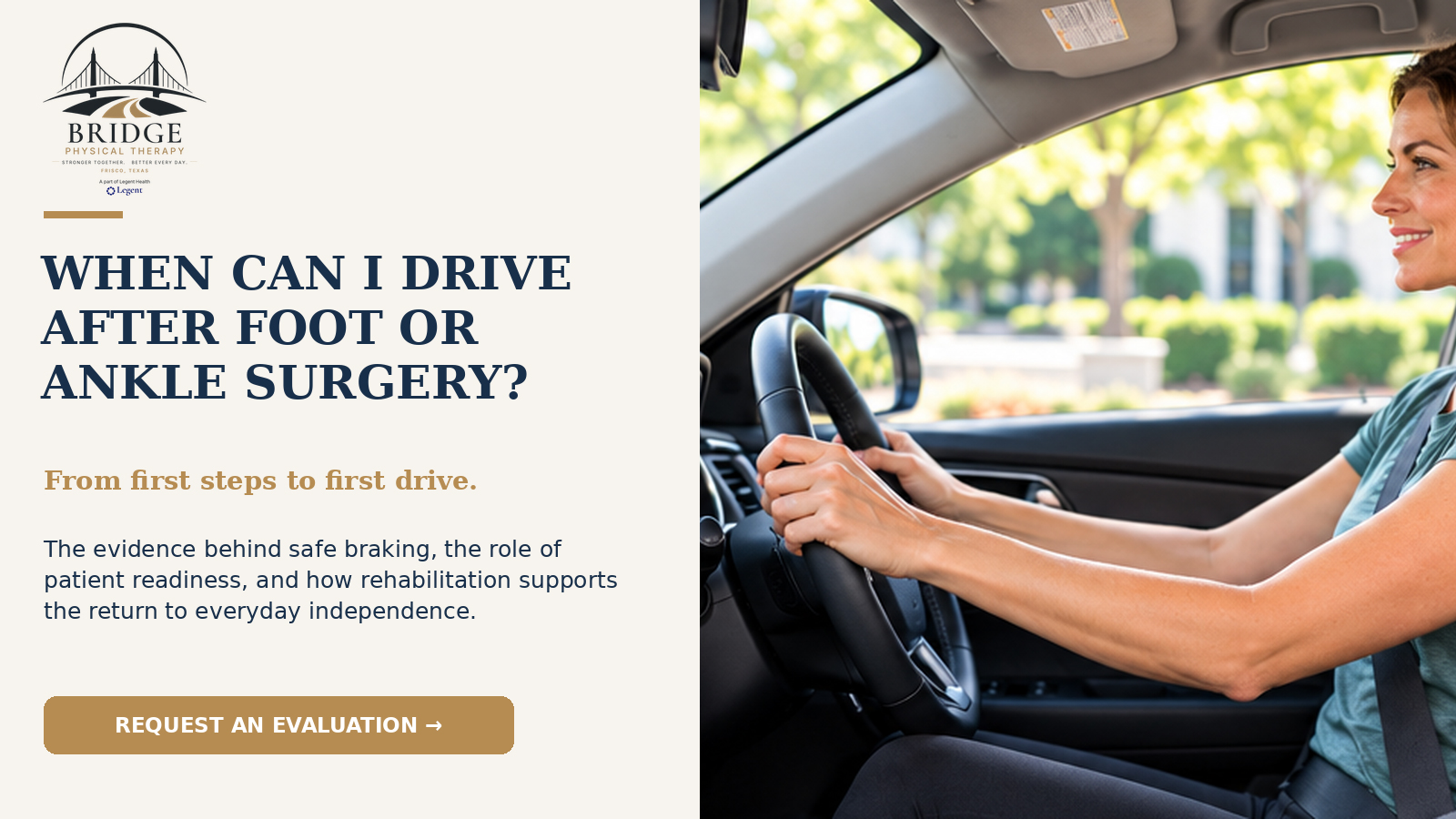
After foot or ankle surgery, the first time you can safely drive may matter almost as much as when you can walk. Getting back behind the wheel restores independence: school drop-offs, work, groceries, medical appointments, and ordinary life. But a calendar date is not the same as a safe braking response. The better question is whether your operated limb has healed enough—and recovered enough movement and control—to manage the vehicle without hesitation.
At Bridge Physical Therapy in Frisco, Texas, we help patients regain the functional building blocks involved in everyday mobility. Our job is to support recovery in coordination with your surgeon, not to overrule surgical precautions or declare that a particular exercise makes someone legally or clinically safe to drive.
Why returning to driving is different from walking
Sometimes patients can walk to the examination room yet cannot comfortably move their right foot from the accelerator to the brake. Walking, driving, and emergency braking are related, but they are not interchangeable. Driving demands coordinated foot placement, rapid response, adequate braking force, an unimpaired attention span, and control under unexpected conditions.
After foot or ankle surgery, swelling, pain, protective movement patterns, immobilization, and reduced strength may all change how the foot behaves. A small bunion correction is different from an ankle fracture, Achilles repair, total ankle replacement, or hindfoot reconstruction. Likewise, recovery after an operation on the left side may be different from recovery after right-sided surgery in a vehicle with an automatic transmission. These distinctions explain why calendar-based rules can mislead patients.
What the research says about brake reaction time and patient readiness
Brake reaction time (BRT) is a research measure describing the interval between a stimulus and a driver’s braking response. Investigators frequently use simulators or controlled tests rather than waiting for real-world traffic events. Results are valuable for counseling, but a passing simulated test does not establish a guarantee of safe on-road driving.
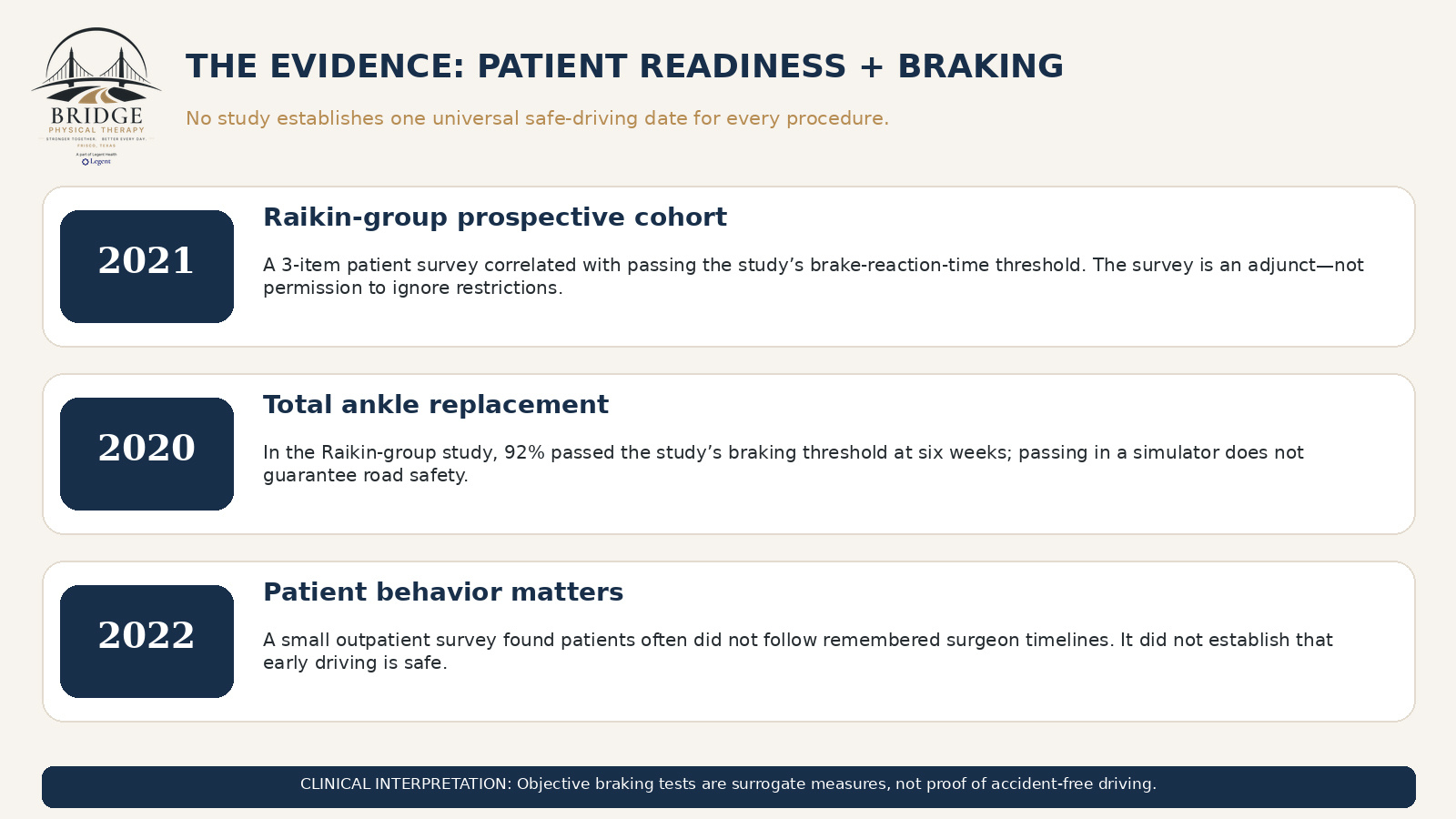
In a prospective study by McDonald, Shakked, Raikin, and colleagues published in Foot & Ankle Specialist, 171 patients undergoing right-sided Achilles repair, total ankle replacement, or hallux valgus correction were studied with a patient-reported readiness instrument and brake-reaction testing. The investigators used a study-specific passing threshold of less than 0.850 seconds. Among patients who scored at least 10 of 15 on the refined three-question survey, the estimated probability of passing that threshold was 99%. This is important: the patient’s self-assessment predicted a laboratory performance measure. The study did not show that confidence alone prevents crashes or replaces restrictions from the operating surgeon. [1]
A separate prospective series focused on total ankle arthroplasty. At six weeks after right total ankle replacement, 54 of 59 patients (92%) met the study’s braking criterion; those who remained in follow-up had passed by nine weeks. This suggests meaningful variation between individuals and supports functional reassessment rather than assuming all patients have the same timetable. [2]
An observational outpatient study by Burnham and colleagues adds a behavioral perspective: patients did not consistently resume driving at the dates they recalled being advised by their surgeons. Only 17 patients participated in the survey, and its design could not prove that earlier return was safe. The lesson is not that medical advice is irrelevant. It is that effective counseling must address the patient’s own assessment, functional status, and real-world pressures. [3]
A systematic review of return to driving following elective right foot and ankle surgery also found that published protocols and methods differ substantially. The underlying message is the same: a period such as six to nine weeks is sometimes useful as a discussion starting point, not as an automatic driving clearance. [4]
Does surgery on the right foot matter more than the left?
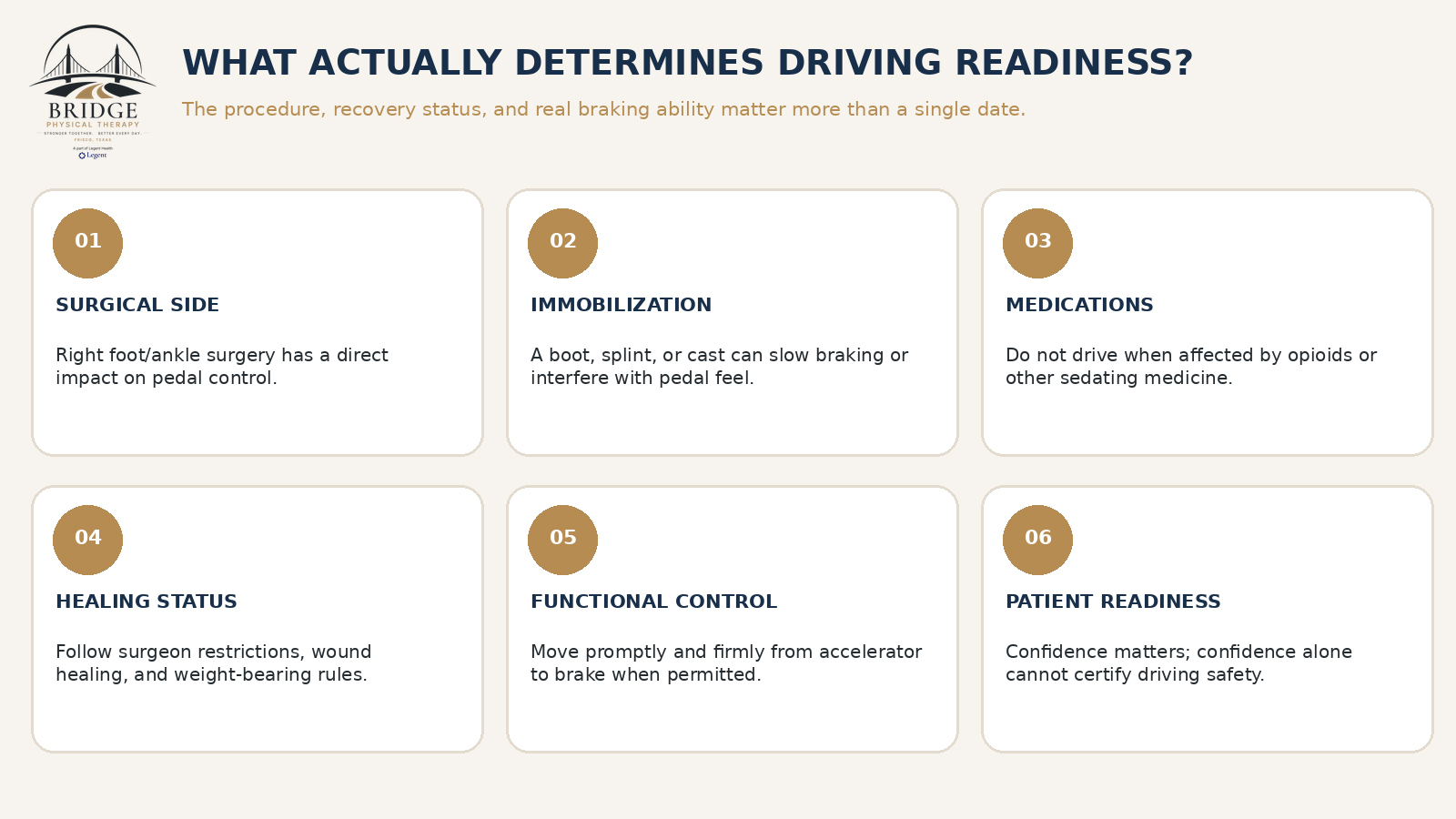
In most U.S. automatic-transmission vehicles, the right foot operates both accelerator and brake. Surgery affecting the right foot or ankle can therefore impair the very limb used for emergency braking. A right-sided walking boot, reduced ankle motion, pain, or decreased calf and dorsiflexor control can be especially problematic.
For a patient recovering from left-sided surgery, the impact on pedal movement may be less direct if they drive an automatic transmission. However, transfer into the vehicle, seat positioning, pain, sedating medications, and surgeon instructions still matter. With a manual transmission, the left leg operates the clutch, so left-sided surgery may substantially change driving readiness. Do not assume that a left-foot operation grants automatic clearance.
Can you drive while wearing a surgical shoe or walking boot?
Driving while wearing a right-sided cast, postoperative shoe, or controlled-ankle-motion (CAM) boot is a particular concern. In a simulated emergency-braking study of healthy volunteers, a walking boot increased mean brake-response time and the frequency of delayed or inaccurate responses compared with ordinary shoes. Another experiment similarly found that right-sided immobilization altered braking metrics. These volunteer studies cannot determine the safety of every postoperative patient, but they give a strong reason to avoid making exceptions casually. [5,6]
Do not remove a prescribed boot merely to drive unless the surgeon has explicitly authorized that activity. Do not try to compensate for right-sided restrictions by experimenting with left-foot braking without proper evaluation and training. The vehicle, medication status, and legal responsibilities also need to be considered.
How soon after bunion surgery, ankle fracture surgery, Achilles repair, or ankle replacement?
There is no one timeline for every operation. After right-sided hallux valgus correction, a prospective braking study found that 85% of tested patients met the study’s criterion at six weeks, with those completing follow-up meeting it by eight weeks. Patients who had more pain and reduced great-toe motion were more likely to fail the early test. This is not evidence that every patient should drive at six or eight weeks. [7]
After ankle fracture fixation, recovery of braking often takes longer than recovery of basic household mobility. Classic simulator research by Egol and colleagues assessed patients at six, nine, and twelve weeks after operative treatment of a right ankle fracture and demonstrated how postoperative recovery affects braking. Surgical fixation can be stable while swelling, ankle motion, or response speed remain limited. [8]
Achilles tendon repair requires special attention to prescribed protection and calf-loading progression. Right-sided ankle replacement or fusion requires procedure-specific clinical review, including mobility, reaction, and brake force. At every stage, the surgeon’s restrictions and healing assessment are the foundation; testing and patient confidence provide additional information rather than superseding them.
What physical therapy can—and cannot—do for driving readiness
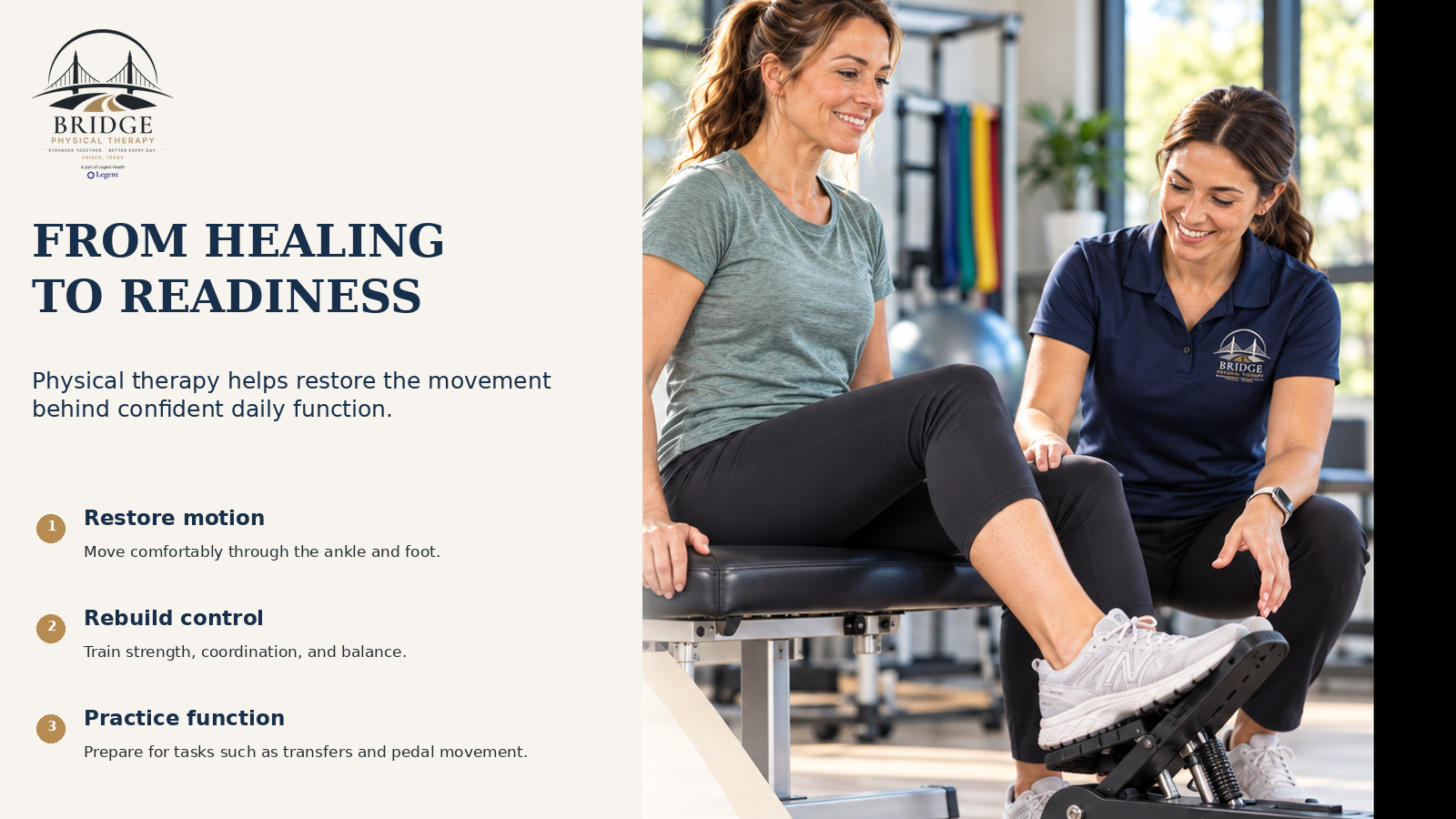
Physical therapy is integral to regaining comfortable, functional movement after lower-extremity surgery. Rehabilitation can help address pain and swelling, foot and ankle mobility, calf and anterior-leg strength, gait symmetry, balance, and confidence with everyday tasks. These elements can be relevant to driving, but the current literature does not prove that any specific PT exercise automatically shortens the time to safe driving or lowers the risk of a crash.
At Bridge Physical Therapy, the emphasis is individualized progression: recovering motion when permitted, reducing compensations, loading the limb appropriately, and practicing functional movement patterns. When the surgical team considers driving, the therapist can document whether the patient continues to demonstrate stiffness, hesitation, weakness, swelling, poor endurance, or difficulty with the basic tasks that support controlled foot placement.
If an objective driving evaluation is needed, a suitably equipped brake-reaction testing service or specialist driving assessment may be appropriate. Bridge does not represent a gym drill or a therapist’s visual judgment as a certified driving test. A therapist’s findings are best used together with the surgeon’s plan and the patient’s informed self-assessment.
Exercises that may support the return to ordinary function
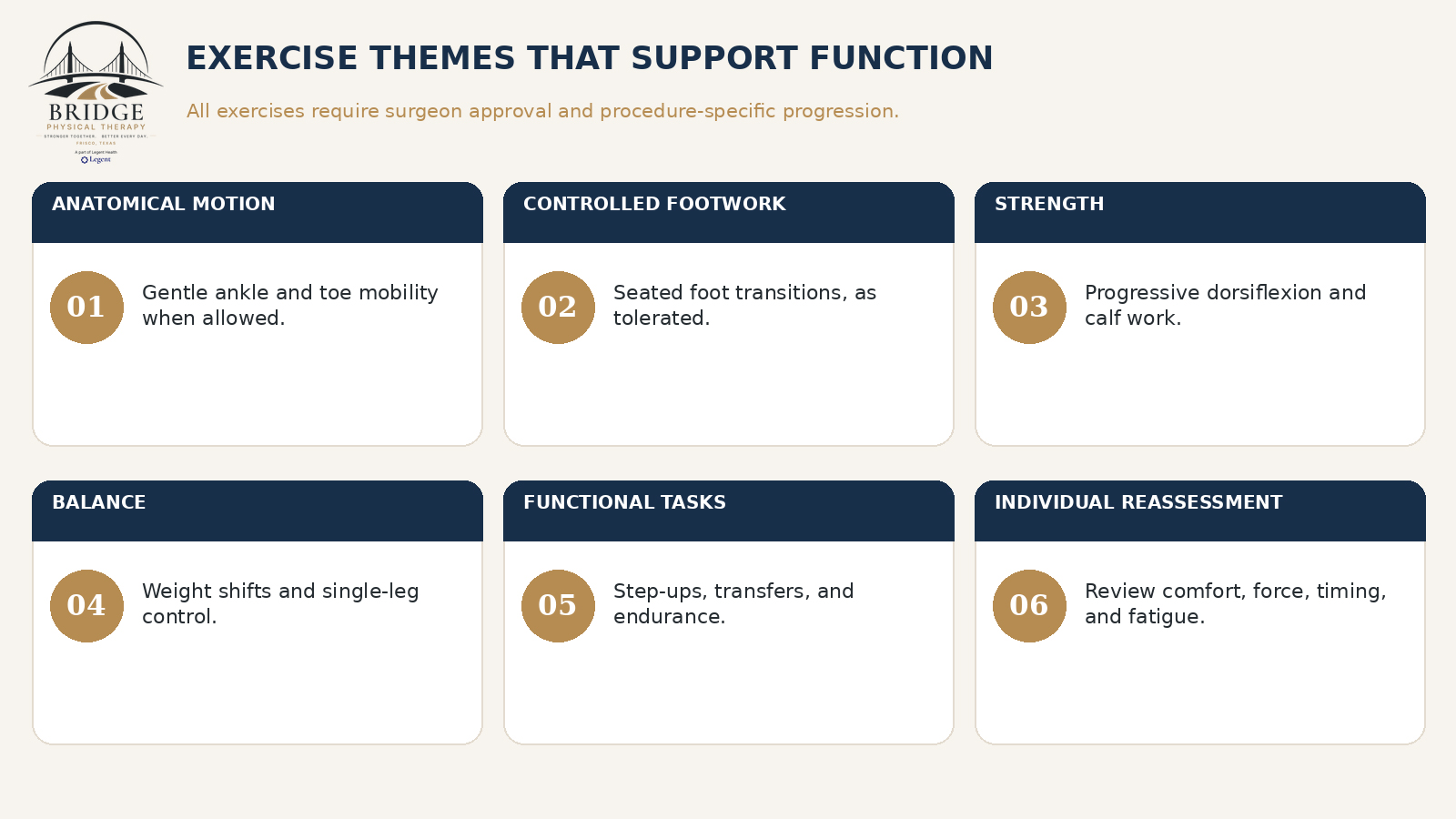
Early postoperative programs may focus on protected positioning, toe motion, edema control, and approved gentle ankle movement. Heel slides, seated foot placement drills, and ankle pumps are not universally appropriate: restrictions after Achilles reconstruction, fusion, fracture repair, or complex tendon surgery must be followed precisely.
Once cleared, therapy can progress to resisted dorsiflexion, graduated calf strengthening, controlled weight shifts, sit-to-stand work, supported single-leg balance, step-up and step-down training, and walking endurance. These activities target the strength, control, and confidence required for everyday mobility. In patients with persistent hesitation or mobility deficits, further assessment is more useful than simply adding repetitions.
The progression is based on the procedure, not a blanket checklist. Exercises should be stopped or modified if they cause significant worsening pain, swelling, neurological symptoms, or conflict with the surgeon’s instructions. No home exercise should be interpreted as a self-administered test proving someone safe to drive.
A practical checklist before the first drive
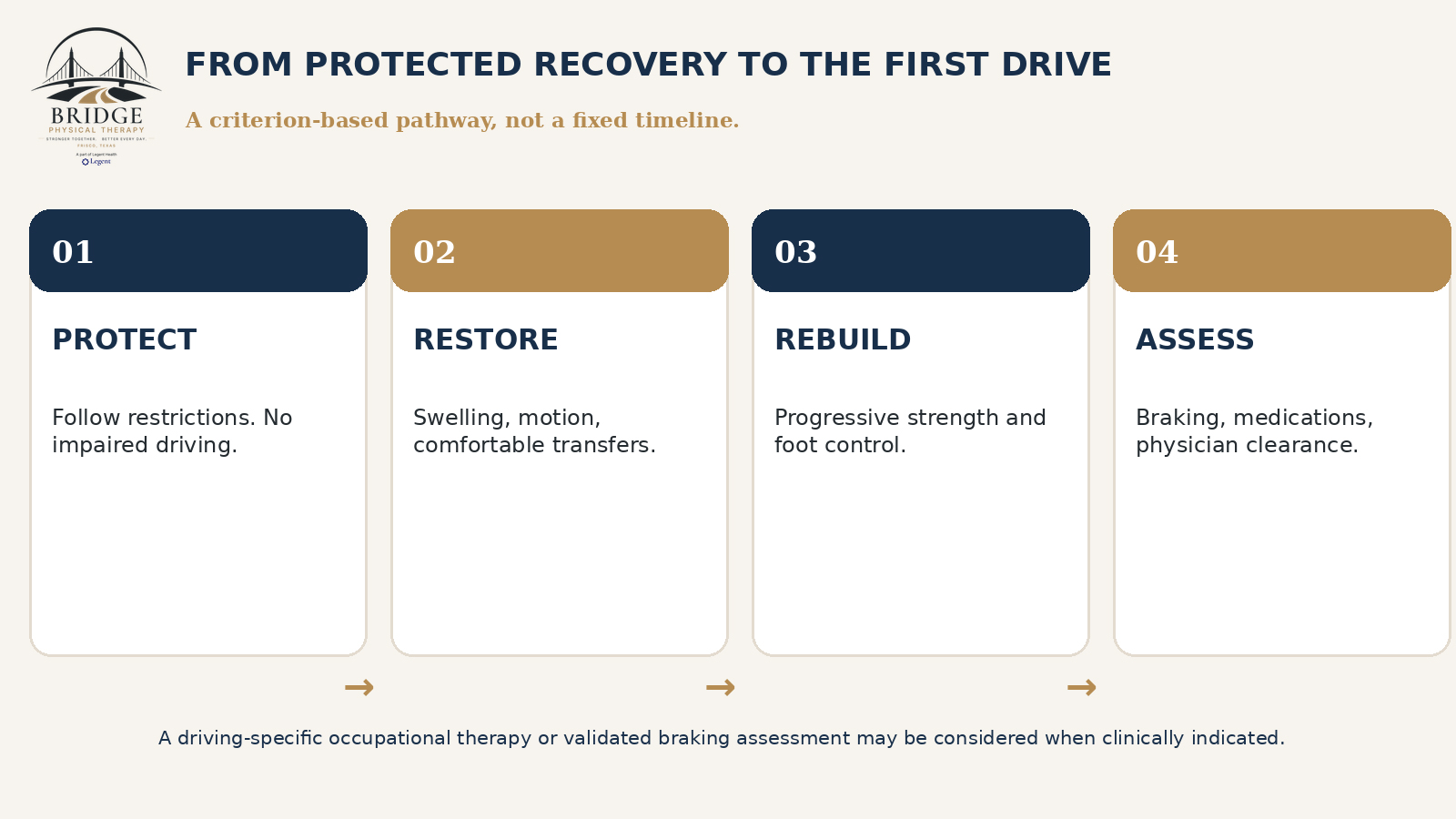
Begin with medical clearance: has the operating surgeon permitted driving, and are the healing and weight-bearing restrictions compatible with vehicle operation? Next, confirm medication safety. Do not drive while impaired by opioids, sleep medicines, muscle relaxants, alcohol, or any medication causing sedation or slower reaction.
Consider how the foot actually functions. Is immobilization still interfering with pedal movement? Can the patient enter and exit the vehicle without unsafe compensation? Is there adequate strength, comfort, and coordinated foot movement? Can the person make an unexpectedly firm braking movement without hesitation, if the clinician has cleared functional testing?
Finally, ask the patient. Do they feel able to respond to a sudden stop? Are they concerned about weakness or awkward foot positioning? Their perspective is not a substitute for clinical judgment, but it can uncover uncertainty that a simple postoperative calendar will miss. If any important question remains unresolved, delay driving and seek individualized guidance.
A different kind of postoperative recovery in Frisco, Texas
Bridge Physical Therapy in Frisco serves postoperative patients throughout North Texas, including people recovering from simpler forefoot procedures and complex ankle or hindfoot reconstructions. Our goal is not simply to help you reach a number of weeks after surgery. It is to help you regain the movement and confidence needed for ordinary life.
That includes the tasks people sometimes forget to ask about: getting into a vehicle, walking across a parking lot, tolerating a longer day on your feet, climbing stairs, and preparing for the eventual return to driving when your surgeon permits it. Recovery is successful when those activities feel progressively more natural, not simply when an X-ray or incision looks better.
If you are uncertain about your readiness to resume driving after foot or ankle surgery, request a postoperative evaluation at Bridge Physical Therapy. We can work with the surgical plan, identify functional limitations, and help build a recovery program that fits your procedure and goals.
Frequently Asked Questions
How many weeks after foot or ankle surgery can I drive?
There is no universal number. Some right-sided procedures have brake-reaction studies around six to nine weeks, but the appropriate date depends on the operation, restrictions, medication use, and actual pedal control. Ask the operating surgeon.
Does it matter whether my right or left foot had surgery?
Yes. In most automatic vehicles, the right foot operates both pedals. Left-sided surgery may permit different progression in some patients, but manual transmissions, immobilization, pain, and medications can still affect driving.
Can I drive in a CAM boot or postoperative shoe?
Right-sided immobilization can delay and alter emergency braking in simulator studies. Do not assume driving in a boot or surgical shoe is safe, and do not remove prescribed immobilization just to drive.
Can a physical therapist clear me to drive?
PT can identify functional limitations and document rehabilitation progress, but it does not replace the operating surgeon’s restrictions or a specialized driving assessment when one is needed.
What did Raikin and colleagues discover?
Their three-question self-reported readiness survey was strongly associated with passing a laboratory brake-reaction threshold after selected right foot and ankle procedures. It was not proof that feeling ready makes someone safe to drive.
Do I need to walk without a limp before I can drive?
A limp may identify weakness, pain, stiffness, or hesitation worth assessing. Walking quality alone, however, is not a validated return-to-driving test; the decision must consider pedal control and the entire clinical situation.
Can I drive if I am still taking pain medication?
Do not drive while impaired by opioids, sedating medicines, or any drug affecting attention or response. Confirm medication safety with your prescribing clinician.
Can I practice braking while my car is parked?
Only if the surgeon permits the required ankle/foot movement, and only as a non-driving functional exercise under appropriate guidance. Such practice cannot certify reaction time or driving safety.
Can Bridge PT help after an ankle fracture or an Achilles repair?
Yes. Rehabilitation goals are tailored to the particular surgery and restrictions, from basic swelling management and motion to gait, strength, balance, and functional recovery.
References and Clinical Sources
- McDonald et al. Foot Ankle Spec. 2021;14:32–38. PMID 31904291.
- McDonald et al. Clin Orthop Relat Res. 2020;478:8–15. PMID 31425279.
- Burnham et al. Hawaii J Health Soc Welf. 2022. PMID 35340939.
- Return to Driving after Elective Foot & Ankle Surgery. Systematic review, 2022. PMC8792567.
- Immobilization Devices and Emergency Brake Response. J Foot Ankle Surg. 2016. PMID 27445123.
- Right-Limb Immobilization and Braking. JBJS Am. 2010. PMID 19952248.
- McDonald et al. Driving After Hallux Valgus Surgery. Foot Ankle Int. 2017. DOI 10.1177/1071100717711926.
- Egol et al. Lower-extremity driving after ankle fracture fixation. JBJS. 2003. PMID 12851340.
- When Can I Drive After Orthopaedic Surgery? Systematic review. PMID 27492688.
Medical disclaimer: This page is general education, not driving clearance or personal medical advice. Follow your surgeon’s written restrictions and applicable legal requirements. If you are uncertain whether you can operate a vehicle safely, do not drive until the concern has been reviewed.