


Walking into physical therapy for the first time can feel uncertain. Will it hurt? Will someone understand what you have been through? Is the session just an hour of exercises that could have been printed from the internet? At Bridge Physical Therapy in Frisco, Texas, we believe your first appointment deserves something better: a conversation, a thoughtful clinical assessment, and a plan centered on the person—not simply the diagnosis.
Our approach is deliberately personal. We emphasize one-on-one attention so that your therapist can understand what matters to you and make decisions with you. Whether you are recovering from surgery, managing a sports injury, dealing with persistent back pain, or trying to stay active as you age, the same principle applies: the right treatment begins with understanding your life.
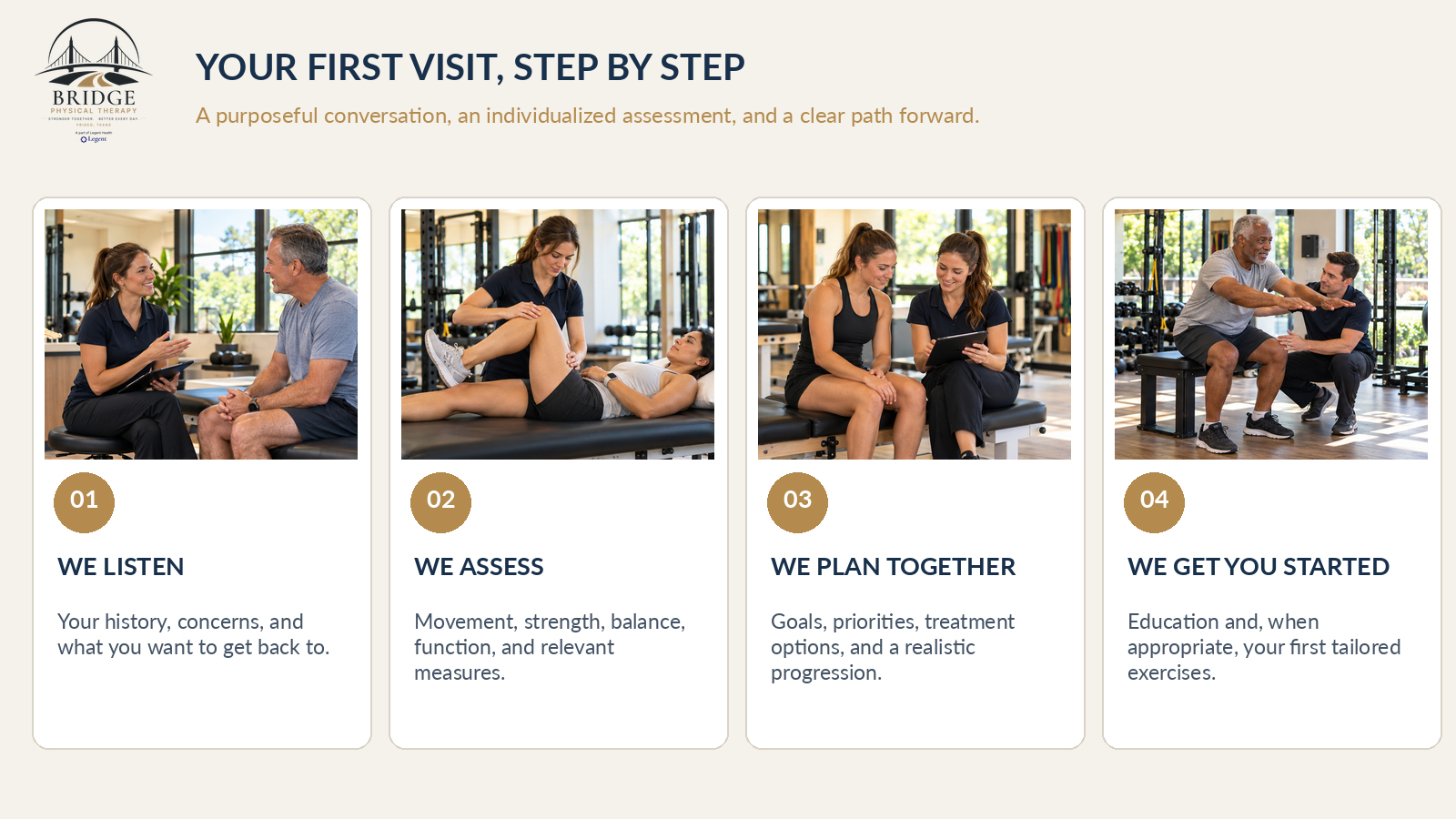
Your first visit starts with a conversation, not a checklist
Before asking you to stretch, balance, squat, or walk across the room, your physical therapist needs to know your story. What brought you here? When did the problem begin? What aggravates it, and what helps? Which treatments have you tried? What has changed about your sleep, work, exercise, family life, or independence? Your medical and surgical history, medications, other health conditions, and relevant imaging may also help the clinician understand the full picture.
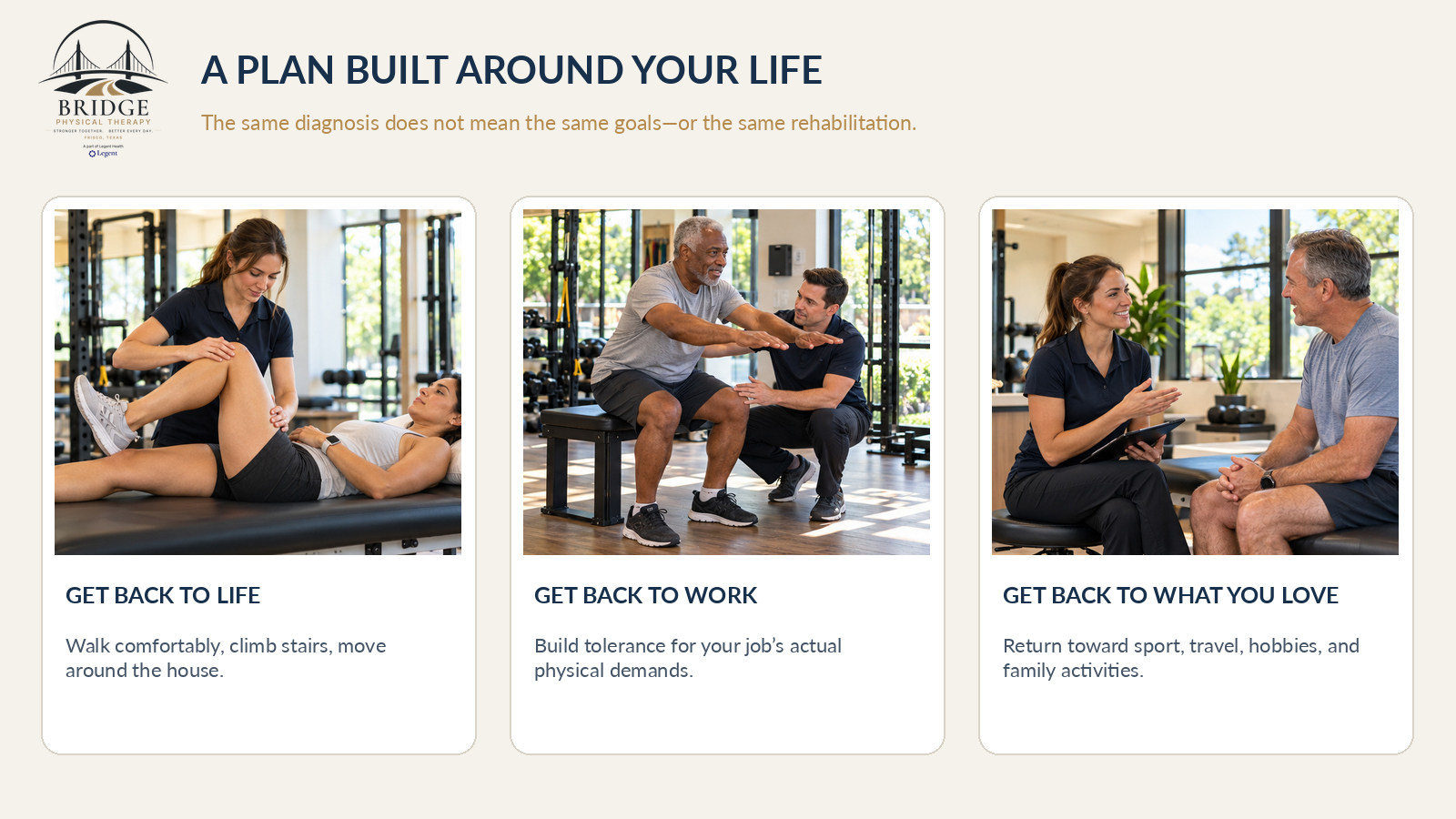
The most important question may be the simplest one: What do you want to be able to do again? One person wants to get through a grocery store without pain. Another wants to carry a toddler, walk a golf course, run a marathon, or return to a demanding job. Two people with the same diagnosis can need entirely different plans because their goals, starting points, and circumstances are different.
We also want you to tell us what worries you. Fear of reinjury, a previous disappointing therapy experience, and uncertainty about postoperative restrictions can all influence recovery. You should be able to ask questions and participate in decisions throughout the visit.

A one-on-one physical therapy evaluation: what will we assess?
Your therapist will choose tests that answer useful questions about your condition and goals. Depending on why you are visiting, the evaluation may include range of motion, muscle strength, posture, walking mechanics, balance, coordination, functional movement, flexibility, endurance, neurological screening, and symptom response to particular activities. A therapist treating a recent ankle operation may evaluate swelling, protected movement, gait, and strength. Someone with low-back pain may need a different assessment. A competitive athlete may require sport-specific testing later in rehabilitation.
Not every test is necessary for every patient. At Bridge, we aim to make the assessment relevant rather than exhausting. We establish appropriate baseline measures so that improvement can be evaluated instead of guessed. A change in pain matters, but so can a better walking pattern, more confident stair descent, improved single-leg control, greater shoulder range of motion, or the ability to return to a favorite activity.
Your comfort and safety come first. If a movement is uncomfortable, tell your therapist. The evaluation should clarify the problem, not require you to prove you can tolerate unnecessary pain. If findings suggest that additional medical assessment is needed, that becomes part of the plan.

Your goals are the foundation of the treatment plan
A diagnosis describes what may be wrong. It does not tell us everything about what matters to you. That is why we build a plan around meaningful goals and the evidence-based interventions most appropriate for your presentation.
For a runner, the plan might eventually emphasize impact tolerance, calf strength, and running mechanics. For someone recovering from a joint replacement, it may focus on swelling, motion, transfers, walking endurance, and stairs. For a person with chronic neck or back pain, it might begin with movement confidence and graded activity. The treatment strategy changes as your body, goals, and functional demands change.
A personalized plan is not a collection of expensive gadgets or a promise of instant results. It is clinical reasoning applied to your specific needs. Your therapist should be able to explain why an exercise or intervention is being recommended, what it is intended to improve, and how you will know when it is time to advance or modify it.
What happens during the hands-on and exercise portion?
Many people expect physical therapy to start with a long workout. Sometimes you will begin selected exercises or therapeutic activities on the first visit; sometimes the evaluation, education, precautions, and planning need most of the appointment. Both can be appropriate.
Depending on the findings, early treatment might include guided movement, safe positioning, a small number of specific exercises, gait instruction, balance work, or education about modifying activities without abandoning movement altogether. Manual therapy may be appropriate for some people, but it is not a required component of every treatment plan. The goal is to choose what is useful, rather than put every patient through the same circuit.
For patients recovering from an operation, the surgeon’s restrictions guide the program. Weight-bearing instructions, motion limits, bracing requirements, tissue healing, and red flags take priority over an arbitrary desire to advance quickly. We want progress, but progress should be earned by healing and function.
You should leave your first visit understanding the next step
When the appointment is over, you should have a clearer explanation of the working clinical findings, the primary problems being addressed, and the next steps in care. Your therapist will discuss a proposed plan, what progress may look like, how treatment may be adjusted over time, and what you can reasonably begin doing between visits.
You may receive a manageable home exercise program or activity recommendations. More exercises are not automatically better exercises. What matters is choosing a realistic program, demonstrating correct technique, and adjusting the dose when symptoms, healing, or priorities change. If something feels confusing or impractical, ask for an alternative. Your participation is essential, and the plan needs to fit your life.
The frequency and duration of treatment depend on the problem, medical restrictions, functional goals, and progress. Some patients benefit from a brief episode of care. Others, particularly after complex surgery or with higher-level athletic goals, need a longer and more structured progression. Your care should be reassessed rather than left on autopilot.

Why the relationship between you and your therapist matters
There is a growing body of rehabilitation literature examining patient-centered communication, therapeutic relationships, and shared decision-making. The American Physical Therapy Association’s framework for an initial evaluation includes history, examination, tests and measures, and a management plan. Systematic reviews also identify communication, trust, collaboration, and meaningful goals as important components of person-centered rehabilitation.
Those studies do not prove that one-on-one care guarantees a faster recovery or that any clinic can promise a particular outcome. They do help explain why a clinician who listens, explains decisions, and adapts a plan to a patient’s goals is doing more than creating a pleasant experience. This is part of thoughtful clinical care. Research on goal-setting and home-exercise adherence also points toward the value of making treatment relevant and practical.
At Bridge, we want patients to feel that their progress belongs to them. Our therapists provide guidance, feedback, and an evolving clinical plan. You bring your goals, questions, preferences, and experiences. Together, those make rehabilitation a partnership rather than a transaction.
What should I wear and bring to my first PT appointment?
Choose comfortable clothing that allows you to move and gives the therapist access to the region being evaluated. Athletic shoes are helpful for gait, balance, and lower-extremity assessments. If you are recovering from foot or ankle surgery, bring the boot, brace, or assistive device you have been prescribed. For a shoulder or arm concern, clothing that allows comfortable access to the area can help.
Bring a current medication list, relevant surgical instructions, available referral or insurance information, and useful imaging reports if you have them. You do not need to arrive with perfect paperwork or a complete medical vocabulary. Bring your questions and be prepared to describe what you want your recovery to make possible.
If you have questions about appointment duration, insurance authorization, costs, or whether a referral is needed, our team can help clarify the administrative requirements when you schedule. These details can vary by payer and medical circumstances.
Who benefits from this kind of individualized care?
The one-on-one approach matters across a broad range of conditions: postoperative rehabilitation, sports injuries, joint pain, spine-related symptoms, balance concerns, overuse conditions, and persistent musculoskeletal limitations. It is particularly valuable when there are competing needs—for example, a patient recovering from surgery while also managing other medical concerns, or an athlete who needs to rebuild both strength and confidence before returning to competition.
Individualization does not always mean harder exercises or more treatment. Sometimes the best first step is identifying what should not yet be loaded, simplifying a home program, coordinating with the surgeon, or helping a patient rebuild confidence in movements that have become intimidating. The right plan can be both sophisticated and straightforward.
Physical therapy in Frisco: the Bridge difference
Bridge Physical Therapy was created around a straightforward belief: excellent rehabilitation starts with the person in front of you. We emphasize attentive, one-on-one care, deliberate assessment, clear communication, and goal-directed progression. We are interested in how you are doing, what you can do now, what you want to return to, and how to close that gap.
Our Frisco clinic serves patients from across North Texas, including those who need surgeon-coordinated rehabilitation and those seeking help with everyday movement, strength, and function. We want your first visit to feel organized and welcoming, but more importantly, useful. You should know what is happening, why it matters, and how your care will be adapted along the way.
If you have been wondering whether physical therapy is right for you or what the first session involves, start with an evaluation. The beginning of recovery should not feel impersonal. It should feel like someone has taken the time to understand what matters to you.
Frequently Asked Questions
What happens at my first physical therapy appointment?
Your therapist will review your history and goals, perform a targeted physical examination, discuss the findings, and outline an individualized plan. Appropriate exercises or education may also begin on the first visit.
How long does a first physical therapy evaluation take?
The time needed varies with the complexity of the problem and the clinic schedule. An initial evaluation often involves more discussion and testing than a routine follow-up. Ask Bridge about the expected appointment duration when scheduling.
Will my first PT visit hurt?
The goal is to understand your symptoms and function, not to push you through unnecessary pain. Some tests may reproduce familiar discomfort, but you should tell your therapist what you feel so the examination and treatment can be adapted.
Will I do exercises at the first visit?
Possibly. Some patients begin a small number of individualized exercises or movement activities. Others need a more detailed evaluation, education, or postoperative precaution review first.
What should I wear to physical therapy?
Wear comfortable clothing that allows movement and access to the area being assessed. Athletic shoes are useful for many gait and balance evaluations. Bring prescribed braces, boots, or mobility devices.
Do I need a physician referral before scheduling PT in Texas?
Referral and authorization requirements depend on applicable Texas law, your insurance plan, and clinical circumstances. Contact Bridge before your appointment so the team can help verify what is needed.
Can physical therapy help after surgery?
Yes, when appropriate for the procedure and healing stage. The therapist follows the surgeon’s restrictions and develops a progression for motion, strength, balance, gait, and function based on your operation and recovery.
Is the treatment plan the same for everyone with the same diagnosis?
No. Two patients with the same diagnosis can have very different starting abilities, medical considerations, goals, and preferences. An individualized plan should reflect those differences and be updated as progress changes.
References and Further Reading
- American Physical Therapy Association. Initial Examination and Evaluation. Guide to Physical Therapist Practice / Defensible Documentation. https://www.apta.org/your-practice/documentation/defensible-documentation/elements-within-the-patientclient-management-model/initial-examination
- ChoosePT / American Physical Therapy Association. Preparing for Your Visit with a Physical Therapist. https://www.choosept.com/why-physical-therapy/prepare
- Puustinen S, et al. The Core Components and Instruments of the Therapeutic Relationship in Musculoskeletal Physiotherapy: A Systematic Integrative Review. Musculoskeletal Care. 2026. DOI:10.1002/msc.70219. https://pubmed.ncbi.nlm.nih.gov/41912328/
- Physical therapist characteristics and therapeutic relationship process factors that improve patient health outcomes: a systematic review. 2025. PMID:39987510. https://pubmed.ncbi.nlm.nih.gov/39987510/
- Grenfell J, et al. People’s Experience of Shared Decision Making in Musculoskeletal Physiotherapy: A Systematic Review and Thematic Synthesis. Behav Sci. 2022. PMID:35049623. https://pubmed.ncbi.nlm.nih.gov/35049623/
- Kang E, et al. Person-Centered Goal Setting: A Systematic Review of Intervention Components and Active Engagement. Arch Phys Med Rehabil. 2022. PMID:34375632. https://pubmed.ncbi.nlm.nih.gov/34375632/
- Behaviour Change Techniques to Promote Self-Management and Home Exercise Adherence for People Attending Physiotherapy with Musculoskeletal Conditions: A Scoping Review. 2023. PMID:37301059. https://pubmed.ncbi.nlm.nih.gov/37301059/