
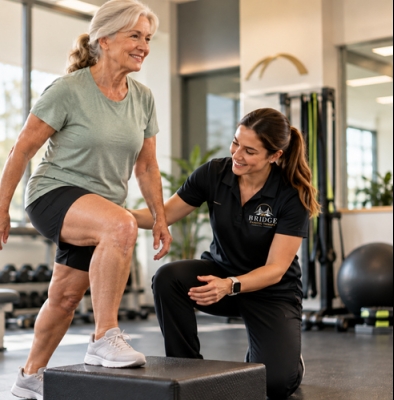
Total knee replacement can replace a worn-out joint, but rehabilitation is what restores motion, quadriceps strength, walking, balance and confidence. Current 2026 physical therapy guidelines support starting rehabilitation early, progressing range of motion and strength, retraining movement and using supervised physical therapy after total knee arthroplasty. The surgical technology matters—but the recovery plan still matters enormously.
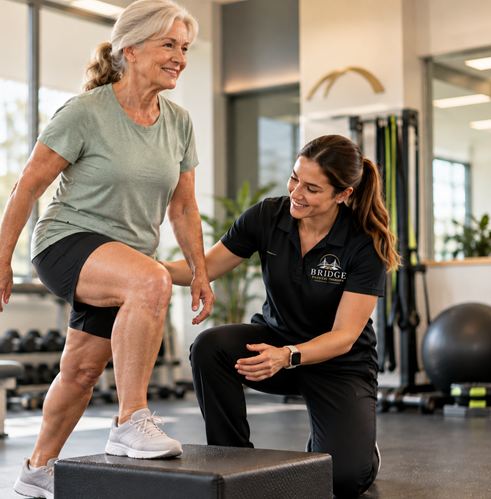
A New Knee Is the Beginning, Not the Finish Line
If you are considering or recovering from a total knee replacement, you have probably heard a lot of modern surgical language: robotic knee replacement, minimally invasive knee replacement, muscle-sparing surgery, same-day joint replacement, personalized alignment. Those advances matter. They can change how surgeons plan the operation, how precisely components are positioned, and in some cases how much soft tissue is disturbed. But there is one important truth that tends to get lost in the technology conversation: surgery replaces the damaged joint; rehabilitation teaches you how to use your leg again.
At Bridge Physical Therapy in Frisco, our role begins where the operating room ends. We help patients from Frisco, Plano, McKinney, Allen, Prosper, Little Elm, The Colony, Celina and surrounding North Texas communities recover motion, rebuild strength, normalize walking and return to real life. The goal is not simply a better X-ray. The goal is getting back to stairs, travel, golf, pickleball, the gym, work, grandchildren and ordinary days without thinking about every step.
What Exactly Is a Total Knee Replacement?
Total knee arthroplasty, often called total knee replacement or TKA, is most commonly performed for advanced knee arthritis when pain, stiffness and loss of function have become difficult to manage with nonsurgical care. The damaged joint surfaces are resurfaced with prosthetic components that create a new bearing surface. Modern implants and surgical techniques are highly sophisticated, but the surrounding muscles, tendons, nervous system and movement patterns still need to recover.
That is why the early postoperative period can feel surprising. The arthritic joint has been replaced, yet the knee is swollen, the quadriceps may feel as if it has forgotten how to work, walking is altered and bending or straightening the knee takes effort. These are precisely the problems rehabilitation is designed to address.
Robotic Knee Replacement: What the Evidence Actually Says
Robotic-assisted total knee replacement is one of the most common topics patients search before surgery. The “robot” does not independently perform the operation. It is a surgical tool that can help the surgeon plan bone cuts, implant position and alignment with a high degree of precision. AAOS describes potential advantages such as more precise execution of the surgical plan and customization for individual anatomy.
The newest randomized-trial evidence is important because it keeps the marketing claims in perspective. A 2026 systematic review and meta-analysis found that robotic-assisted TKA reduced alignment error and alignment outliers compared with conventional TKA, but patient-reported function, pain, safety and most other clinical outcomes were broadly similar. In other words, robotics can improve technical precision, but it does not eliminate the need for recovery work. A beautifully aligned knee still needs quadriceps strength, knee motion, balance and normal gait.
What About Minimally Invasive or Muscle-Sparing Knee Replacement?
“Minimally invasive” and “muscle-sparing” describe surgical strategies intended to limit soft-tissue disruption compared with a traditional exposure. Depending on the surgeon and approach, this may involve a smaller incision or less disruption of the quadriceps mechanism. Patients are understandably attracted to the idea of less tissue trauma and a faster early recovery.
The evidence is encouraging but nuanced. A 2026 network meta-analysis of randomized trials found that some minimally invasive approaches were associated with better early pain or range-of-motion outcomes, while conventional approaches performed better on some safety outcomes. Long-term superiority of one approach is not established across every patient. The right surgical approach depends on anatomy, deformity, surgeon experience and the needs of the individual patient.
The practical message is simple: a muscle-sparing or minimally invasive operation may help the early experience, but it does not make the rehabilitation process optional. Swelling, quadriceps inhibition, stiffness, weakness and altered walking can still occur after even the most modern operation.
Why Physical Therapy Is So Important After Knee Replacement
The 2026 APTA clinical practice guideline for total knee arthroplasty is unusually clear about the elements of rehabilitation that matter. It recommends that physical therapy, including early mobilization, begin within 24 hours after uncomplicated TKA. It strongly recommends progressive strength training in the early post-acute period and motor-function training such as balance, gait and movement retraining. It also supports active, active-assisted and passive range-of-motion exercise, supervised physical therapist management, early progressive physical activity and neuromuscular electrical stimulation for appropriate patients with quadriceps activation deficits.
That evidence mirrors what patients feel in real life. The quadriceps often becomes inhibited after surgery, meaning it may not fully “turn on” even when you are trying hard. The knee can become stiff if extension and flexion are not addressed. Swelling can change the way you walk. Guarding one leg can create asymmetry and poor habits. Physical therapy gives those problems a structured plan instead of waiting for them to resolve on their own.
What Does Total Knee Replacement Rehab Look Like?
There is no single perfect timeline, because recovery depends on preoperative function, surgical approach, age, medical history, swelling, pain, home support and individual goals. Still, most rehabilitation follows a logical sequence.
In the first days and weeks, priorities usually include swelling control, knee extension, progressive flexion, quadriceps activation, safe transfers and walking with the appropriate assistive device. Patients practice the basics because the basics matter: getting out of a chair, controlling the leg, walking without compensation and navigating the home safely.
As healing progresses, the program becomes more demanding. Strength training increases. Sit-to-stand mechanics, step-ups, stair control, balance and walking endurance become more important. Later stages focus less on “having had surgery” and more on the activities the patient actually wants to regain—travel, golf, gardening, fitness, work, recreational sports or simply keeping up with family.
Prehab: Can Physical Therapy Before Surgery Help?
Yes, and current evidence supports it. The 2026 APTA guideline recommends preoperative exercise programs for patients undergoing TKA to improve strength, flexibility and endurance, with evidence showing benefits in early postoperative strength, function and pain. Prehab is not about trying to reverse end-stage arthritis. It is about entering surgery with the strongest possible foundation and knowing what recovery will require.
Even a short preoperative period can be useful for learning walker or cane technique, practicing the first postoperative exercises, discussing home setup and identifying strength or balance limitations before surgery.
What We Measure at Bridge
A good knee-replacement program should not feel like a random series of exercises. At Bridge Physical Therapy, treatment is progressed around measurable findings: knee motion, swelling, quadriceps activation, walking quality, strength, balance, ability to rise from a chair, stair performance and the activities that matter to the patient.
We also pay attention to the opposite leg, hips and trunk because recovery does not happen in one joint alone. A patient may regain adequate knee flexion but still walk poorly because of weakness or fear. Another may have good strength but limited extension that changes gait mechanics. The program should find the limiting factor and address it.
What Does Success Look Like?
Success after knee replacement is not one range-of-motion number or one date on the calendar. It is being able to straighten the knee enough to walk efficiently, bend it enough for daily tasks, generate enough strength to rise from a chair and control stairs, and move without constantly protecting the surgical side. For one patient, success may be walking a neighborhood loop. For another, it may be golf, travel, cycling or returning to a demanding job. Rehabilitation should connect the clinical milestones to the life the patient actually wants back.
How Long Does Recovery Take?
Patients often want a single number. Real recovery is more individualized. Many people resume a meaningful portion of daily activity within the first several weeks, but rebuilding strength, endurance and confidence continues for months. AAOS notes that many patients resume regular activities of daily living around 6 to 12 weeks after robotic-assisted joint replacement, but that should not be interpreted as the end of rehabilitation. Returning to higher-level activity and fully rebuilding strength often takes longer.
The most useful question is not “How many weeks has it been?” but “What can I do well today, and what still needs to improve?” That keeps the process objective and prevents both unnecessary delay and premature progression.
When Should You Call Your Surgeon?
Some discomfort, swelling and stiffness are expected after total knee replacement. However, patients should contact the surgical team promptly for concerning symptoms such as fever, increasing wound drainage, uncontrolled or rapidly worsening pain, marked redness, or significant calf pain or swelling. New chest pain or shortness of breath requires urgent medical evaluation. Your surgeon’s instructions always take priority over general guidance.
Total Knee Replacement Rehab in Frisco, Texas
Bridge Physical Therapy is located at Baylor Frisco – Professional Building #1, 5575 Warren Parkway, Suite 115, Frisco, TX 75034. We provide orthopedic and post-surgical rehabilitation for patients throughout Frisco and the surrounding North Texas growth corridor.
If you are preparing for a robotic knee replacement, minimally invasive knee replacement, muscle-sparing knee replacement or traditional total knee replacement—or if you are already home and wondering whether your recovery is where it should be—our team can help create a clear plan. The technology used in surgery is only part of the story. Recovery is where the new knee becomes part of your life again.
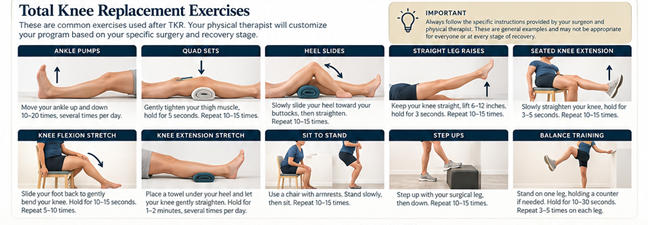
Example Total Knee Replacement Exercises
These are general examples, not a universal protocol. Exercise selection and timing should match the surgeon’s instructions, stage of healing, wound status, swelling, strength, balance and individual goals. The therapist should modify or delay any exercise that is not appropriate for a specific patient.
Frequently Asked Questions
How soon should physical therapy start after total knee replacement?
For an uncomplicated total knee replacement, current APTA guidance supports physical therapy and early mobilization beginning within 24 hours after surgery. The exact setting may be the hospital, home or outpatient clinic depending on the patient and surgical plan.
Is physical therapy still necessary after robotic knee replacement?
Yes. Robotic assistance may improve surgical planning and alignment precision, but it does not replace rehabilitation. Patients still need to restore motion, quadriceps strength, gait, balance and functional confidence.
Does minimally invasive or muscle-sparing knee replacement mean a faster recovery?
Some minimally invasive approaches may improve early pain or range of motion, but results vary and no approach eliminates the need for rehabilitation. Recovery depends on the entire surgical and patient picture.
How long is physical therapy after knee replacement?
The duration varies. Many patients make major functional gains over the first 6 to 12 weeks, while strength and endurance may continue improving for months. Therapy duration should be based on objective progress and goals.
What exercises are common after knee replacement?
Common early exercises may include ankle pumps, quadriceps sets, heel slides, knee-extension work, straight-leg raises when appropriate, sit-to-stand practice, gait training and progressive balance and strengthening.
Where is Bridge Physical Therapy located?
Bridge Physical Therapy is located at Baylor Frisco – Professional Building #1, 5575 Warren Parkway, Suite 115, Frisco, Texas 75034, serving Frisco and surrounding North Texas communities.
EVIDENCE FOUNDATION / REFERENCES
- Bove AM, Carroll LA, Cone S, et al. Clinical practice guideline for physical therapist management of total knee arthroplasty: revision 2026. Physical Therapy. 2026;106(7):pzag058. Source
- American Physical Therapy Association. Physical Therapist Management of Total Knee Arthroplasty: Revision 2026. Source
- American Academy of Orthopaedic Surgeons. Robotic-Assisted Joint Replacement. OrthoInfo. Source
- Mosleh M, Eldesouky A, Nounou MV, et al. Robotic-assisted versus conventional total knee arthroplasty: updated systematic review and meta-analysis of randomized controlled trials with GRADE assessment. Journal of Orthopaedic Surgery and Research. 2026. Source
- Huh MH, Kim HJ, Shin YS. Comparison of conventional and minimally invasive approaches of primary total knee arthroplasty: a network meta-analysis of randomized controlled trials. BMC Musculoskeletal Disorders. 2026;27:336. Source