
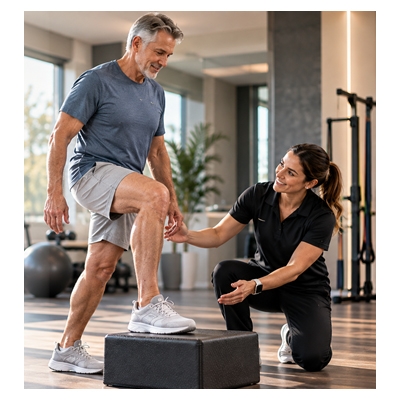
Total ankle replacement rehabilitation helps patients restore safe ankle motion, rebuild strength, improve balance and gait, and return to meaningful daily activity after surgery. Recovery must follow the surgeon’s weight-bearing and wound-healing restrictions, because timelines vary by implant, surgical approach, and any additional tendon, ligament, or bone procedures.
A New Ankle Is Only the Beginning
For someone who has lived with severe ankle arthritis, total ankle replacement can feel like a major turning point. The goal of surgery is straightforward: replace the damaged joint surfaces, relieve pain, and preserve ankle motion instead of eliminating it with a fusion. But the operation itself is only part of the recovery story. The new joint has to be protected while the incision and bone interfaces heal, swelling has to be controlled, motion has to return gradually, and the muscles of the foot, ankle, calf, hip, and leg have to learn how to work together again. That is where rehabilitation matters. At Bridge Physical Therapy in Frisco, total ankle replacement rehab is designed around the person behind the implant: the patient who wants to walk the neighborhood again, travel without planning every step around pain, play golf, hike, work comfortably, or simply move through a normal day with more confidence.
What Is Total Ankle Replacement?
Total ankle replacement, also called total ankle arthroplasty or TAA, is a motion-preserving surgery for selected patients with end-stage ankle arthritis. The damaged surfaces of the tibia and talus are replaced with metal components and a medical-grade bearing surface. The American Orthopaedic Foot & Ankle Society recognizes total ankle replacement as an established treatment option for appropriately selected patients with painful ankle arthritis who have failed nonsurgical care. Modern implant designs, instrumentation, and surgical techniques have improved substantially compared with early generations of ankle replacements. Contemporary systematic reviews report meaningful improvement in pain and patient-reported function, although implant longevity is still more variable than patients may be familiar with from hip or knee replacement. That is why patient selection, alignment, soft-tissue health, and long-term activity choices all matter.
Ankle Replacement vs. Ankle Fusion: Why Patients Ask About Motion
One of the most common searches patients make is “ankle replacement vs fusion.” Ankle fusion remains an excellent operation for many patients and can provide dependable pain relief. The tradeoff is that the ankle joint is intentionally fused, so motion through the ankle itself is eliminated. Total ankle replacement attempts to relieve pain while preserving motion. The best randomized evidence to date, the TARVA trial, found that both ankle replacement and ankle fusion significantly improved walking-related outcomes at one year; overall, neither procedure was clearly superior on the primary endpoint. The important takeaway is not that one operation wins for every patient. It is that both can work well, and the choice should be individualized based on age, deformity, bone quality, neighboring-joint arthritis, activity goals, medical risk, and surgeon judgment. For the patient who has already chosen ankle replacement, physical therapy focuses on turning preserved motion into useful motion.
Why Physical Therapy Matters After Ankle Replacement
An ankle implant can preserve a joint, but it does not automatically restore a normal gait. Months or years of arthritis often cause stiffness, calf weakness, altered balance, shorter steps, avoidance of uneven surfaces, and compensations through the knee, hip, and opposite leg. After surgery, immobilization and temporary weight-bearing restrictions add another layer of weakness. Rehabilitation helps bridge that gap. The early priorities are usually protection, swelling control, safe mobility, and maintaining strength in the rest of the body. As the surgeon clears motion and loading, therapy can progressively address ankle range of motion, foot intrinsic strength, calf function, gait mechanics, balance, endurance, and functional tasks such as stairs. Formal postoperative PT protocols are not perfectly standardized across the literature, so good care should not force every patient through the same timeline. The surgeon’s specific restrictions always come first.
What Does the Recovery Timeline Look Like?
Patients often search for a single ankle replacement recovery timeline, but the safest answer is that there is no universal calendar. A commonly used academic rehabilitation protocol from Mass General Brigham emphasizes pain and swelling control in the immediate postoperative period, then gradually introduces ankle motion and limited loading as healing allows. Many patients are non-weight-bearing during the earliest phase, and walking progression may occur over subsequent weeks in a protective boot. Exact timing changes when the surgery includes procedures such as Achilles or gastrocnemius lengthening, tendon transfer, ligament reconstruction, osteotomy, bone grafting, or additional hindfoot surgery. This is why someone else’s social-media recovery timeline should never replace the protocol from your own surgeon. At Bridge, the therapist’s job is to understand the operation that was actually performed and build rehabilitation around it.
The Early Phase: Protect the Incision, Control Swelling, Keep the Rest of You Strong
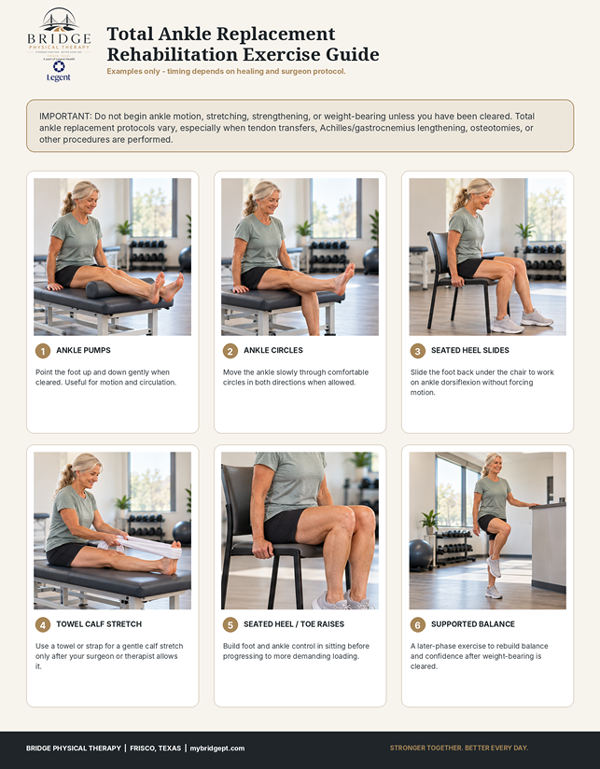
In the first weeks after total ankle replacement, the most important goals are often the least glamorous. Elevation and swelling management matter. The incision must heal. Weight-bearing precautions have to be respected. Safe transfers and use of crutches, a walker, or a knee scooter may need to be practiced. At the same time, the rest of the body does not need to become deconditioned. Depending on restrictions, therapy may include hip and knee strengthening, core work, circulation exercises, and education about positioning and safe mobility. Once the surgeon permits ankle motion, exercises may include gentle ankle pumps, circles, controlled dorsiflexion work, and scar or soft-tissue mobility after the incision is healed. The point is not to chase motion aggressively. The point is to recover motion without compromising healing.
The Middle Phase: From Protected Weight Bearing to Better Walking
As weight bearing is advanced, rehabilitation becomes more functional. This is when many patients begin to appreciate how much ankle arthritis had changed the way they moved before surgery. Therapy may focus on restoring a smoother heel-to-toe gait, improving ankle and foot mobility, rebuilding calf and lower-extremity strength, and reducing compensatory movement at the knee or hip. Seated heel and toe raises can progress to more demanding calf work when permitted. Balance and proprioception become increasingly important as the patient transitions from a boot to regular footwear. The goal is not simply to walk without an assistive device; it is to walk efficiently enough that daily life stops revolving around the ankle.
Modern Ankle Replacement: CT Planning, Patient-Specific Guides, and “Robotic” Searches
Patients increasingly search terms such as robotic ankle replacement, custom ankle replacement, or computer-guided ankle replacement. The technology landscape in ankle surgery is different from hip and knee replacement. Robotic platforms are not yet as established in total ankle arthroplasty as they are in knee surgery. Modern ankle replacement more commonly uses advanced imaging, CT-based preoperative planning, and in some systems patient-specific cutting guides designed around the individual patient’s anatomy. These technologies can help the surgeon plan component position and alignment, but technology does not replace surgical judgment, soft-tissue management, or rehabilitation. For the patient, the practical message is simple: precise surgery creates the opportunity for a good result; rehabilitation helps convert that opportunity into better function.
How Much Motion Will I Get Back?
A successful ankle replacement does not necessarily create a perfectly normal ankle. Most patients are trying to gain something more valuable: enough comfortable motion to walk more naturally and perform daily activities with less pain. Earlier meta-analysis of modern ankle replacements demonstrated improvement in ankle range of motion and functional scores after surgery, and more recent reviews continue to show improved patient-reported outcomes with contemporary implants. The amount of motion a patient ultimately achieves depends on preoperative stiffness, deformity, soft tissues, implant position, associated procedures, and rehabilitation. Physical therapy can help maximize the motion that is safely available, but forcing the ankle beyond the biology of the reconstruction is not the goal.
Can I Return to Golf, Hiking, Travel, or Exercise?
For many patients, this is the question that matters most. A 2023 systematic review of return to sport after total ankle arthroplasty found that sports participation generally increased after surgery, with a pooled postoperative participation rate around 62%. Cycling, swimming, hiking, and gym-based exercise were among the most common activities. Some studies reported return to prior activity levels in selected patients, but high-impact sports were uncommon and the evidence remains limited. That means expectations should be realistic. Walking, travel, golf, cycling, swimming, hiking, and fitness are common goals. Running, jumping, high-impact court sports, and aggressive cutting activities may place more stress on the implant and should be discussed directly with the surgeon. Pickleball, for example, is not automatically prohibited, but it is a higher-demand activity than walking or cycling and should be treated as an individualized return-to-activity decision rather than a default milestone.
What About Implant Longevity?
Patients deserve a balanced answer. Modern total ankle replacement has improved, but it is not a lifetime guarantee. A 2024 systematic review of long-term outcomes found reported survivorship at ten years ranging from approximately 66% to 94%, with substantial variation between implant systems, studies, and definitions of failure. Another contemporary meta-analysis found that newer implant generations have improved survivorship and reduced several complications compared with earlier designs. Those numbers should not scare patients away from a procedure that may dramatically improve quality of life, but they do reinforce the value of protecting the result. Maintaining a healthy weight, choosing reasonable long-term activities, following the surgeon’s surveillance recommendations, and restoring efficient gait and strength are all sensible parts of preserving the reconstruction.
Why Bridge Physical Therapy for Ankle Replacement Rehab?
Total ankle replacement is not as common as knee or hip replacement, and the rehabilitation should reflect that. Bridge Physical Therapy is built around orthopedic and post-surgical rehabilitation rather than generic exercise volume. Our approach is to understand the exact operation, the surgeon’s restrictions, the patient’s preoperative limitations, and the life the patient wants to return to. We track motion, strength, gait, balance, swelling, and functional milestones while progressing the program deliberately. Just as importantly, we explain why each stage matters. Patients should know what they are allowed to do, what they are not ready to do yet, and what measurable progress looks like. That clarity can make a long recovery feel much more manageable.
Local Ankle Replacement Physical Therapy in Frisco and North Texas
Bridge Physical Therapy is located at Baylor Frisco - Professional Building #1, 5575 Warren Parkway, Suite 115, Frisco, TX 75034. We serve patients from Frisco, Plano, McKinney, Allen, Prosper, Little Elm, The Colony, Celina, and surrounding North Texas communities. If you are preparing for total ankle replacement, have recently undergone ankle arthroplasty, or are further along in recovery but still struggling with walking, stiffness, weakness, or balance, an orthopedic physical therapy evaluation can help organize the next phase. The goal is bigger than an implant that looks good on an X-ray. The goal is getting back to a life in which you think less about your ankle and more about where you want to go next.
Frequently Asked Questions
When does physical therapy start after total ankle replacement?
The exact timing is surgeon-specific. Early rehabilitation often begins with protection, swelling control, safe mobility, and strengthening of unaffected areas. Ankle motion and weight bearing are added only when the surgeon clears them.
How long does recovery take after ankle replacement?
Meaningful recovery occurs over months, not days. Walking progression often improves during the first several months, while strength, balance, endurance, and confidence can continue improving for much longer. Associated procedures can extend the timeline.
Is ankle replacement better than ankle fusion?
Both procedures can provide major pain relief and functional improvement. Randomized evidence has not shown that one operation is clearly best for every patient. The decision depends on anatomy, activity goals, age, deformity, adjacent-joint disease, medical factors, and surgeon judgment.
Can I walk normally after total ankle replacement?
Many patients improve walking ability after surgery, but gait recovery depends on preoperative stiffness, strength, alignment, associated procedures, and rehabilitation. Therapy focuses on making the available ankle motion useful during real walking.
Can I play golf or hike after ankle replacement?
Low-impact activities such as walking, cycling, swimming, hiking, gym exercise, and golf are commonly reported after ankle replacement. Higher-impact sports require individualized discussion with the surgeon.
Is there robotic ankle replacement?
Robotic assistance is less established for ankle replacement than for knee replacement. Modern ankle systems may instead use CT-based planning and patient-specific instrumentation to help guide implant alignment.
What areas does Bridge serve?
Bridge Physical Therapy is located in Frisco and serves patients from Plano, McKinney, Allen, Prosper, Little Elm, The Colony, Celina, and surrounding North Texas communities.
Examples of Total Ankle Replacement Rehabilitation Exercises.
Examples only. Your surgeon’s restrictions and the procedures performed during your ankle replacement determine when motion, stretching, strengthening, and weight bearing are safe.
EVIDENCE FOUNDATION / REFERENCES
- American Orthopaedic Foot & Ankle Society. Position Statement: The Use of Total Ankle Replacement for the Treatment of Arthritic Conditions of the Ankle.
- Goldberg AJ, et al. Total Ankle Replacement Versus Arthrodesis for End-Stage Ankle Osteoarthritis: A Randomized Controlled Trial. Ann Intern Med. 2022. PMID: 36375147.
- Goldberg AJ, et al. Total ankle replacement versus ankle arthrodesis for patients aged 50-85 years with end-stage ankle osteoarthritis: the TARVA RCT. Health Technol Assess. 2023;27(5):1-80.
- St Mart JP, et al. Contemporary modern total ankle arthroplasty: a systematic review and meta-analysis of indications, survivorship and complication rates. Surgeon. 2024;22(3):174-181.
- Lee MS, et al. Long-term Outcomes After Total Ankle Arthroplasty: A Systematic Review. Foot Ankle Orthop. 2024;9(4). PMID: 39525891.
- Arceri A, et al. Return to sports after total ankle arthroplasty: A systematic review and meta-analysis. J Orthop. 2023;44:57-65. PMID: 37700779.
- Massachusetts General Brigham Sports Medicine. Rehabilitation Protocol for Total Ankle Arthroplasty / Physical Therapy Guidelines for Total Ankle Arthroplasty.
- Hershfeld B, et al. Total Ankle Arthroplasty: A Comparative Review of Surgical Approaches and Outcomes. JBJS Open Access. 2026.