
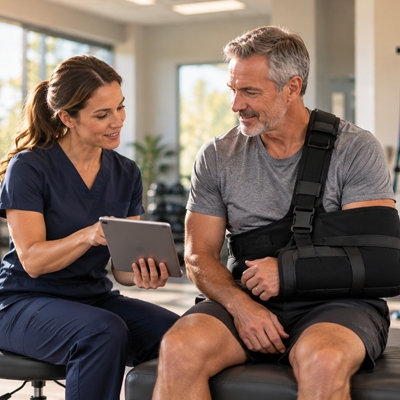
Physical therapy after rotator cuff repair helps patients protect the healing tendon, regain shoulder mobility, rebuild strength, and gradually return to everyday activities. Recovery occurs in stages. The correct timing of sling use, shoulder movement, resistance training, and return to sport depends on the operation and the surgeon’s instructions—not a one-size-fits-all calendar.
A repaired rotator cuff is not the same as a shoulder that is merely sore or stiff. Surgery reconnects damaged tendon tissue to bone, but the biological process of healing continues for months. An effective rehabilitation plan respects that healing while helping prevent unnecessary stiffness, weakness, and loss of confidence.
At Bridge Physical Therapy in Frisco, Texas, the focus is practical: help you move safely today while building toward the activities that matter tomorrow. Whether your goal is dressing comfortably, returning to work, lifting your grandchildren, playing golf, or reaching overhead, progress should be deliberate and individualized.

What Happens at Your First Rehabilitation Appointment?
A postoperative evaluation should begin with an understanding of what happened in surgery, not merely a measurement of how far you can raise your arm. Bring your operative instructions, current sling or brace, prescribed home program, and information about associated procedures such as biceps treatment. The therapist will review your permitted movements, symptoms, sleep, swelling, and how you are managing daily tasks.
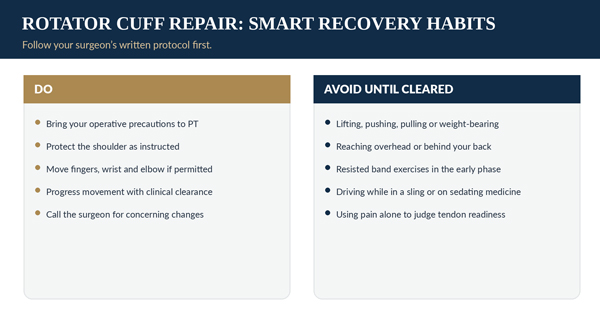
For a newly repaired tendon, a successful first visit may consist mainly of education, positioning, and planning. You should leave knowing which arm motions are allowed, which are restricted, how to protect the shoulder while dressing and sleeping, and when to contact the surgical team. An aggressive stretching session is not evidence of better care.
Why Is Rehabilitation Important After Rotator Cuff Repair?
The rotator cuff consists of four muscles and their tendons that help stabilize and move the shoulder. Tears may develop from injury, repetitive load, or progressive tendon degeneration. Surgical repair aims to restore tendon attachment, but successful recovery also depends on restoring motion, coordinated shoulder-blade mechanics, and functional strength.
Early rehabilitation is a balance. Moving the shoulder too aggressively may place unwanted stress on a healing repair. Delaying appropriate movement can contribute to stiffness. Your surgical team determines where that balance should fall based on the tendons repaired, tear size, tissue quality, fixation, and any additional procedures.
When Should Physical Therapy Begin After Surgery?
There is no single correct start date for every patient. Some surgeons prescribe supervised therapy early. Others delay shoulder movement while protecting the repair. The American Academy of Orthopaedic Surgeons’ 2025 guideline found similar clinical and patient-reported outcomes with earlier versus delayed mobilization, including delays of up to eight weeks, for selected small-to-medium full-thickness repairs. That finding does not mean every tear should be mobilized immediately.
For example, larger or complex repairs, compromised tendon quality, subscapularis repairs, and associated procedures may require additional restrictions. Bring your postoperative orders to your first therapy visit. Your physical therapist should coordinate with the surgeon when instructions are incomplete or unclear.
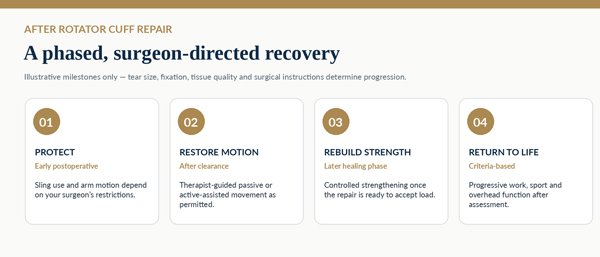
The Four Phases of Rotator Cuff Repair Recovery
Phase 1: Protect the Repair and Maintain Comfort
During the initial postoperative period, the priorities are protection, comfortable positioning, swelling control, and safe daily activities. Many patients wear a sling for several weeks; the precise duration varies. If permitted, the therapist may address hand, wrist, and elbow movement, education about posture, and very specific protected shoulder movements. Do not remove a sling, begin pendulum swings, or perform active shoulder exercises simply because you saw them online.
Sleeping may be easier in a recliner or with pillows that support the operated arm. Avoid using the repaired shoulder to push out of a chair, carry shopping bags, lift a child, or brace a fall unless the surgeon has specifically allowed it.
Phase 2: Gradually Restore Shoulder Motion
As clearance is given, rehabilitation may introduce therapist-assisted passive range of motion, followed by active-assisted and eventually active movement. These terms describe who moves the arm: with passive motion the shoulder muscles do not actively lift the arm; with active-assisted movement you receive help; and with active movement the shoulder muscles do the work.
The goal is not to force a maximum stretch. It is to restore useful motion within the limits of the repair, watching for compensation such as shrugging or arching the back. Progress is based on both surgical restrictions and the quality of the movement—not simply the number of weeks since surgery.
Phase 3: Rebuild Strength and Shoulder Control
Once tendon healing and your surgeon’s protocol allow loading, your therapist may add gentle resistance, rotator cuff strengthening, scapular stabilizer training, and endurance work. The American Society of Shoulder and Elbow Therapists’ commonly referenced consensus framework places progressive strengthening around 12 weeks after arthroscopic repair, but it is not a universal prescription.
Resistance bands, rows, and external-rotation exercises can be useful in the appropriate phase. They are not appropriate early postoperative exercises for everyone. The therapist will monitor technique, tolerance, and any increase in pain or weakness before advancing the load.
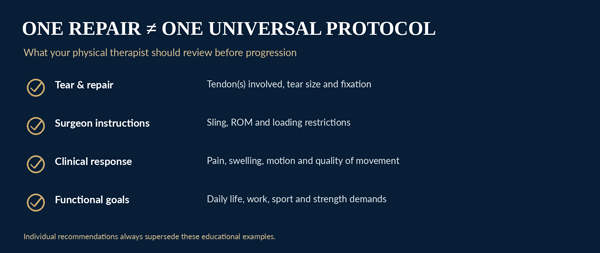
Phase 4: Return to Work, Exercise, and Recreation
The final stage focuses on what you need your shoulder to do. Someone returning to desk work has different demands from a carpenter, swimmer, golfer, or tennis player. Therapy may progress toward reaching, carrying, controlled overhead strength, endurance, and sport- or work-specific movement.
Many patients regain substantial daily function over several months, while heavier work or high-demand sport may take longer. Return should reflect motion, strength, confidence, healing considerations, and surgeon clearance—not a guaranteed date.
What Exercises Are Used After Rotator Cuff Repair?
Typical programs may include wrist and hand motion while protected, surgeon-authorized passive elevation, gentle assisted shoulder movement, scapular-control exercises, and later resistance-band strengthening. The exact sequence depends on the repair. A photo of an exercise cannot tell you whether it is appropriate for your current postoperative phase.
One of the best questions to ask at each visit is: “What can I safely do now, and what should I still avoid?” You should understand not only how to perform your home program, but also why each restriction matters.
How Can You Tell Whether Recovery Is Progressing?
Success is broader than pain relief. Your therapist may monitor supported and active motion, shoulder-blade control, tolerance of everyday tasks, sleep, functional questionnaires, and eventual strength. Progress often comes in steps. A temporary flare after a more active day does not necessarily mean the tendon has failed, but persistent or unexpectedly severe symptoms deserve attention.
Research also suggests that patients with selected small tears may do well with a therapist-instructed home program rather than frequent supervised visits. Others benefit from closer monitoring, especially when recovery is complicated by pain, weakness, stiffness, or a more complex repair. A good clinic tailors the level of supervision rather than prescribing the same number of appointments for everyone.
Five Ways to Make Home Recovery Safer and More Effective
First, keep a copy of the surgeon’s protocol available to everyone involved in your care. Second, arrange your home so common items are easy to reach without pulling or lifting with the operative arm. Third, take only the medication and use the cold therapy recommended by your clinical team. Fourth, perform your assigned exercises at the prescribed dose rather than adding repetitions or resistance because you feel stronger. Fifth, attend scheduled follow-up appointments and report persistent pain, new weakness, unexpected swelling, or difficulty complying with the restrictions.
The temptation to “get ahead” of rehabilitation is understandable, particularly when the shoulder begins to feel better. But pain relief and tendon healing are not the same milestone. Recovery often becomes more active only after your surgeon decides the tissue can safely tolerate additional load. A measured progression now can be more valuable than early gains that compromise later function.
When Should You Contact Your Surgeon?
Contact your surgical team promptly for fever, worsening redness or drainage, new or progressive numbness, an abrupt loss of previously regained function, or pain that is severe and unexpected. Sudden chest pain or difficulty breathing requires emergency evaluation. Follow your surgeon’s specific postoperative warning-sign instructions.
Frequently Asked Questions About Rotator Cuff Repair Physical Therapy
How long will I need to wear a sling?
Many repairs involve sling protection for several weeks, but the duration varies with repair size and surgical technique. Your own surgeon’s written instructions control.
Can I start physical therapy one week after surgery?
Possibly, but a very early visit may focus on education and protected movement rather than active shoulder exercise. Some patients are directed to wait longer before shoulder motion. Verify the plan with your surgeon.
When can I lift my arm above my head?
Overhead movement is reintroduced according to the operative restrictions and healing milestones. Assisted motion and active lifting are different stages; do not assume both are allowed together.
When can I use resistance bands or weights?
Usually later in recovery, after sufficient healing and return of controlled motion. The specific timing depends on your repair and protocol. Starting too soon may overload the tendon.
Do I need physical therapy if I have home exercises?
Some people with uncomplicated small repairs can succeed with a structured, clinician-taught home program. Others need ongoing supervision. The decision should consider the surgical plan, mobility, symptoms, adherence, and goals.
When can I drive after rotator cuff repair?
Do not drive while impaired by sedating medication or when a sling or shoulder restriction prevents safe vehicle control. Ask your surgeon when driving is appropriate.
How long until I can golf or play tennis?
It depends on the sport, tear and repair, strength, range of motion, and surgeon clearance. Overhead and high-velocity activities typically need a more demanding rehabilitation progression than routine daily activities.
Is PT for a rotator cuff tear the same as PT after repair surgery?
No. A nonoperative rotator cuff program may build strength while the tendon remains torn, whereas postoperative therapy must protect the surgically repaired tendon-bone interface. Exercises and timelines are not interchangeable.
Rotator Cuff Repair Rehabilitation in Frisco, Texas
Bridge Physical Therapy serves patients in Frisco and the surrounding North Texas communities of Plano, McKinney, Allen, and beyond. The objective is straightforward: pair your surgeon’s repair-specific precautions with a personalized, functional rehabilitation plan that helps you return to life with greater confidence.
If you have recently undergone rotator cuff repair—or surgery is planned—contact Bridge Physical Therapy to discuss an evaluation, your surgeon’s rehabilitation instructions, and scheduling options. Treatment should be coordinated with the surgeon, and recovery milestones cannot be guaranteed.
Medical disclaimer: This information is educational, not individualized postoperative instruction. Follow your surgeon’s written restrictions and contact the treating team for new or concerning symptoms. Illustrations show general concepts, not patient-specific exercise prescriptions.
Evidence & Sources
- AAOS, 2025. Management of Rotator Cuff Injuries: Evidence-Based Clinical Practice Guideline. https://www.aaos.org/rccpg2025 — Most up-to-date U.S. guideline; supports individualized early vs delayed mobilization for selected small-to-medium repairs and nuance of supervised vs home-based programs.
- Thigpen CA et al. The American Society of Shoulder and Elbow Therapists’ consensus statement on rehabilitation following arthroscopic rotator cuff repair. J Shoulder Elbow Surg. 2016;25:521–535. https://pubmed.ncbi.nlm.nih.gov/26995456/ — Staged protected movement and strengthening framework; consensus, not a mandatory universal schedule.
- AAOS OrthoInfo. Rotator Cuff Tears: Surgical Treatment Options. https://www.orthoinfo.org/treatment/rotator-cuff-tears-surgical-treatment-options/ — Patient-facing examples of slings, postoperative motion and recovery expectations.
- Mazuquin BF et al. Effectiveness of early versus delayed rehabilitation following rotator cuff repair. PLOS ONE. 2021. https://doi.org/10.1371/journal.pone.0252137 — Randomized-trial systematic review comparing early and delayed rehabilitation; interpretation depends on tear/population.