

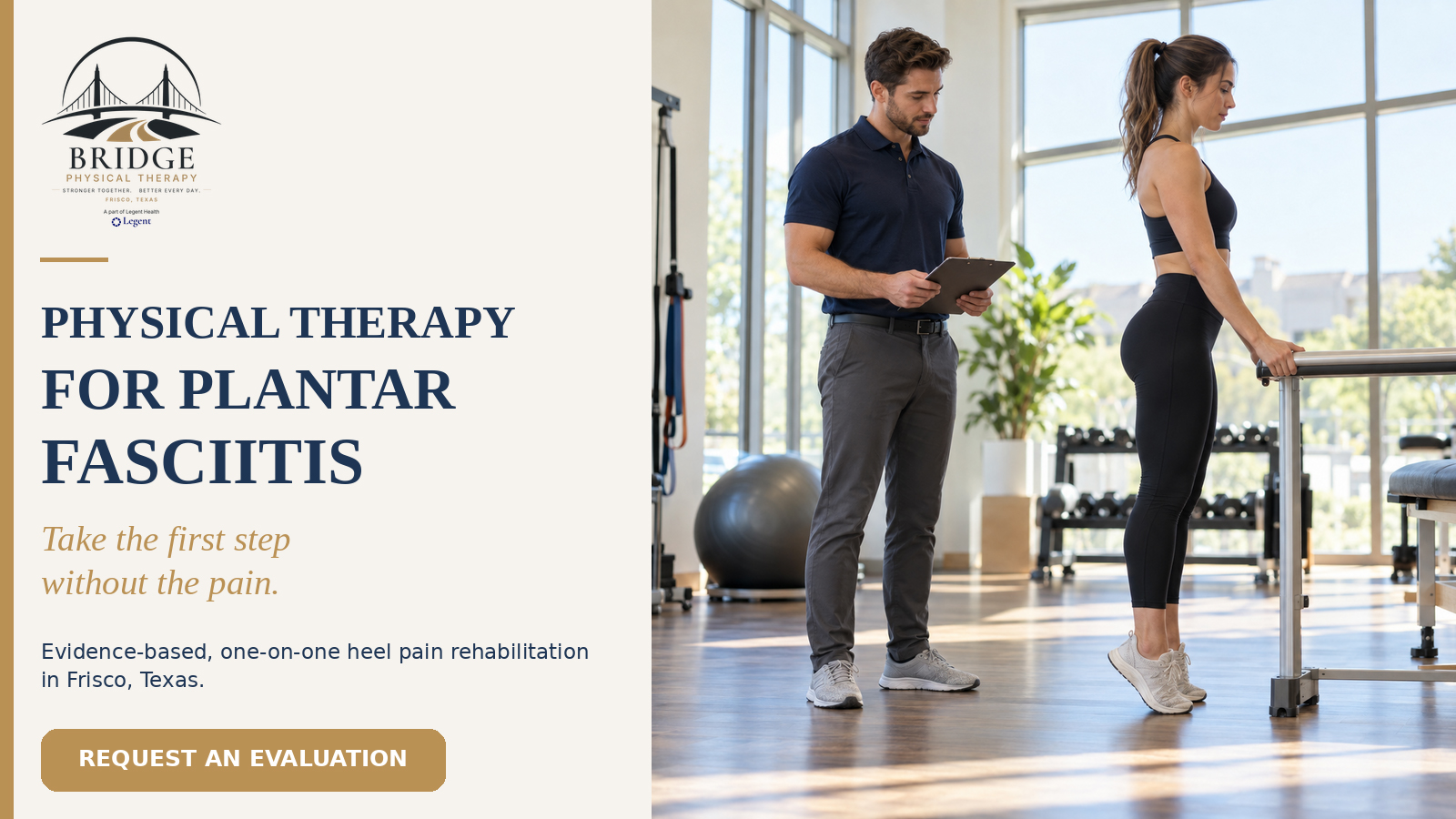
That stabbing pain under your heel with your first steps out of bed can make an ordinary morning feel like an obstacle course. For some people, it settles after a few minutes of walking, only to return after a long workday, a run, or another period of sitting. This familiar pattern often points to plantar fasciitis—also called plantar fasciopathy or plantar heel pain—but an accurate diagnosis still matters.
At Bridge Physical Therapy in Frisco, Texas, rehabilitation starts with your history, your movement, and what you want to get back to. A teacher standing all day, a runner increasing mileage, and a parent who simply wants to walk comfortably may share heel pain but need different treatment plans. The aim is not just to soothe the heel for an hour. It is to restore the foot's ability to handle real life.
The strongest guidance favors active, individualized treatment: plantar fascia–specific and calf stretching, foot and ankle strengthening, targeted hands-on care, and sensible changes to how the heel is loaded. Orthotics, taping, night splints, and other options can help selected patients, but none is a substitute for a plan that progressively restores function. [1,2]
What is plantar fasciitis—and why does it hurt in the morning?
The plantar fascia is a strong band of connective tissue along the sole of the foot, extending from the heel toward the toes. It helps support the arch and contributes to how the foot handles load during walking and running. Repeated loading that exceeds the tissue's current tolerance can lead to a painful condition often better described as plantar fasciopathy, because persistent cases are not simply an ongoing inflammatory process. [3]
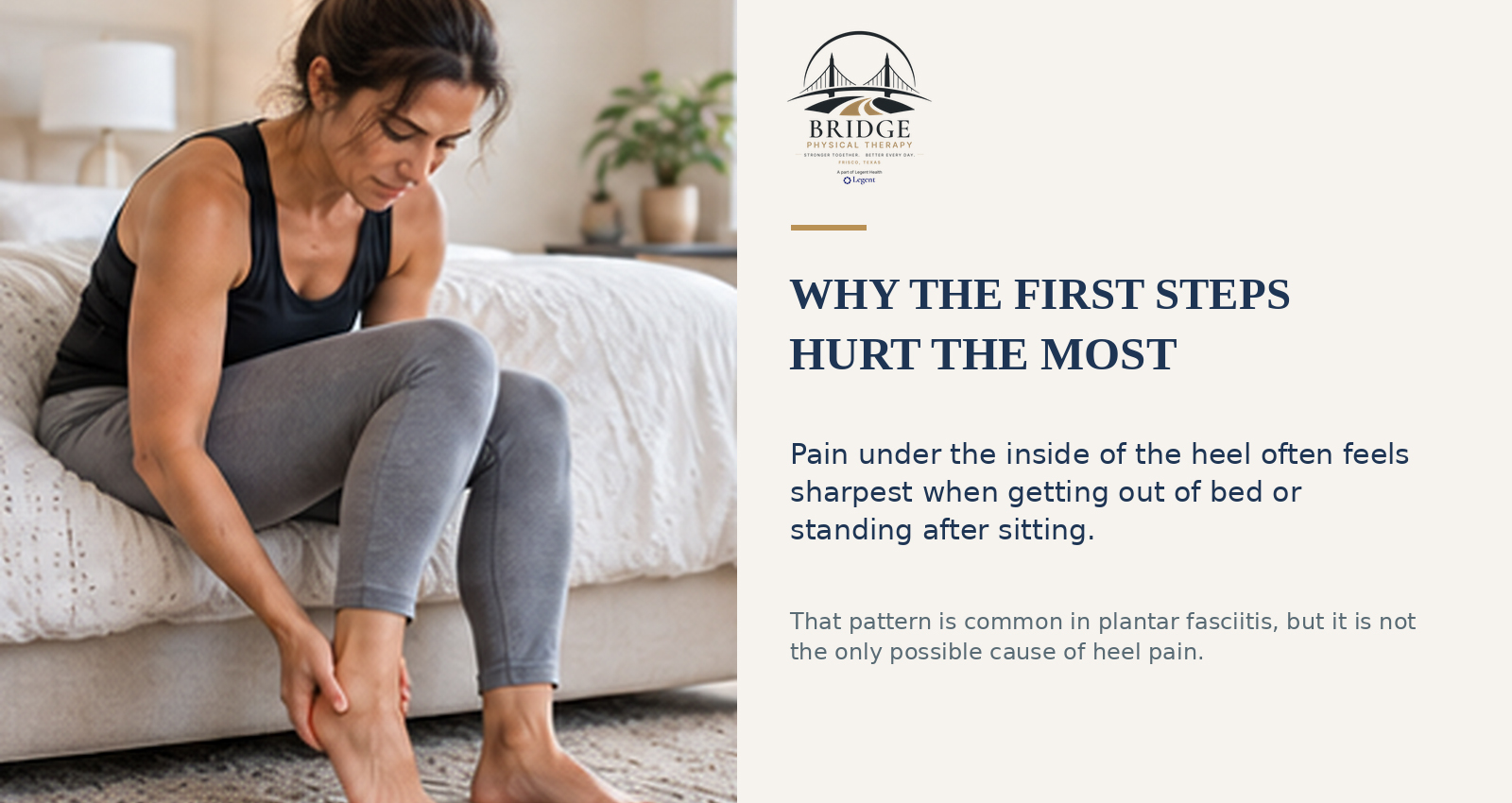
People commonly describe pinpoint tenderness near the inner underside of the heel. The first steps after sleep or sitting can be especially painful; symptoms may ease as the foot warms up, then return after long periods on your feet. Limited ankle motion, abrupt increases in running or standing, footwear changes, and other loading factors can contribute. A heel spur on an X-ray does not by itself establish the cause of pain. [3]
How can physical therapy help plantar fasciitis?
A skilled physical therapist does more than hand over a sheet of stretches. The initial evaluation considers the location and behavior of your pain, ankle and great-toe mobility, calf and foot strength, walking pattern, balance, footwear, and the demands of your work or sport. Your therapist can track measures such as first-step pain, standing tolerance, walking distance, and a validated function score to show whether your plan is actually working.
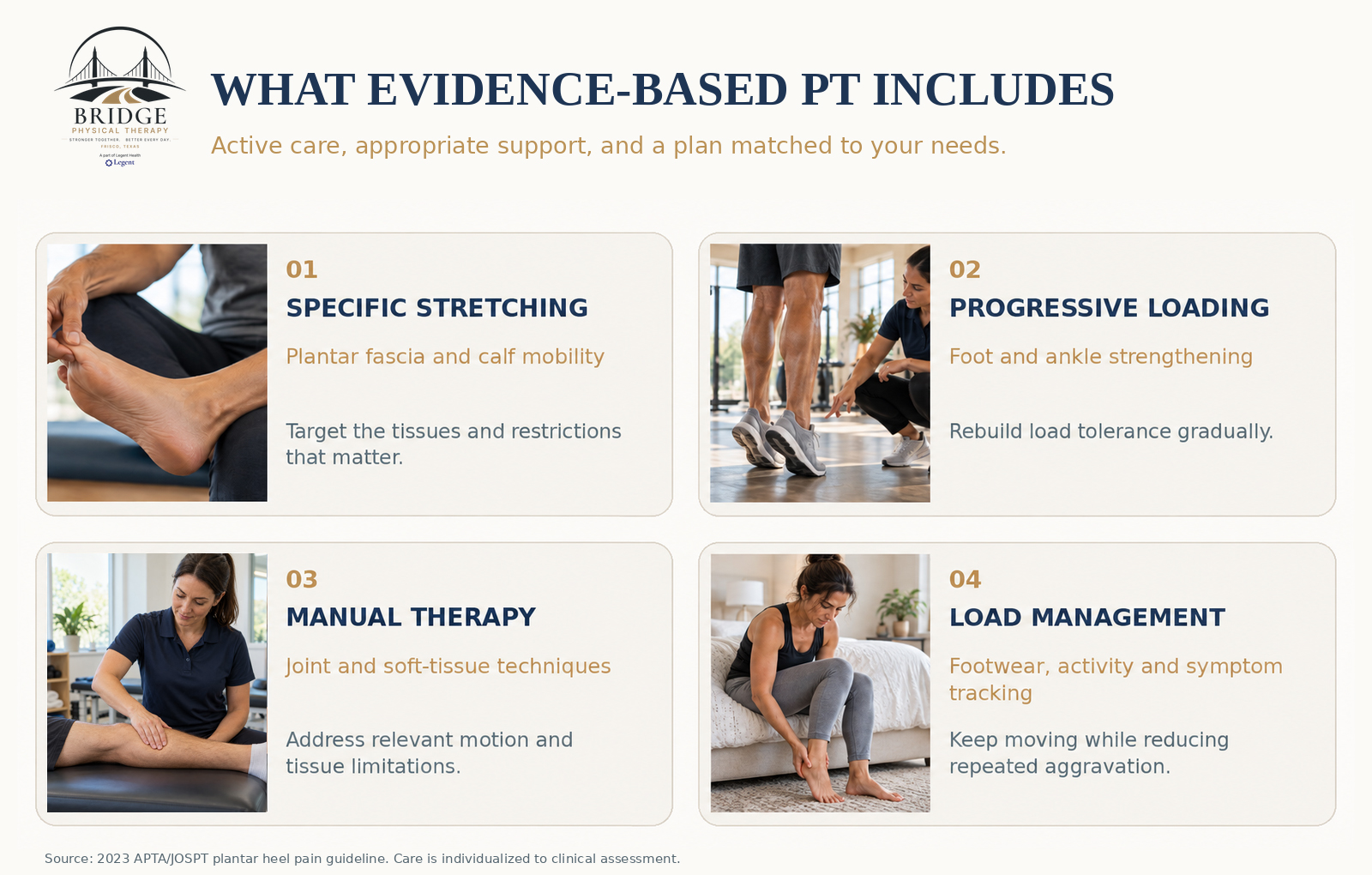
The 2023 American Physical Therapy Association–linked clinical practice guideline recommends a multimodal approach. Its strongest recommendations include manual therapy where movement restrictions are present, plantar fascia–specific and calf stretching, therapeutic exercise with resistance training, and taping as an adjunct for short-term symptom improvement. [1] A separate best-practice review similarly identifies education, stretching, and taping as important initial care. [2]
What happens at your first plantar fasciitis PT evaluation?
Your first session should begin with a conversation, not an automatic circuit of exercises. Your therapist will ask when the pain began, where it hurts, what happens when you take your first steps, and how your symptoms change with work, exercise, or rest. Bring the shoes you wear most often and describe changes in training, shifts, or daily walking. If your symptoms are not typical of plantar fasciitis, the next step may be to clarify the diagnosis rather than push through treatment.
The physical examination may include ankle mobility, calf strength and endurance, great-toe motion, tenderness around the heel, walking mechanics, single-leg balance, and how your symptoms behave during controlled loading. A clinician might use a function questionnaire or record your first-step pain to establish a baseline. These findings guide which activities to modify first and whether taping, footwear changes, stretching, or progressive resistance work should receive emphasis.
At the end of the visit, you should know what the therapist thinks is driving your symptoms, what to do between visits, and which signs would justify reassessment. A small, consistent home plan can be more valuable than an elaborate list of exercises you cannot maintain. Your goals might be pain-free school drop-offs, completing a twelve-hour shift, walking a golf course, or gradually returning to running; those are the outcomes against which your progress should be judged.
1. Plantar fascia–specific stretching: more precise than simply stretching your calf
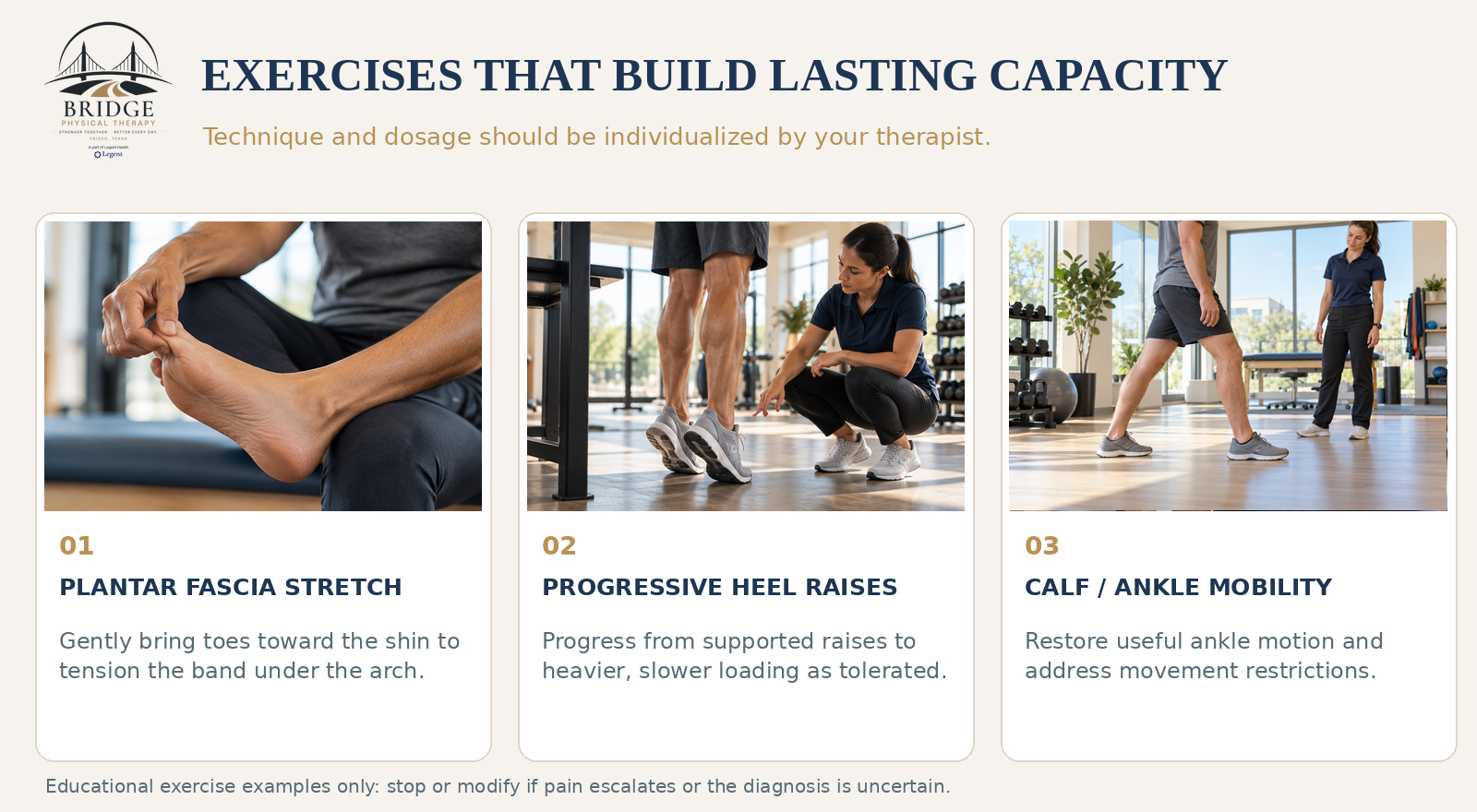
This is one of the most useful distinctions for patients. Rather than only leaning into a wall to stretch the Achilles tendon, a plantar fascia–specific stretch brings the toes gently back toward the shin, placing a controlled stretch along the band under the arch. It can be particularly helpful before those first painful steps. The intensity should be comfortable rather than aggressive.
In a randomized trial of 101 people with chronic plantar fasciitis, DiGiovanni and colleagues found better short-term outcomes with tissue-specific plantar fascia stretching than with a standard Achilles stretching protocol, alongside other treatments provided to both groups. This does not make calf stretching unnecessary; the current guideline supports both approaches when appropriate. [4]
2. Progressive strengthening: teaching the foot to tolerate load again
Stretching may help symptoms, but persistent heel pain often demands more than flexibility. Your calf, intrinsic foot muscles, and supporting leg muscles must manage the repeated forces of walking, stairs, and sport. A therapist may begin with supported heel raises, controlled foot exercises, and tolerable walking, then progress resistance and single-leg loading as symptoms permit.
A small randomized study by Rathleff and colleagues compared plantar-specific stretching with progressive high-load heel raises, both alongside shoe inserts. At three months, the strengthening group reported better foot function; the groups were not meaningfully different at later follow-ups. The lesson is not that everyone should immediately perform heavy calf raises. It is that thoughtful progressive loading can be a powerful part of rehabilitation, especially when matched to irritability and capacity. [5]
3. Manual therapy, gait work, and smarter activity choices
When ankle motion is restricted or the calf and plantar tissues are especially sensitive, manual therapy may help improve mobility and function. A therapist can also assess how you walk: are you protecting the heel, shortening your stride, or shifting load in a way that is creating a new problem? Restoring efficient movement matters as much as temporarily reducing pain.
Load management does not necessarily mean stopping all activity. It may mean breaking up long standing shifts, temporarily reducing hills or running mileage, choosing more supportive shoes, avoiding prolonged barefoot walking on hard floors, and using pain response the next morning to guide progression. Your plan should preserve appropriate physical activity while reducing repeated overload. [1,2]
What about orthotics, taping, night splints, and dry needling?
Foot orthotics and taping
Rigid or elastic taping can provide short-term improvement in symptoms and function when combined with other therapy. Shoe inserts or orthoses may be useful when part of a broader program, but the 2023 guideline advises against relying on custom or prefabricated orthoses as the sole short-term treatment. An expensive custom insert is not automatically superior for every patient. [1]
Night splints
If pain with the first step in the morning is persistent, a night splint may be worth discussing. The 2023 guideline supports a one- to three-month night-splint program for patients with consistent first-step morning pain. Comfort, sleep disruption, and adherence still matter. [1]
Dry needling, laser, and shockwave treatment
The guideline supports trigger-point dry needling in selected cases and includes low-level laser therapy as a possible component of rehabilitation. The evidence-based best-practice review identifies extracorporeal shockwave therapy as an option for symptoms that do not improve sufficiently with a well-delivered initial program. Availability, suitability, cost, and individual response should guide these decisions—not marketing claims. [1,2]
Therapeutic ultrasound and injections
Routine therapeutic ultrasound should not be presented as an essential first-line solution; the 2023 guideline specifically advises against using it to improve the benefits of stretching. Injections and surgery are not routine starting points for most people with typical plantar fasciitis. Persistent cases should be reassessed by the treating clinician or foot-and-ankle specialist before moving toward more invasive options. [1,3]
How long does physical therapy for plantar fasciitis take?
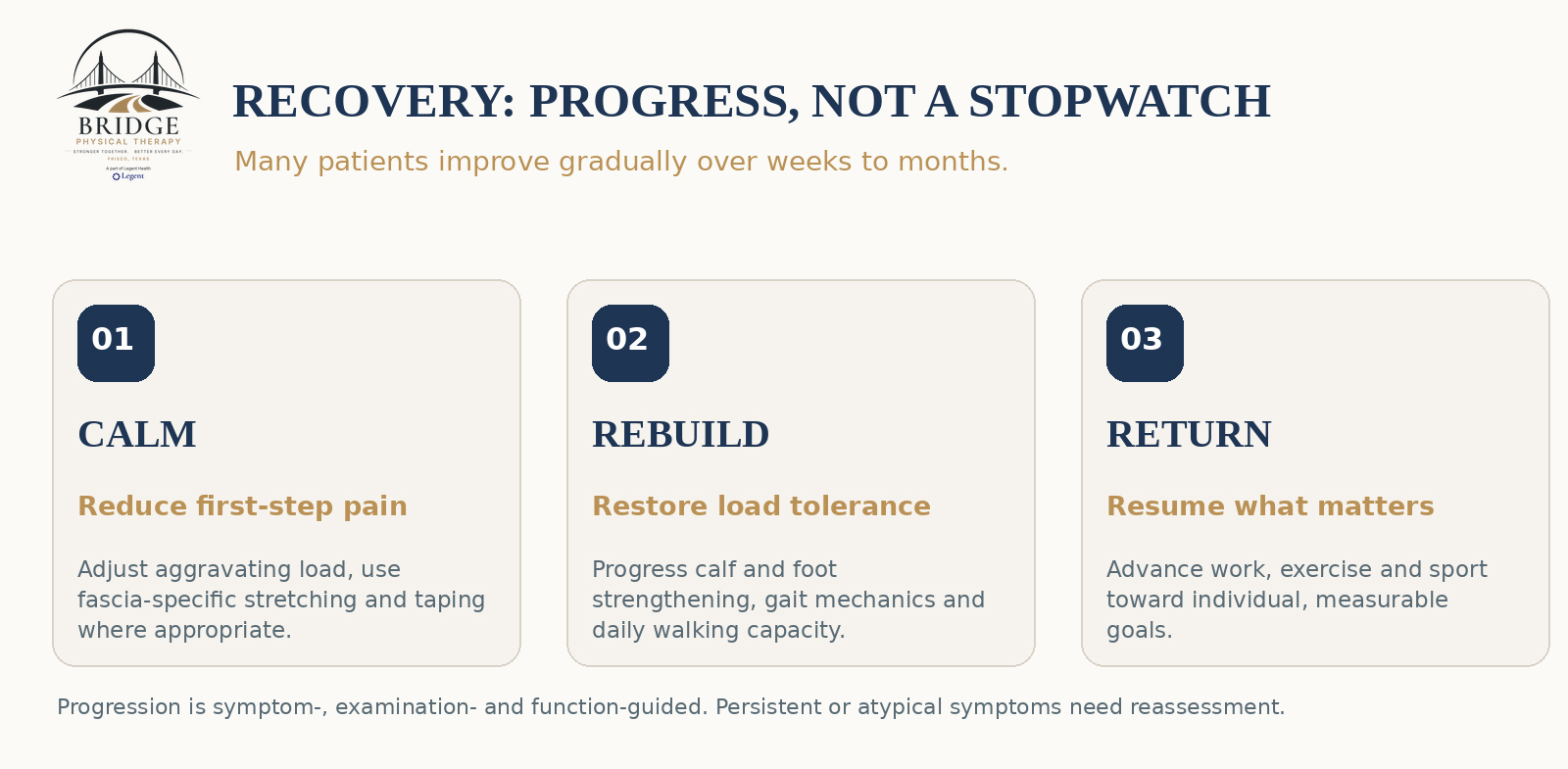
There is no one-size-fits-all visit count. Some people respond to a short course of targeted PT and a consistent home program; others with long-standing symptoms or demanding activity goals need a longer progression. The early focus is to calm irritability and restore comfortable walking. The next step is rebuilding strength and loading tolerance. The final step is returning to longer work shifts, fitness, running, or sport without a recurring flare.
Improvement can take weeks, and full resolution may take several months. Many patients improve with conservative care, but timelines vary. Rather than promising a cure by a certain date, Bridge measures progress against meaningful goals: less first-step pain, improved walking and standing tolerance, stronger heel raises, and confidence returning to the activities that matter to you. [2,3]
How do you know your heel pain rehabilitation is working?
Progress is not always a straight line. Symptoms can fluctuate with changes in work hours, footwear, travel, or training. Useful early signs include fewer painful first steps, less heel soreness after standing, improved tolerance for walking, and more comfortable ankle motion. Later milestones may include stronger, better-controlled heel raises, longer walking distances, and a gradual return to higher-impact activity without worsening pain the following morning.
Tracking one or two meaningful measures is often more informative than focusing on each day's pain score. A teacher might track the end-of-shift response; a runner might track comfortable walking and the following morning's symptoms before adding run intervals. If improvement stalls despite consistent treatment, your therapist should reconsider the diagnosis, the exercise dose, recovery opportunities, and whether another clinician or adjunctive treatment is appropriate. Individualized care means changing the plan when the evidence from your own progress says it is time.
When heel pain is not plantar fasciitis
Not all heel pain is caused by the plantar fascia. Numbness, tingling, burning, unusual night pain, swelling, a sudden traumatic onset, or pain that is not reproduced near the typical heel attachment may suggest another problem. Possibilities include a calcaneal stress fracture, nerve entrapment, heel-fat-pad pain, inflammatory conditions, or a plantar fascia tear. [3]
If the diagnosis is uncertain, symptoms are worsening, or a structured program is not helping as expected, reassessment is appropriate. Imaging or a surgical consultation may be useful in selected cases, but uncomplicated plantar fasciitis is usually diagnosed from the history and examination. Severe inability to bear weight, fever, redness, or new progressive neurological symptoms warrant prompt medical assessment.
Why Bridge Physical Therapy is different
Heel pain is common; your goals are not. At Bridge Physical Therapy, a patient recovering from a long day on their feet should not receive an identical program to a distance runner building mileage or an active older adult preparing for travel. We emphasize thoughtful, one-on-one assessment and individualized progression rather than moving patients through a generic circuit.
Your therapist can coordinate with your referring orthopedic or foot-and-ankle clinician when needed, adapt the home plan as you improve, and help you understand why each exercise matters. The objective is not an arbitrary number of appointments. It is useful improvement in how you live, work, and move.

Frequently asked questions about plantar fasciitis physical therapy
Can physical therapy actually help plantar fasciitis?
Yes. Clinical practice guidelines support stretching, strengthening, manual therapy, and other selected treatments to improve pain and function. A structured plan often helps patients regain activity even when symptoms have been present for months. [1,2]
What is the best exercise for plantar fasciitis?
There is no single best exercise for every person. Plantar fascia–specific stretching and progressively loaded heel raises have meaningful clinical evidence, but the choice and dosage depend on symptoms, mobility, and strength. [4,5]
Should I walk with plantar fasciitis or rest completely?
Many people can continue modified walking. The right amount depends on pain during activity, the response afterward, and first-step discomfort the next morning. Prolonged total rest is not automatically the best approach.
Are custom orthotics required for plantar fasciitis?
No. Orthoses can help as part of a broader rehabilitation plan, but current guidance does not support using them as the only short-term treatment. Your therapist can help decide whether an insert or taping trial fits your needs. [1]
Does rolling a frozen bottle or using a massage ball cure it?
These methods may offer temporary symptom relief for some people, but they do not replace a progressive program that addresses activity load, stretching, strength, and footwear. Stop if pressure worsens symptoms.
How long before I can run again?
Return to running depends on walking comfort, calf strength, hopping tolerance where appropriate, and symptom response to progressively longer or faster efforts. A graded return is safer than picking a fixed date.
Do heel spurs mean I need surgery?
No. Heel spurs can appear on imaging without being the main cause of symptoms, and most people with typical plantar fasciitis begin with conservative care. Persistent pain merits individualized assessment. [3]
Do I need a referral to begin physical therapy in Frisco?
Referral, evaluation, treatment, and insurance requirements depend on Texas practice rules, payer benefits, and your particular clinical situation. Contact Bridge to verify your coverage, appointment options, and whether a referral or physician order is needed.
Your next step: a plan built around your life
The goal of physical therapy for plantar fasciitis is not simply to make the heel temporarily less sore. It is to help you take your first steps more comfortably, build strength for the demands of your day, and return to the movement you enjoy. At Bridge Physical Therapy in Frisco, that starts with a careful assessment and a program created around you.
Clinical references and publishing review
References are for editorial verification. Maintain inline [#] markers as linked superscripts or bracketed numbers in the published article; do not delete them.
[1] Koc TA Jr, et al. Heel Pain–Plantar Fasciitis: Revision 2023. J Orthop Sports Phys Ther. 2023;53(12):CPG1–CPG39.
PMID 38037331 | DOI 10.2519/jospt.2023.0303 | https://pubmed.ncbi.nlm.nih.gov/38037331/
[2] Morrissey D, et al. Management of plantar heel pain: a best practice guide informed by a systematic review, expert clinical reasoning and patient values. Br J Sports Med. 2021;55:1106–1118.
DOI 10.1136/bjsports-2019-101970 | https://bjsm.bmj.com/content/55/19/1106
[3] Trojian T, Tucker AK. Plantar Fasciitis. Am Fam Physician. 2019;99(12):744–750.
https://www.aafp.org/pubs/afp/issues/2019/0615/p744.html
[4] DiGiovanni BF, et al. Tissue-specific plantar fascia-stretching exercise enhances outcomes in patients with chronic heel pain. J Bone Joint Surg Am. 2003;85(7):1270–1277.
PMID 12851352 | DOI 10.2106/00004623-200307000-00013 | https://pubmed.ncbi.nlm.nih.gov/12851352/
[5] Rathleff MS, et al. High-load strength training improves outcome in patients with plantar fasciitis: a randomized controlled trial with 12-month follow-up. Scand J Med Sci Sports. 2015;25:e292–e300.
PMID 25145882 | DOI 10.1111/sms.12313 | https://pubmed.ncbi.nlm.nih.gov/25145882/
Clinical safety / editorial note
Treatment recommendations are condition-dependent and should be individualized to diagnosis, tolerance, comorbidities and clinician assessment. Photo scenes illustrate concepts; do not represent them as actual Bridge clinicians or treatment claims. Verify scheduling URL, clinic address, phone, insurance/referral language, and credentials prior to publishing.