
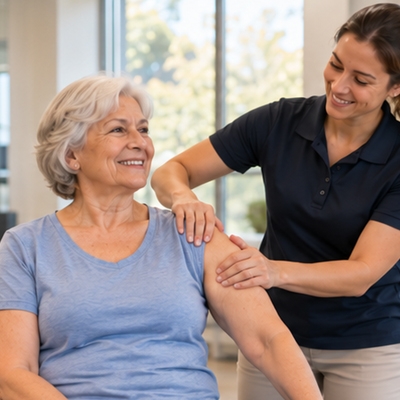
Total shoulder replacement can be life-changing for patients with severe arthritis, persistent pain, or loss of function that has not responded to conservative care. But the operation is only the first step. After surgery, the real-world question is simple: how do you safely regain motion, rebuild strength, and get back to the routines that matter?
At Bridge Physical Therapy in Frisco, Texas, rehabilitation after shoulder replacement is focused on function. For many adults in their 60s and beyond, success means sleeping more comfortably, washing hair without pain, reaching into a cabinet, getting dressed more easily, and returning to a more independent, active life. Physical therapy helps translate surgical improvement into meaningful everyday use of the arm.
What Is Total Shoulder Replacement?
Total shoulder replacement, also called shoulder arthroplasty, replaces the worn joint surfaces of the shoulder with prosthetic components. The goal is to reduce pain and improve function when arthritis, collapse, or other structural damage has made the shoulder unreliable and painful.
Patients are often surprised that pain relief and function do not return overnight. The tissues around the shoulder have to heal, swelling has to settle, protective movement patterns have to change, and strength has to be rebuilt gradually. The shoulder is a complex joint, and recovery works best when rehabilitation respects both healing biology and movement quality.
Anatomic Total Shoulder vs. Reverse Shoulder Replacement
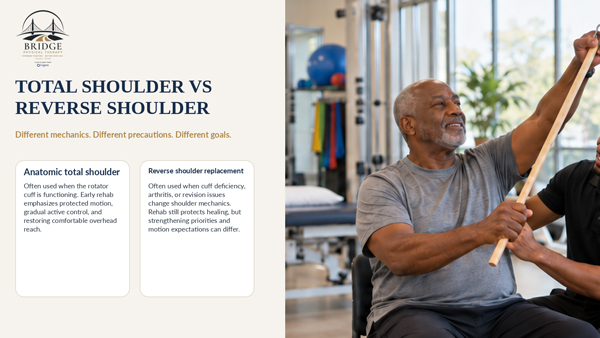
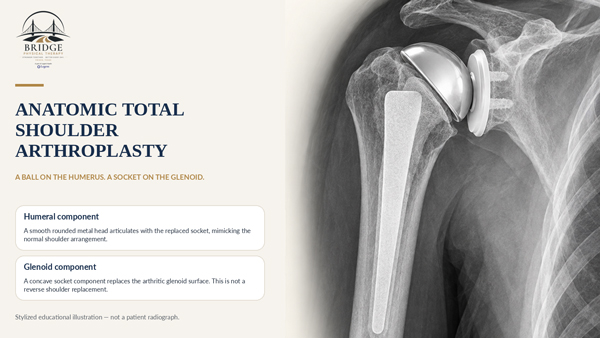
Not every shoulder replacement behaves the same way. In a traditional anatomic total shoulder replacement, the ball-and-socket relationship is recreated in a way that more closely resembles normal anatomy. This is commonly used when the rotator cuff is functional enough to help power and stabilize the shoulder.
In a reverse shoulder replacement, the mechanics are intentionally changed so that the deltoid muscle can do more of the lifting work. This is often used when rotator cuff deficiency, cuff tear arthropathy, complex deformity, fracture patterns, or revision circumstances make a standard replacement less reliable.
That difference matters in physical therapy. Motion limits, strengthening priorities, and realistic expectations can vary based on implant type and tissue quality. Some patients progress with excellent overhead function; others achieve their best outcome by regaining comfortable daily-life motion and dependable shoulder-level activity rather than unrestricted reach. The key is not comparing yourself to the internet or another patient. The key is following the surgical plan that fits your shoulder.
Why Physical Therapy Matters After Shoulder Replacement
Physical therapy after shoulder replacement is not just about handing out exercises. It is about guiding the right exercise at the right time. Too little motion can contribute to stiffness. Too much activity too early can irritate or overload healing tissue. Good rehabilitation lives in the middle: protected progress.
Therapists help patients understand sling use, sleeping position, safe transfers, swelling control, walking posture, and early movement expectations. As recovery progresses, therapy addresses shoulder blade control, gentle mobility, the transition from passive to active motion, and eventually strengthening and functional reach.
Just as important, therapy helps patients avoid compensations. Many people shrug the shoulder upward, twist the trunk, or overuse the neck when the arm does not yet move well. Those habits can delay recovery and make the shoulder feel weaker than it really is. A trained eye can correct that early.
The Early Phase: Protection, Pain Control, and Passive Motion
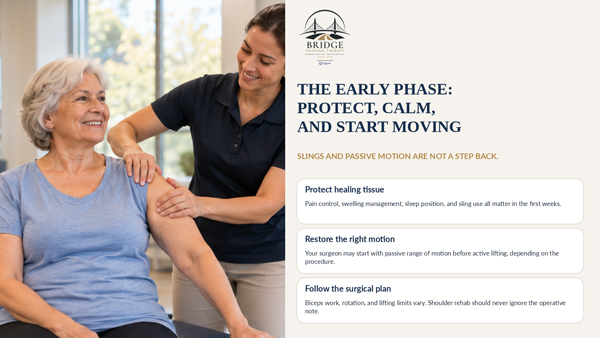
The early weeks after total shoulder replacement are typically about protection. Many patients leave surgery with a sling and detailed instructions about when to wear it, how to sleep, and what movements to avoid. The exact details depend on the surgeon, the implant, the quality of the soft tissues, and whether additional procedures were performed.
Early rehabilitation often emphasizes pain control, swelling management, walking and posture, hand-wrist-elbow motion, and carefully prescribed passive or assisted shoulder movement. Passive motion means the shoulder is moved with help rather than actively lifted by the recovering arm itself. That helps prevent excessive strain while mobility begins to return.
This phase can feel deceptively slow, especially for active patients. But healing tissue does not benefit from impatience. A shoulder that is calm, protected, and moving in the right direction usually performs better later than one that was repeatedly irritated early.
Restoring Motion, Strength, and Daily Function
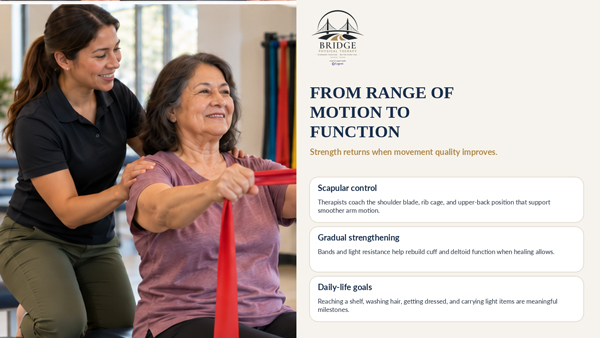
As healing progresses, therapy usually advances from passive motion to active-assisted and then active motion. Later, the program may expand to include light strengthening, scapular stabilization, rotator cuff or deltoid work when appropriate, and task-specific training.
For many patients, the most important milestones are practical. Can you put on a shirt more easily? Reach the steering wheel comfortably? Put away light dishes? Wash your hair? Sleep without waking repeatedly from pain? Those are real functional wins, and therapy should keep them in focus.
Rehabilitation also pays attention to the upper back and shoulder blade. The shoulder does not operate in isolation. Posture, thoracic mobility, scapular control, and neck tension all influence how comfortable and efficient the shoulder feels.
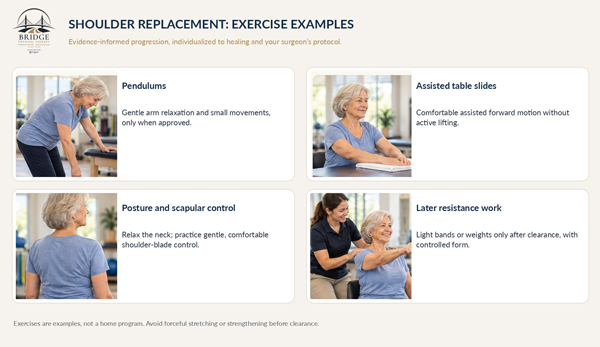
Examples of commonly prescribed exercises include gentle pendulums, assisted table slides, comfortable scapular-control work, and later light resistance training. These are examples, not a universal sequence or a prescription. Anatomic shoulder arthroplasty commonly requires protection of the subscapularis repair, and resistance or external rotation must follow the individual surgeon’s limits. The American Society of Shoulder and Elbow Therapists recommends staged progression based on tissue healing and patient factors.
A Practical Recovery Timeline
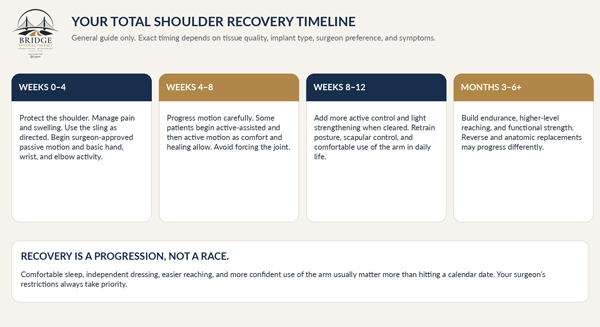
Every surgeon has preferences, and every shoulder heals at its own pace, but a general pattern is common. The first several weeks are focused on protection, passive motion, and symptom control. In the next phase, many patients progress active-assisted and then active motion. Later, light strengthening, endurance, and functional reaching are introduced more intentionally. Meaningful improvement often continues for several months.
Patients sometimes ask for one exact timetable, but shoulder recovery is not that neat. Reverse replacements can progress differently from anatomic replacements. Tissue quality matters. So does preoperative stiffness. The better question is not “What week should I be doing X?” but “What is the safest next step based on my symptoms, healing, and surgeon’s instructions?”
When Outpatient PT Is Especially Helpful
Not every patient needs the same amount of supervised care. Some are organized, consistent, and progress smoothly with a structured home plan plus periodic guidance. Others clearly benefit from more frequent therapy visits—especially if motion remains limited, the shoulder stays irritable, compensations develop, or confidence with daily function lags behind.
Outpatient PT can be particularly valuable for patients who have had prolonged preoperative stiffness, revision surgery, reverse replacement, balance limitations that make sling management harder, or goals that require more than basic pain relief. The point is not to create dependency. It is to solve the problems that stand between surgery and function.
What Does the Literature Say?
The literature on shoulder arthroplasty rehabilitation consistently supports a structured, progressive approach, but it does not support a one-size-fits-all recipe. Published protocols and reviews generally emphasize protected early motion, gradual progression based on tissue healing, and close attention to implant type and surgeon precautions.
There is also broad agreement that outcomes are influenced by more than formal exercise volume alone. Pain level, stiffness, preoperative function, rotator cuff or deltoid capacity, and compliance with precautions all matter. That is one reason thoughtful supervision can be useful: the right program is not just a list of exercises. It is a sequence of decisions.
For patients, the takeaway is practical. Good rehab should help you restore comfortable range, improve function, and build confidence without promising unrealistic speed. The goal is steady recovery, not aggressive heroics.
When to Contact the Surgical Team
Increasing wound redness, drainage, fever, rapidly worsening pain, progressive swelling, sudden loss of motion, or a significant change in the shoulder should prompt a call to the surgical team. Serious medical symptoms such as shortness of breath, chest pain, fainting, or new severe swelling require urgent medical attention.
Physical therapy is a powerful part of recovery, but it does not replace postoperative medical supervision. The best outcomes come when the patient, surgeon, and rehabilitation team are aligned.
Bridge Physical Therapy in Frisco, Texas
At Bridge Physical Therapy, postoperative shoulder care is built around evidence-informed progression and patient-specific goals. That means respecting the operation, understanding the difference between total and reverse shoulder replacement, and using therapy to improve the activities that matter in real life.
If you are preparing for shoulder replacement or recovering after surgery, a clear plan can make the process less intimidating. The right program should help you move forward with structure, perspective, and confidence.
Frequently Asked Questions
How long does physical therapy take after total shoulder replacement?
Many patients participate in rehabilitation for several weeks to several months, depending on implant type, stiffness, goals, and surgeon preference. Some continue improving beyond the formal therapy period.
Is rehab different after reverse shoulder replacement?
Yes. Reverse shoulder replacement changes shoulder mechanics, so motion expectations and strengthening priorities can differ from anatomic total shoulder replacement.
When can I lift my arm after shoulder replacement?
That depends on the operation and your surgeon’s protocol. Many programs begin with passive or assisted motion before active lifting. Do not force the arm overhead just because the calendar has advanced.
What does PT help with after shoulder replacement?
Physical therapy can help with pain control, swelling, mobility, posture, shoulder blade control, gradual strengthening, dressing, grooming, reaching, and confidence using the arm in daily life.
Can I do only home exercises after shoulder replacement?
Some patients do very well with a structured home program, while others benefit from supervised therapy. Persistent stiffness, compensation, pain, or uncertainty are common reasons to involve outpatient PT.
What if my shoulder feels stiff?
Stiffness is common, but the solution is not always more force. A therapist can help determine whether the joint needs a change in mobility strategy, symptom management, exercise dosage, or surgeon follow-up.
To discuss your shoulder replacement recovery, request an evaluation with Bridge Physical Therapy in Frisco, Texas.
Selected references and educational sources
- Kennedy JS, et al. The American Society of Shoulder and Elbow Therapists’ consensus statement on rehabilitation for anatomic total shoulder arthroplasty. J Shoulder Elbow Surg. 2020;29:2149–2162. DOI:10.1016/j.jse.2020.05.019. https://pmc.ncbi.nlm.nih.gov/articles/PMC8262512/
- Denard PJ, Lädermann A. Immediate versus delayed passive range of motion following total shoulder arthroplasty. J Shoulder Elbow Surg. 2016;25:1918–1924. DOI:10.1016/j.jse.2016.07.032. https://pubmed.ncbi.nlm.nih.gov/27727055/
- Postoperative Rehabilitation After Shoulder Arthroplasty. Orthop Clin North Am. 2023; PMID:37003664. https://pubmed.ncbi.nlm.nih.gov/37003664/
- A Systematic Review of Proposed Rehabilitation Guidelines Following Anatomic and Reverse Shoulder Arthroplasty. J Orthop Sports Phys Ther. 2019. DOI:10.2519/jospt.2019.8616. https://pubmed.ncbi.nlm.nih.gov/31021690/
- Can we accelerate rehabilitation following reverse shoulder arthroplasty? A systematic review. Shoulder Elbow. 2024;16(2):214–227. https://pmc.ncbi.nlm.nih.gov/articles/PMC11034463/