

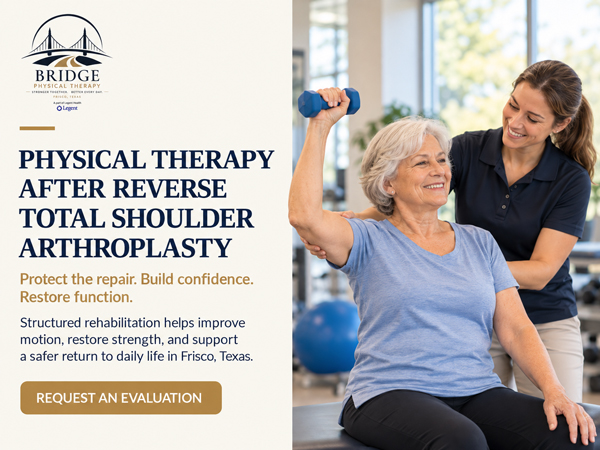
Reverse total shoulder arthroplasty can dramatically improve pain and function for patients whose shoulder problems are not well served by a standard anatomic shoulder replacement. Many people who need a reverse shoulder replacement have a massive rotator cuff tear, cuff tear arthropathy, complex arthritis, a prior failed shoulder surgery, or a fracture pattern that changed how the shoulder works. The surgery is important, but surgery alone is not the finish line. To turn pain relief into useful everyday function, patients usually need a thoughtful, phase-based rehabilitation program.
At Bridge Physical Therapy in Frisco, Texas, physical therapy after reverse total shoulder arthroplasty focuses on safe progression, clear education, and restoring the daily activities that matter most. For many adults, that means reaching a shelf, washing hair, dressing more comfortably, sleeping better, carrying light household items, and moving the arm with more confidence. The goal is not just motion for motion’s sake. The goal is dependable function.
What is reverse total shoulder arthroplasty?
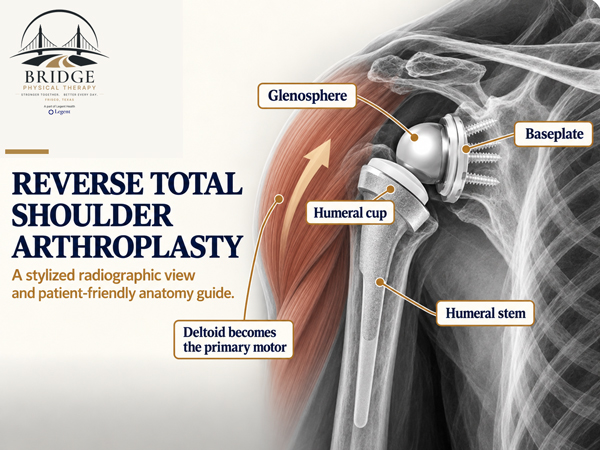
In a standard, or anatomic, total shoulder replacement, the joint is rebuilt in a way that more closely mirrors natural anatomy: the humeral side functions as the ball and the socket remains on the glenoid side. Reverse total shoulder arthroplasty flips that relationship. A glenosphere is fixed to the shoulder blade side, and a socket-like humeral cup is placed on the arm side.
That design change is not cosmetic. It changes shoulder mechanics so the deltoid can do more of the lifting work when the rotator cuff is no longer functioning well enough to power the arm on its own. That is why reverse shoulder arthroplasty is so commonly used for cuff tear arthropathy, irreparable cuff deficiency, some revisions, and selected fractures in older adults.
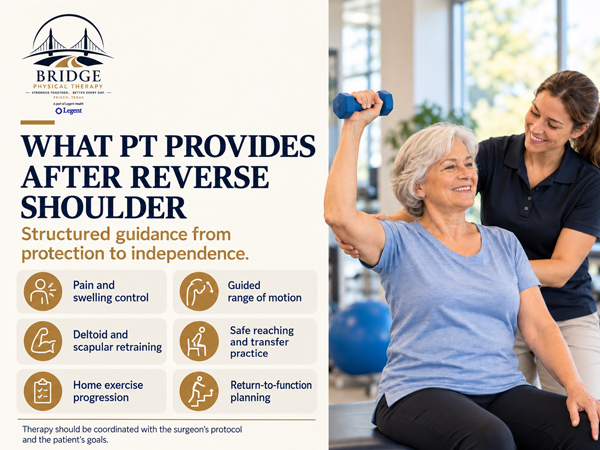
Because the mechanics are different, rehabilitation is also different. Reverse shoulder physical therapy is not simply “standard shoulder rehab.” The precautions, exercise priorities, and expectations can differ meaningfully from anatomic total shoulder replacement. That is one reason surgeon-directed, procedure-specific physical therapy matters.
Why reverse shoulder rehab is different
After reverse total shoulder arthroplasty, patients are typically learning how to use a new mechanical system. Rather than relying heavily on an intact rotator cuff, recovery often emphasizes deltoid activation, scapular control, postural mechanics, and careful reintroduction of functional reaching.
Early precautions are especially important. Depending on the surgeon and implant, patients may need to avoid positions that combine shoulder extension, adduction, and internal rotation early in recovery because those positions can increase instability risk. Sling use, transfer mechanics, sleeping posture, and safe ways to get dressed all matter in the first phase.
That is why good therapy is not simply a list of exercises. It is coaching, pacing, protecting, and guiding the patient through the right dose of motion and strength at the right time.
What physical therapy provides after reverse total shoulder arthroplasty
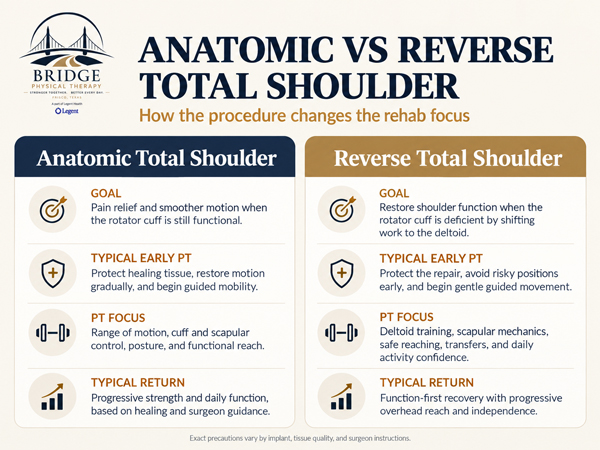
Physical therapy after reverse total shoulder arthroplasty typically includes pain and swelling management, guidance for sling use and protection, gradual restoration of comfortable motion, postural and scapular retraining, deltoid strengthening when appropriate, safe transfer and reaching practice, progressive return to daily tasks, and a structured home exercise progression.
Patients often underestimate how valuable this guidance can be. Many people are willing to work hard, but early recovery is not about pushing through pain or doing more repetitions just because a calendar says it is time. Recovery works best when progression matches healing, symptoms, and surgeon instructions.
The phases of recovery after reverse total shoulder arthroplasty
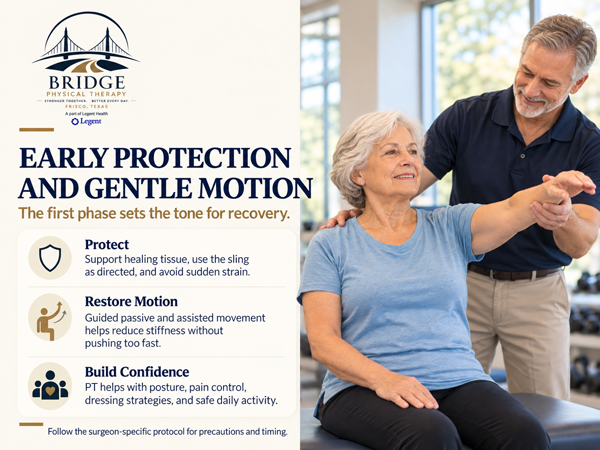
The early phase usually emphasizes protection. The shoulder has been reconstructed, soft tissues need time to heal, and swelling and pain are still settling. Therapy in this phase often includes education, hand-wrist-elbow motion, posture, walking mechanics, gentle passive or assisted shoulder motion, and strategies for basic daily activities.
As healing progresses, therapy often advances to active-assisted and then active motion within the surgeon’s parameters. Patients may begin to move the arm more intentionally while continuing to avoid overload. The focus is not just range of motion on a table. It is quality of motion.
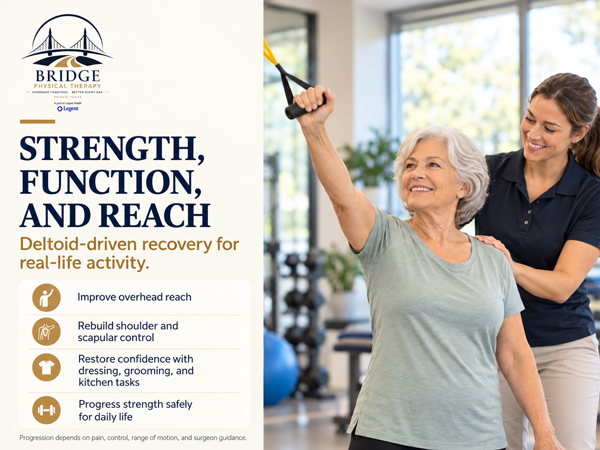
Later rehabilitation usually introduces more strengthening, especially for the deltoid and surrounding stabilizers. Functional drills may target reaching a cabinet, light carrying, grooming tasks, controlled pushing from a chair, and other practical activities. Many patients are more interested in independence than in athletic performance, and therapy should reflect that.
Reverse shoulder recovery timeline
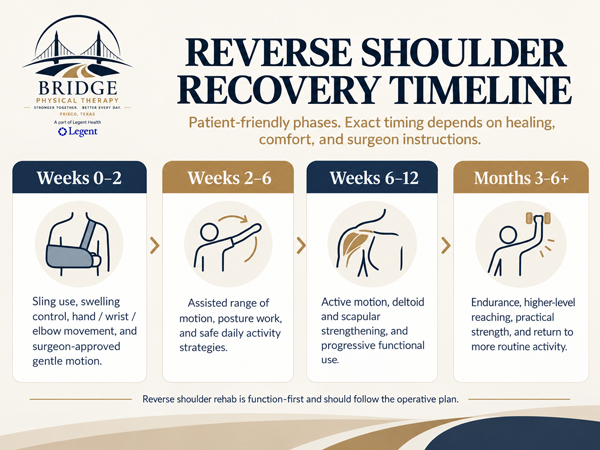
Every surgeon has preferences, and every patient’s starting point is different, but a practical recovery pattern often looks like this: the first several weeks focus on protection, sling use, symptom control, and gentle passive or assisted movement; the next phase emphasizes gradual progression of motion and better light function; later phases target strengthening, endurance, and more confident functional reaching.
Many patients feel early relief in pain before they feel fully recovered in function. That is normal. Reverse total shoulder arthroplasty often improves pain first, then motion and everyday use build more gradually. Improvement commonly continues for months.
Evidence-based exercises after reverse total shoulder arthroplasty
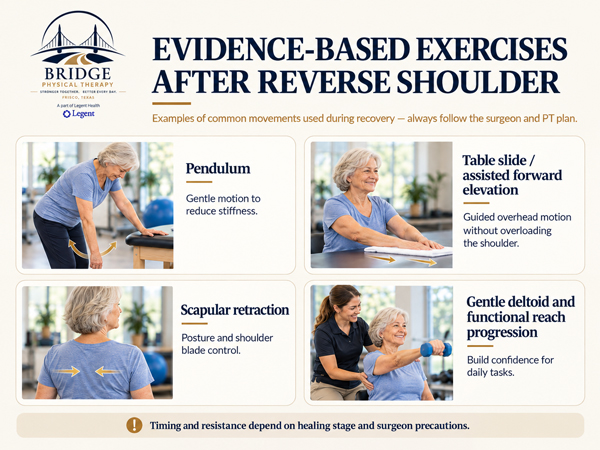
Exact exercise progressions depend on the surgeon’s plan, tissue quality, and the individual patient, but examples of commonly used categories include pendulum-type unloading drills when allowed, assisted table slides or supported mobility drills, scapular setting and postural control, gentle active-assisted elevation within safe limits, deltoid-focused strengthening once appropriate, and low-load functional reaching practice.
Contemporary rehabilitation guidance supports staged progression rather than aggressive early loading. In other words, better rehab is not usually faster rehab. Better rehab is appropriately timed rehab. A shoulder that is repeatedly flared up by overactivity often lags behind one that was advanced more intelligently.
Goals, expectations, and when to call the surgeon
Patients often ask what success should look like. In general, therapy aims to help patients reduce pain and guarding, restore functional motion, improve confidence with dressing and grooming, build deltoid-driven arm control, improve scapular mechanics, and return to safer, more independent living.
Patients should alert their surgeon or therapist if they experience significant new pain, a sudden loss of function, increasing redness or drainage, fever, or a dramatic change in shoulder position or stability. A progressive rehab plan should feel challenging at times, but it should still make clinical sense.
Why choose Bridge Physical Therapy in Frisco, Texas?
At Bridge Physical Therapy, rehabilitation after reverse total shoulder arthroplasty is built around structured progression and clear communication. The emphasis is on evidence-based recovery, patient education, and function that carries over to daily life. Patients in Frisco, Texas and the greater North Texas area often want more than a generic exercise handout. They want a plan.
That is where procedure-specific physical therapy matters. Reverse shoulder arthroplasty is not the same as rotator cuff rehab, and it is not the same as anatomic total shoulder rehab. Therapy should match the procedure.
Frequently Asked Questions
How long does physical therapy last after reverse total shoulder arthroplasty?
That varies, but many patients work through a structured recovery over several months. The exact number of visits depends on the surgical plan, symptoms, progress, and home-program consistency.
Is reverse shoulder replacement rehab different from standard total shoulder rehab?
Yes. The mechanics are different, the role of the deltoid is different, and the precautions may be different. Reverse shoulder arthroplasty rehab should follow the surgeon’s protocol and patient-specific needs.
When can I use my arm for daily activities?
Light daily use often returns gradually as healing progresses, but the timing is surgeon-specific. Therapy helps patients resume activity safely rather than guessing their way through recovery.
Will physical therapy help with stiffness after reverse shoulder replacement?
Yes, structured physical therapy is commonly used to improve mobility, reduce guarding, and help patients regain functional motion while still respecting healing tissue.
What if my main goal is independence rather than sports?
That is a very common goal. Reverse shoulder arthroplasty rehab often focuses heavily on practical daily-life function, comfort, confidence, and independence.
If you are looking for physical therapy after reverse total shoulder arthroplasty in Frisco, Texas, Bridge Physical Therapy can help guide recovery from protection through functional return.
Selected references
- American Society of Shoulder and Elbow Therapists: consensus principles for shoulder arthroplasty rehabilitation and staged progression.
- Rehabilitation literature on reverse total shoulder arthroplasty emphasizing protection, deltoid-driven recovery, and function-first progression.
- Contemporary clinical guidance for procedure-specific shoulder arthroplasty exercise progression and precautions.