
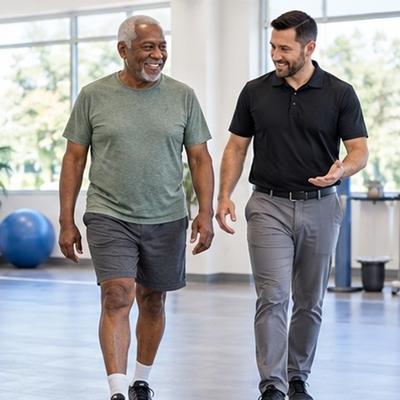
Partial knee replacement is often presented as the smaller cousin of total knee replacement. That description is not wrong, but it is incomplete. A better way to explain it is this: in a carefully selected patient, the surgeon resurfaces only the damaged compartment of the knee instead of replacing the whole joint. The goal is to relieve compartment-specific arthritis pain while preserving more of the native knee.
At Bridge Physical Therapy in Frisco, Texas, physical therapy after partial knee replacement focuses on restoring the practical things patients care about: getting swelling down, regaining a straight knee and comfortable bend, walking without a limp, managing stairs, rebuilding quadriceps strength, and returning to daily life with more confidence. Some patients recover faster than they expected. Others need more coaching than they expected. Both can be normal.
What Is a Partial Knee Replacement?
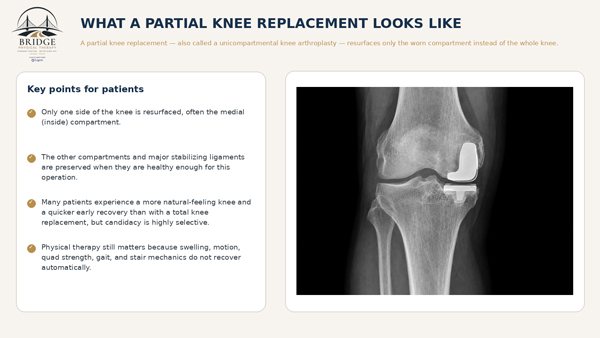
A partial knee replacement is also called a unicompartmental knee arthroplasty, often shortened to UKA or partial knee replacement. Instead of resurfacing the entire knee, the operation replaces only the worn compartment—most commonly the medial or inside compartment. This preserves the healthier compartments and usually preserves important native ligaments, which can help the knee feel more natural after recovery.
Not every patient is a candidate. The procedure is typically reserved for people with arthritis isolated to one compartment and acceptable ligament function, alignment, and overall knee condition. When the operation is indicated, many patients appreciate the smaller operation and potentially quicker early recovery compared with a total knee replacement.
Why Physical Therapy Still Matters After a “Smaller” Operation
A partial knee replacement may involve less bone and soft-tissue disruption than a total knee replacement, but it is still major surgery. Swelling, pain, stiffness, quadriceps inhibition, and gait changes can develop quickly if recovery is not guided well. Patients often assume that because the incision is smaller, the knee will automatically behave normally. In reality, walking mechanics, balance, stair performance, and lower-extremity strength still need structured rebuilding.
Physical therapy also helps protect against the most common functional problems after knee arthroplasty: loss of full knee extension, inadequate flexion for daily activities, a persistent limp, difficulty standing from chairs, and hesitation with stairs or longer walks. The best programs do not simply hand out exercises. They coach the patient through swelling management, movement quality, progressive loading, and realistic activity progression.
What Does the Evidence Suggest?
Peer-reviewed literature generally supports the idea that partial knee replacement can allow rapid early recovery in selected patients, but the rehabilitation literature is not as standardized as many people assume. A 2022 systematic review in *Physiotherapy* evaluated early postoperative physiotherapy after unilateral unicompartmental knee replacement and found wide variability in treatment content, dosage, and timing, with a recent shift toward faster pathways and more self-directed rehabilitation. The review also noted that the quality of the available studies was limited.
A broader 2023 systematic review examining therapeutic exercise after total and unicompartmental knee arthroplasty similarly found substantial heterogeneity and limited clarity about which exact exercise strategies are superior. The practical takeaway is not that therapy is unnecessary; it is that rehabilitation should be individualized, goal-directed, and adjusted to the patient’s symptoms and function rather than copied from a generic handout.
Activity data are also encouraging. Systematic reviews suggest that patients after unicompartmental knee arthroplasty often return to low-impact physical activity at high rates, and in some analyses they return to activity more readily than total knee arthroplasty patients. That does not mean high-impact sport is universally advisable, but it does support a progressive, function-focused rehabilitation plan.
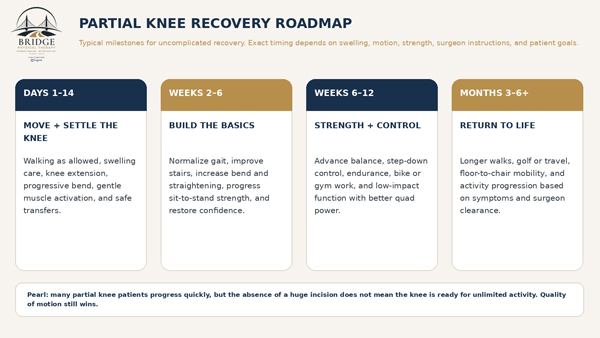
Phase 1: Quiet the Knee and Restore Motion
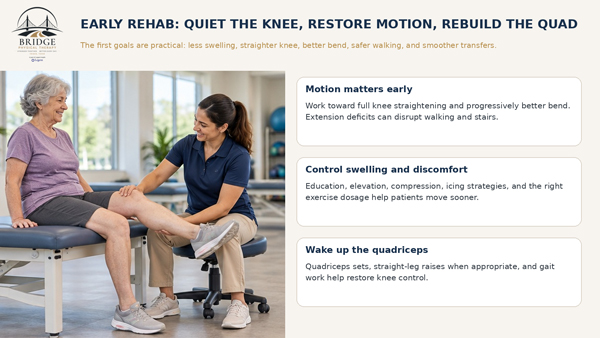
In the first days and weeks after surgery, the major priorities are swelling control, pain management, safe walking, and restoration of motion. Full knee extension deserves special attention. If the knee does not straighten well, patients often walk with the knee slightly bent, which increases energy demand and can make the whole recovery feel less stable. Knee bending matters too, because it affects sitting, getting into a car, and navigating stairs.
Physical therapy during this phase may include education, icing and compression strategies, elevation, heel slides, quadriceps activation work, gait training, and gentle transfer practice. Depending on the surgeon’s plan and the patient’s baseline status, many people are allowed to bear weight early, but the quality of that walking still matters. The goal is not merely to take steps—it is to take better steps.
Phase 2: Rebuild Strength and Normalize Walking
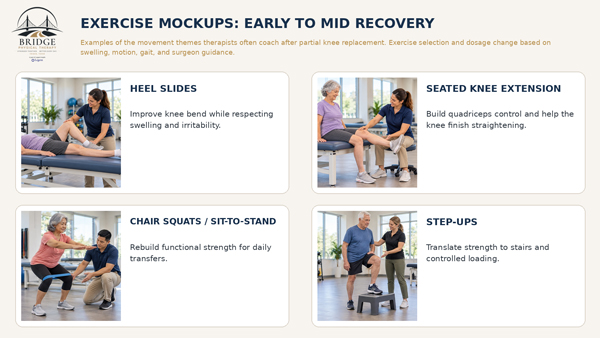
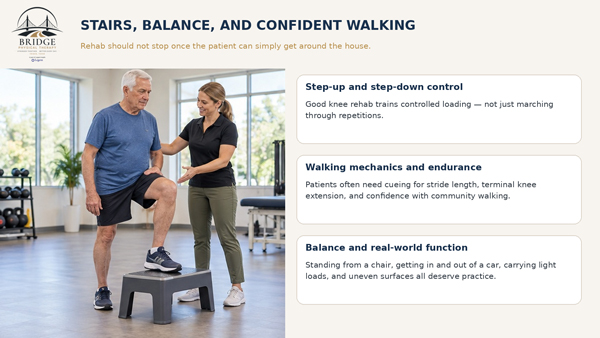
As swelling settles and motion improves, the program usually shifts toward functional strength and gait normalization. Common targets include sit-to-stand ability, step-up control, weight acceptance on the operative leg, balance, and walking endurance. A patient may feel “pretty good” at this stage yet still lack quadriceps control or avoid loading the operated side normally.
This is where coached repetition makes a difference. A therapist can identify subtle compensations—leaning the trunk, shortening the step length, avoiding terminal knee extension, or using momentum instead of strength. Those details are especially important in active adults who want to walk longer distances, travel, golf, or keep up with family life.
Exercise Mockups: What PT Commonly Uses
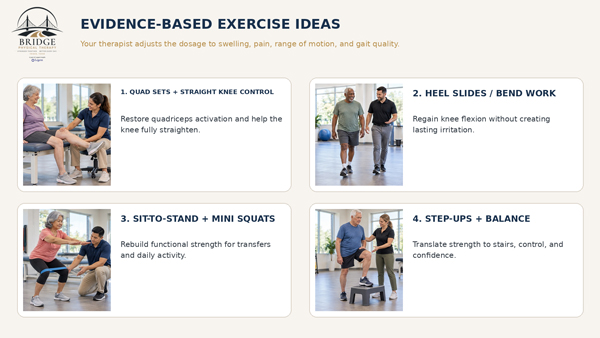
The exact exercise list should fit the patient, the knee, and the surgeon’s guidance, but partial knee replacement programs often progress through recognizable themes. Early work may emphasize heel slides, knee extension, swelling control, and quadriceps activation. As the knee settles down, therapy typically progresses toward functional strengthening, step-up control, balance, and walking tolerance.
What matters most is not collecting a giant home program. It is using the right movements at the right time and progressing them when the knee is ready. At Bridge Physical Therapy, the exercise plan is adjusted to symptoms, motion, walking mechanics, and real-life goals rather than copied from a one-size-fits-all template.
Phase 3: Stairs, Balance, and Real-Life Function
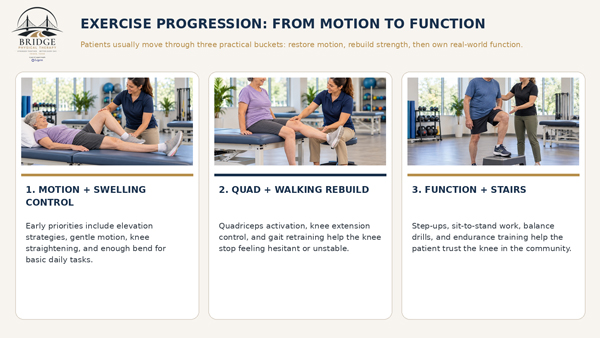
Partial knee replacement patients are often most frustrated not by simple walking on level ground, but by functional tasks such as stairs, stepping down curbs, standing from low seats, pivoting in tight spaces, and carrying items while moving. Good rehabilitation intentionally trains those demands. Step-up and step-down drills, closed-chain strengthening, single-leg control, and balance progressions help restore confidence in the knee.
For some patients, the later phase also includes endurance work, light gym progression, and a guided return to preferred low-impact recreation. The right question is not just “How many weeks out are you?” but “What does your knee let you do well today—and what still feels weak, stiff, swollen, or uncertain?”
Common Problems PT Can Address After Partial Knee Replacement
Persistent swelling, difficulty fully straightening the knee, limited bend, quadriceps weakness, a limp, poor stair tolerance, poor balance, and fear of loading the operated side are all common reasons patients benefit from continued therapy. Some patients also report soreness around the kneecap or along the joint line as activity increases. Often, the answer is not to stop moving entirely but to adjust the exercise dose, refine technique, and progress more intelligently.
Patients should also know the red flags that deserve medical attention rather than just more exercise: worsening calf swelling, chest pain, shortness of breath, fevers, wound drainage, or severe escalating pain that seems disproportionate to normal postoperative soreness. PT is part of the recovery team, not a substitute for surgical follow-up.
How Long Does Recovery Take?
Many partial knee replacement patients regain basic walking earlier than total knee replacement patients, and some progress very quickly. Even so, recovery still happens in phases. The first two weeks are usually about settling the knee. The next month often emphasizes motion, gait, and basic strength. The six-to-twelve-week period is commonly where patients notice meaningful gains in endurance, stairs, and everyday function. Higher-level activity can continue to improve for months.
The key is that a fast recovery should still be a controlled recovery. Being ahead of schedule is great. Flare-ups from doing too much, too fast are less great. The best rehabilitation plans preserve momentum without feeding frustration.
Why Bridge Physical Therapy in Frisco?
Bridge Physical Therapy serves patients in Frisco and the broader Dallas–Fort Worth area who want postoperative care that is practical, evidence-aware, and coordinated with surgical expectations. After partial knee replacement, patients do not need generic knee exercises thrown at them. They need a plan that matches the operation, the person, and the actual functional goals that matter at home and in the community.
If you are looking for physical therapy after partial knee replacement in Frisco, Texas, the most useful next step is an evaluation that documents swelling, range of motion, gait, quadriceps function, stairs, balance, and the activities you are trying to get back to. From there, the program becomes specific—not generic.
Frequently Asked Questions
How is physical therapy after partial knee replacement different from PT after total knee replacement?
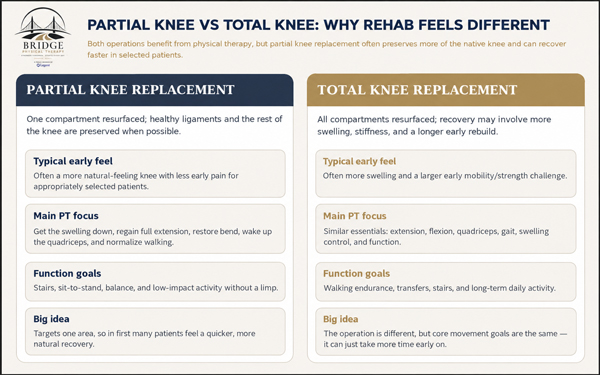
The priorities overlap—swelling control, range of motion, quadriceps strength, gait, and stairs—but many partial knee patients progress faster early and often report a more natural-feeling knee. The therapy plan should still be individualized instead of assuming that “faster” means “no rehab needed.”
When should I start PT after a partial knee replacement?
That depends on your surgeon’s plan, but rehabilitation commonly begins very early after surgery. The first visits usually focus on walking, knee motion, swelling control, and quadriceps activation.
What exercises are commonly used after a partial knee replacement?
Typical exercises include quadriceps sets, straight-leg raises when appropriate, heel slides, sit-to-stand drills, step-ups, balance work, and progressive closed-chain strengthening. The right exercise dose depends on swelling, pain response, and movement quality.
How long does it take to recover from a partial knee replacement?
Many patients recover basic mobility relatively quickly, but full recovery is still a process. Early motion and walking often improve over the first several weeks, while strength, stairs, endurance, and confidence can continue to improve for months.
Can I return to golf, travel, or exercise after a partial knee replacement?
Many patients return to low-impact activity, travel, and recreation after partial knee replacement. The timing depends on healing, strength, walking quality, balance, and surgeon clearance. A therapist can help build a staged return instead of guessing.
Is swelling normal after partial knee replacement?
Yes—some swelling is expected. The goal is not zero swelling immediately, but a trend toward less swelling and better function. Persistent or worsening swelling, especially with calf pain or systemic symptoms, should be discussed with your medical team.
References and Further Reading
- Jenkins C, Minns Lowe C, Barker KL. Early post-operative physiotherapy rehabilitation after primary unilateral unicompartmental knee replacement: a systematic review. Physiotherapy. 2023;118:39-53. PMID: 36257840. https://pubmed.ncbi.nlm.nih.gov/36257840/
- Seeber GH et al. Effectiveness and therapeutic validity of physiotherapeutic exercise starting within one year following total and unicompartmental knee arthroplasty for osteoarthritis: a systematic review. Clin Rehabil. 2023. PMID: 36991323. https://pubmed.ncbi.nlm.nih.gov/36991323/
- Waldstein W et al. Sport and physical activity following unicompartmental knee arthroplasty: a systematic review. Knee Surg Sports Traumatol Arthrosc. 2017;25(3):717-728. PMID: 27209192. https://pubmed.ncbi.nlm.nih.gov/27209192/
- Jassim SS et al. Return to sport post-knee arthroplasty: an umbrella review for consensus guidelines. Bone Jt Open. 2022. PMID: 35300532. https://pubmed.ncbi.nlm.nih.gov/35300532/