
If you have ever heard a patient describe an Achilles rupture, the story is often remarkably similar: a sudden pop, a sharp pain in the back of the ankle, and the feeling that somebody kicked them from behind. It commonly happens during basketball, pickleball, tennis, soccer, running, or a quick change of direction. Many patients assume surgery is the only way back. In reality, for appropriately selected acute Achilles tendon ruptures, non-operative treatment can work very well — but the success of non-operative care depends heavily on following a structured, evidence-based rehabilitation protocol.
That point matters. The difference is not simply “boot versus surgery.” The real differentiator is whether the patient is managed with modern functional bracing, protected loading, and progressive physical therapy instead of a generic, overly cautious, prolonged immobilization strategy. At Bridge Physical Therapy in Frisco, we focus on the evidence, the timeline, and the milestones that matter. Our goal is not just to help the tendon heal. Our goal is to help the patient heal at the right length, restore strength, regain confidence, and return safely to work, exercise, and sport.
Why non-operative treatment works
The old narrative was that non-operative care automatically meant a weaker result and a much higher risk of re-rupture. That is not how the modern literature reads when a functional rehabilitation protocol is used. Several high-level studies changed the conversation. Twaddle and Poon demonstrated that early motion is a major driver of outcome and that surgery is not the only route to a good result. Willits and colleagues later published a landmark multicenter randomized trial using accelerated functional rehabilitation and showed that operative and non-operative groups had similar functional outcomes when both followed a structured rehab pathway. Nilsson-Helander and colleagues also compared surgical and non-surgical care with early mobilization and reinforced the idea that early functional treatment is central to recovery.
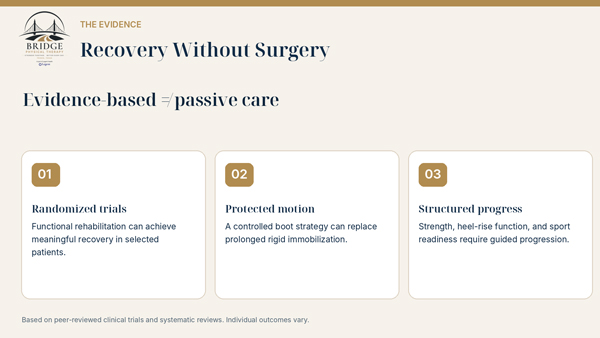
More recently, the UKSTAR trial showed that functional bracing is a safe and effective option for non-operative management and that it performs at least as well as plaster casting for many patients. Systematic reviews and meta-analyses have reached a similar conclusion: early functional rehabilitation, including functional bracing and progressive loading, performs at least as well as prolonged non-weight-bearing immobilization for many patients treated without surgery. In short, non-operative care is not “doing nothing.” Done correctly, it is an active treatment strategy built around tendon protection, progressive loading, gait restoration, and calf recovery.
What makes this protocol different
The biggest mistake in non-operative Achilles care is treating every rupture as though the only goal is to avoid motion. Early healing matters, but so do tendon length, calf capacity, and restoration of normal movement. If a patient is immobilized for too long, deconditions heavily, and loses tendon stiffness and calf strength, the tendon may heal but the function may lag badly. Evidence-based rehabilitation recognizes that reality.
A modern non-operative program is built around a few principles. First, the tendon is protected early in plantarflexion so the torn ends can approximate. Second, the patient is usually moved into a functional boot with heel wedges rather than kept immobilized indefinitely in a cast. Third, weight bearing and motion are progressed carefully and intentionally instead of being ignored until late in the process. Fourth, calf strengthening, balance, and criteria-based return to running are emphasized, because the final outcome depends on more than simply closing the gap.
This is why many general protocols fall short. They may tell patients to “go to PT” but fail to provide a detailed progression. At Bridge, we believe the protocol should be explicit, time-based early, and criteria-based later.
Who is a good candidate for non-operative care?
Non-operative management is typically considered for appropriately selected acute midsubstance Achilles tendon ruptures, especially when the tendon ends approximate well in plantarflexion and the patient can follow a structured rehabilitation program. Patient goals, age, activity demands, medical history, timing from injury, gap characteristics, and surgeon preference all matter. Some patients may still be better served with surgery, especially when there is a delayed presentation, poor tendon apposition, a complex tear pattern, or other factors that make non-operative healing less reliable.
That is why every protocol must be individualized. The treating orthopaedic specialist determines whether non-operative treatment is appropriate. Physical therapy then helps execute that plan with precision.
Peer-reviewed non-operative Achilles rehabilitation protocol
Below is a practical evidence-based framework drawn from the peer-reviewed literature and from the modern functional rehabilitation concepts that have shown good results. Exact timelines can vary by surgeon and patient response, but the overall progression is consistent with the best available evidence.
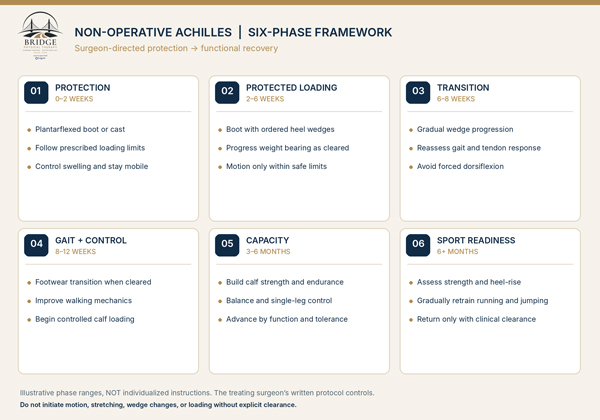
Phase 1: Day 0 to Week 2 — Protection and tendon approximation.
The priority is to protect the rupture while it starts to heal. The ankle is usually immobilized in plantarflexion in a cast or, more commonly, a functional boot with heel wedges. Weight bearing is often allowed in a protected manner depending on the treating specialist. Physical therapy priorities include education, swelling control, pain management, safe gait with assistive devices, maintenance of knee and hip strength, proximal conditioning, and avoidance of dorsiflexion stretch. The patient should not be stretching the Achilles in this phase.
Phase 2: Weeks 2 to 6 — Functional bracing and early protected loading.
The patient continues in the boot with heel wedges. Weight bearing is progressed as tolerated under the specialist’s protocol. Heel wedges are gradually reduced, often one wedge every one to two weeks. Gentle active motion is typically introduced within protected limits, commonly to neutral but not beyond neutral. Therapy focuses on swelling control, maintaining lower-extremity function, gentle activation, safe mobility, and preserving overall conditioning without placing the healing tendon at risk.
Phase 3: Weeks 6 to 8 — Transition phase.
By this point, many patients are transitioning toward full weight bearing with fewer or no wedges, again depending on the treating specialist. The PT emphasis shifts toward restoring a more normal walking pattern, improving active control, and beginning more functional strengthening. This phase is critical: too little progression leaves the patient weak and stiff, while too aggressive a progression can irritate the tendon or risk elongation.
Phase 4: Weeks 8 to 12 — Gait restoration and early strengthening.
Patients are commonly weaned from the boot into a supportive shoe, sometimes with a small heel lift early in the transition. Therapy priorities include gait retraining, progressive calf activation, lower-extremity strengthening, balance work, and restoration of functional mobility. Double-leg calf work, seated calf strengthening, controlled step activities, and progressive balance drills are often appropriate. The major goal is to move from “protected healing” to “restored function” without overloading the tendon too quickly.
Phase 5: Months 3 to 6 — Strength, balance, and tendon capacity.
This is where many patients feel better, but they are not done. True recovery requires rebuilding calf strength, tendon capacity, balance, and lower-extremity power. Progressive strengthening advances from double-leg work toward single-leg work as tolerated. Eccentric and concentric loading, stair training, uneven-ground control, step-down work, and more challenging balance tasks all come into play. If the patient wants to run, jump, or return to sport, this phase is where the foundation is built.
Phase 6: After 6 months — Return to running and return to sport.
Return to running, jumping, and cutting should be criteria-based, not simply calendar-based. The patient should demonstrate acceptable pain levels, improved calf strength, better limb symmetry, good movement quality, and confidence. Sport-specific progressions then follow. Some patients may return sooner and some later, but the best outcomes are seen when progression is driven by function instead of impatience.
What physical therapy should focus on
Physical therapy after a non-operative Achilles rupture is not just about generic ankle exercises. The most important goals are to protect tendon healing early, minimize avoidable stiffness and deconditioning, restore normal gait, rebuild plantarflexion strength, improve balance and proprioception, and gradually return the patient to sport or higher-demand activity.
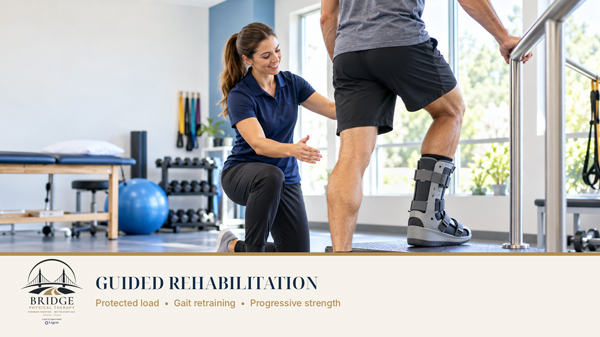
That means the rehab plan should evolve over time. Early on, the focus is protection, swelling control, education, and safe loading. Later, the focus becomes gait mechanics, calf function, and lower-extremity kinetic chain control. Still later, the emphasis turns to tendon capacity, running mechanics, jumping, and sport-specific demands.
At Bridge Physical Therapy in Frisco, we also pay attention to what often gets missed: hip and trunk control, symmetry of movement, confidence under load, and realistic return-to-sport decision making. Achilles recovery is never just local tissue healing. It is whole-limb and whole-athlete recovery.
How long does recovery take?
Patients understandably want a date on the calendar, but Achilles recovery is best understood in phases. Protected walking in a boot may begin early depending on the treating physician. Boot weaning often occurs around the 8- to 10-week range, though it varies. More normal walking typically continues to improve over the next several weeks. A gradual running progression often does not begin until later in recovery, frequently in the 4- to 6-month range once strength and control criteria are met. Higher-level cutting, jumping, and sport participation often require 6 to 9 months or more, and some patients continue to notice gains up to a year.
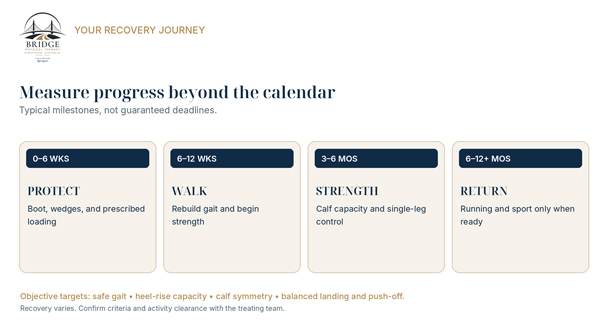
The important message is this: non-operative care works best when patients do not confuse “feeling better” with “being ready.” Symptoms frequently improve before the tendon and calf are truly ready for high-demand loading.
What are the goals of recovery?
A successful non-operative Achilles program aims to achieve more than tendon continuity. The goals are to allow the tendon to heal at a functional length, restore a normal walking pattern, rebuild calf strength and endurance, improve balance and lower-extremity control, restore confidence, and return the patient to daily life and sport with a lower risk of re-injury.
For some patients, the goal is getting back to recreational exercise. For others, it is competitive sport. For many, it is simply being able to walk, travel, work, and stay active without feeling weak or unstable. The endpoint should be individualized, but the process should still be structured.
Why this matters in Frisco and DFW
Frisco is an active community. Patients here are playing basketball, pickleball, golf, tennis, flag football, lifting weights, running trails, and staying busy with work and family. That makes Achilles rehab especially important. A generic protocol is not enough for an active patient population. Patients need a clear pathway that reflects the literature, matches their goals, and is progressed by therapists who understand both tendon biology and return-to-activity demands.
If you are looking for non-operative Achilles rupture physical therapy in Frisco, Texas, or the greater DFW area, the key question is not simply whether a clinic offers PT. The key question is whether the clinic understands how to execute a true evidence-based functional protocol. That is where outcomes are made.
Conclusion
The bottom line is straightforward: non-operative treatment for Achilles tendon rupture can work, and it can work very well, when the right patient follows the right protocol. The peer-reviewed literature supports functional bracing, early controlled rehabilitation, and progressive loading for appropriately selected patients. The days of assuming that prolonged inactivity is the best non-operative strategy are behind us.
At Bridge Physical Therapy, we use an evidence-based, phase-driven approach to help patients move from protection to strength, from strength to function, and from function back to the activities they care about. If you or a loved one is recovering from a non-operative Achilles rupture in Frisco or the surrounding North Texas area, a structured rehabilitation plan can make all the difference.
FAQ
Can an Achilles rupture heal without surgery?
Yes. For appropriately selected acute Achilles ruptures, non-operative treatment can work very well when paired with a structured functional rehabilitation program.
When should physical therapy start after a non-operative Achilles rupture?
The exact start date depends on the treating specialist, but modern protocols often involve early education, protected loading, and progressive rehab rather than long periods of complete immobilization.
Will I be non-weight-bearing the whole time?
Usually not. Many evidence-based protocols use a functional boot and allow protected weight bearing earlier than older protocols did, but the exact progression depends on the physician’s plan.
How long until I can walk normally again?
Many patients are transitioning out of the boot around 8 to 10 weeks, but a more normal walking pattern can continue improving beyond that. Recovery varies by patient and by protocol.
When can I run or play sports again?
Return to running and sport should be based on strength, function, movement quality, and symptom response — not just time. Running often begins later in recovery, and full sport participation may take 6 to 9 months or longer.
Is non-operative care weaker than surgery?
Not necessarily. Modern studies show that when a structured functional rehabilitation program is used, many patients achieve excellent outcomes without surgery while also avoiding surgical wound-related risks.
Selected Peer-Reviewed References
- Twaddle B, Poon P. Early motion for Achilles tendon ruptures: is surgery important? Am J Sports Med. 2007;35(12):2033-2038. PMID: 17885221.
- Willits K, Amendola A, Bryant D, et al. Operative versus nonoperative treatment of acute Achilles tendon ruptures: a multicenter randomized trial using accelerated functional rehabilitation. J Bone Joint Surg Am. 2010;92(17):2767-2775. PMID: 21037028.
- Nilsson-Helander K, Silbernagel KG, Thomeé R, et al. Acute Achilles tendon rupture: a randomized, controlled study comparing surgical and nonsurgical treatments using validated outcome measures. Am J Sports Med. 2010;38(11):2186-2193. PMID: 20802094.
- Costa ML, Achten J, Parsons NR, et al. Plaster cast versus functional brace for non-surgical treatment of Achilles tendon rupture (UKSTAR): a multicentre randomised controlled trial and economic evaluation. Lancet. 2020. PMID: 32035553.
- Zhao JG, Meng XH, Liu L, Zeng XT, Kan SL. Rehabilitation regimen for non-surgical treatment of Achilles tendon rupture: a systematic review and meta-analysis of randomised controlled trials. J Sci Med Sport. 2021. PMID: 33388266.
- Zhang H, Tang H, He Q, et al. Is early controlled motion and weightbearing recommended for nonoperatively treated acute Achilles tendon rupture? A systematic review and meta-analysis. Orthop J Sports Med. 2021. PMID: 34568502.
- Van der Vlist AC, et al. Accelerated rehabilitation in non-operative management of acute Achilles tendon ruptures: a systematic review and meta-analysis. J Foot Ankle Surg. 2021. PMID: 34400090.
- Holm TL, et al. Systematic review of nonoperative functional protocols for acute Achilles ruptures utilizing a formal rehabilitation protocol showing lowest rerupture rates. J Foot Ankle Surg. 2020. PMID: 32975140.
Clinical note: This article provides general information, not individualized medical instructions. Non-operative Achilles rupture treatment is appropriate only after evaluation by a qualified treating clinician. Follow the written plan for immobilization, heel-wedge changes, weight-bearing, stretching and return to activity. Seek urgent care for new chest pain, shortness of breath or new marked calf swelling, or a concerning new injury.
Clinical Evidence & Publication Release
This article differentiates structured functional rehabilitation from passive immobilization. The studies below do not establish one universally correct wedge-removal schedule or support replacing physician orders. Surgeon and lead PT must approve the exact protocol adopted by Bridge before this page is published.
- Willits et al., JBJS 2010 — multicenter RCT of surgery versus nonoperative treatment with accelerated functional rehabilitation
https://pubmed.ncbi.nlm.nih.gov/21037028/ - Twaddle & Poon, AJSM 2007 — randomized prospective trial of early controlled motion
https://pubmed.ncbi.nlm.nih.gov/17885221/ - UKSTAR, Lancet 2020 — randomized functional-brace versus cast trial
https://pubmed.ncbi.nlm.nih.gov/32035553/ - 2021 RCT systematic review, nonoperative functional rehabilitation strategies
https://pubmed.ncbi.nlm.nih.gov/33388266/ - 2021 systematic review/meta-analysis, controlled early motion and weight-bearing
https://pubmed.ncbi.nlm.nih.gov/34568502/ - 2020 systematic review of detailed nonoperative rehab protocols
https://pubmed.ncbi.nlm.nih.gov/32975140/