

If you have been told you need a meniscus repair or a partial meniscectomy, one of the first questions is usually, “What will physical therapy look like afterward?” The short answer is that both procedures can do very well, but the rehabilitation plan is not the same. Meniscus repair is designed to preserve and heal the meniscal tissue, so rehab is usually slower and more protective. Partial meniscectomy removes unstable torn tissue, so motion and weight bearing often progress faster.
At Bridge Physical Therapy in Frisco, Texas, the goal is not just to get your knee bending again. The goal is to help you walk normally, control swelling, rebuild quadriceps and hip strength, restore balance, and safely return to work, workouts, running, and sport. Whether your surgeon repaired the meniscus or trimmed it, the details of your rehab matter.
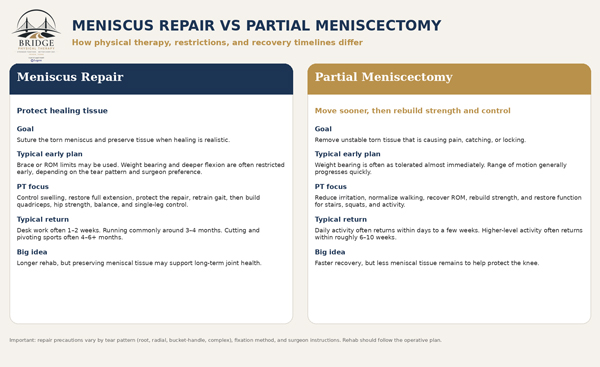
Meniscus Repair vs Meniscectomy: What Is the Difference?
The meniscus is the shock-absorbing cartilage between the femur and tibia. A meniscus repair tries to sew the torn tissue back together so it can heal. This option is commonly chosen when the tear pattern, location, and tissue quality make healing realistic. A partial meniscectomy, by contrast, removes the unstable torn portion that is causing pain, catching, or locking.
This difference in surgical goal drives the difference in physical therapy. After a repair, the therapist has to protect healing tissue while steadily restoring motion and strength. After a meniscectomy, the tissue does not need to biologically heal in the same way, so the patient can usually progress faster. In general, meniscus-preserving surgery is favored when appropriate because keeping functional meniscal tissue may help protect the knee joint over time.
Why Rehab Is More Protective After Meniscus Repair
A repaired meniscus must heal. That means early physical therapy often emphasizes swelling control, pain reduction, restoring full knee extension, and carefully progressing flexion and weight bearing according to the surgeon’s instructions. Depending on the tear pattern, a brace may be used, and deeper knee flexion, pivoting, loaded twisting, or aggressive squatting may be limited during the early phase.
Systematic reviews of isolated meniscus repair rehabilitation show wide variability in protocols. The good news is that early range of motion and appropriately progressed weight bearing do not appear to worsen outcomes in many cases, but there is no single universal protocol. In real-world practice, that means your rehab should be individualized to the exact repair, not copied from a generic template.
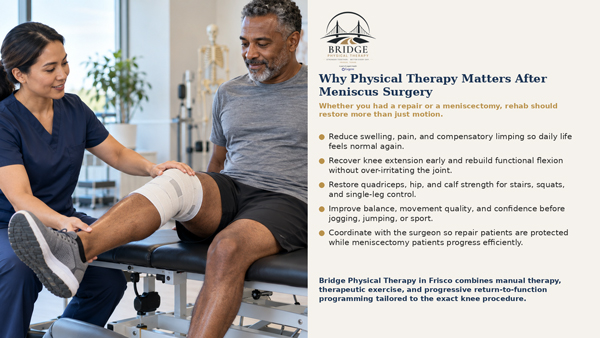
Why Rehab Is Usually Faster After Partial Meniscectomy
After a partial meniscectomy, most patients can bear weight as tolerated relatively quickly and begin moving the knee right away. Physical therapy is still important, because a “small scope” can still leave patients with swelling, quad shutdown, stiffness, poor gait mechanics, and reduced confidence on stairs or with return to exercise.
The faster timeline is one of the biggest differences patients notice. Many people recover daily function within days to a few weeks after meniscectomy, whereas meniscus repair often requires a more patient, staged approach over several months. That faster timeline does not mean rehab should be skipped. Good PT helps restore movement quality so the knee is not simply “less painful,” but truly ready for higher demand.
Physical Therapy After Meniscus Repair: Typical Phases
Phase 1: Protection and Motion
During the first several weeks, physical therapy usually focuses on swelling control, patellar mobility, restoring knee extension, activating the quadriceps, and progressing flexion within allowed limits. Gait training is often needed, especially if crutches or a brace are used. The most common early mistakes are pushing flexion too aggressively, limping, and letting the quadriceps stay inhibited.
Phase 2: Strength and Control
As healing progresses, PT begins building more closed-chain strength, balance, and single-leg control. The exact timing depends on the surgeon’s plan and the tear type, but this phase usually emphasizes bodyweight strength, step work, controlled squatting, and neuromuscular control.
Phase 3: Impact and Return to Sport
Later phases focus on power, running progression, landing quality, agility, and sport-specific movement. A good therapist should not clear return to sport based on the calendar alone. Swelling, range of motion, strength, hop performance, and movement quality all matter.
Physical Therapy After Partial Meniscectomy: Typical Phases
Phase 1: Calm It Down and Normalize Walking
Because patients can usually move sooner, the early emphasis is often on reducing swelling, restoring extension and flexion, and normalizing gait. Many patients benefit from quad activation, straight-leg raises, bike work, and gentle closed-chain exercise almost immediately.
Phase 2: Build Strength Quickly but Cleanly
Once motion is coming back, PT typically progresses to squats, step-ups, balance work, hip strengthening, and functional strengthening. The biggest goal is to restore confidence and movement quality without creating reactive swelling.
Phase 3: Return to Activity
Jogging, jumping, or athletic progression may begin much earlier than after repair, depending on symptoms and exam findings. Many active patients can get back to higher-level activity in a matter of weeks rather than months, but criteria still matter. Good mechanics and adequate strength are key.
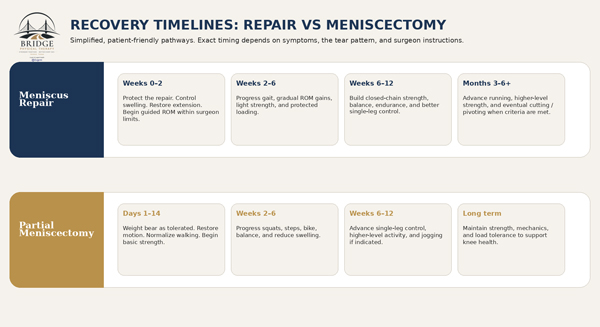
How Long Does Recovery Take?
This is where meniscus repair and meniscectomy separate clearly.
For partial meniscectomy, many patients return to regular daily life quickly, and athletes may return to sport in roughly 7 to 9 weeks, although individual timelines vary.
For isolated meniscus repair, return to sport is usually much later. Systematic reviews report that many patients return somewhere in the range of about 3.3 to 10 months, with many protocols landing around 4 to 6 months or more. A frequently cited average for return to sport after isolated meniscal repair is around 5.6 months.
The key point for patients in Frisco and the broader Dallas–Fort Worth area is this: the “right” timeline depends on what was done in the operating room. Repair patients should not compare themselves with friends who had a meniscectomy, and meniscectomy patients should not assume they need months of unnecessary protection.
Goals of Physical Therapy After Meniscus Surgery
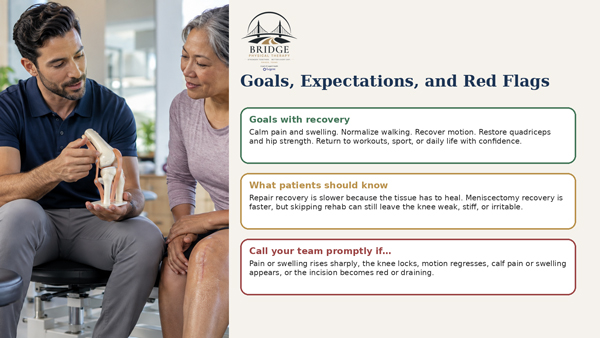
Whether you had a meniscus repair or a partial meniscectomy, high-quality PT should work toward several concrete goals:
- Control pain and swelling.
- Restore full knee extension and functional flexion.
- Normalize walking and stairs.
- Rebuild quadriceps, hamstring, glute, and calf strength.
- Improve balance and single-leg control.
- Progress safely toward running, cutting, pivoting, and sport when appropriate.
- Reduce fear and restore confidence.
At Bridge Physical Therapy, these goals are approached with a combination of hands-on care, therapeutic exercise, movement retraining, and criteria-based progression. That is especially important for athletes and active adults who want to return not just to “some activity,” but to the activity that matters to them.
Why Location-Specific, Surgeon-Directed Rehab Matters
If you are looking for physical therapy after meniscus repair or meniscectomy in Frisco, Texas, you want a team that understands the difference between procedures and communicates clearly with your surgeon. Rehab should reflect the exact operative plan, the tear pattern, your age and goals, and how your knee responds session to session.
That local, surgeon-directed approach is a differentiator. It helps prevent the two extremes patients commonly see online: progressing too fast and irritating the knee, or being held back by a cookie-cutter protocol that is too conservative for the actual procedure.
Frequently Asked Questions
Is meniscus repair better than meniscectomy?
Not automatically. If the tear is repairable, preserving the meniscus is often preferred because it keeps more functional tissue in the knee. But some tears are not good repair candidates. Your surgeon decides based on tear pattern, tissue quality, blood supply, and your goals.
Which recovery is harder?
Meniscus repair usually requires a longer, more restrictive early rehab process. Partial meniscectomy usually has a faster and easier early recovery, but that does not mean PT is optional.
When can I run again?
After meniscectomy, many patients return to impact activity relatively quickly if pain, swelling, and strength allow. After repair, running is usually delayed and introduced in a staged manner once healing and strength benchmarks are appropriate.
When can I return to sports?
Return to sport after meniscectomy may happen in a matter of weeks. After repair, it commonly takes several months. Criteria-based testing is more useful than the calendar alone.
What if my knee swells after PT?
A small amount of post-exercise soreness can be normal. Repeated swelling, sharp pain, loss of motion, or limping usually means the program needs to be adjusted.
The Bottom Line
Physical therapy after meniscus repair versus meniscectomy should not be treated like the same problem. Repair rehab protects healing tissue and usually takes longer. Meniscectomy rehab moves faster but still requires structured work to restore strength, mechanics, and confidence. In both cases, the best outcomes come from a clear surgical plan, a therapist who understands the evidence, and a progression matched to the person in front of them.
If you are looking for meniscus surgery rehab in Frisco, Texas, Bridge Physical Therapy can help guide the process from early recovery through return to sport and full function.
Evidence Notes / References
- Harput G, et al. Rehabilitation following meniscal repair: a systematic review. BMJ Open Sport Exerc Med. 2018.
- O’Donnell K, et al. Rehabilitation Protocols After Isolated Meniscal Repair: A Systematic Review. Am J Sports Med. 2017.
- Grassi A, et al. Return-to-Play and Rehabilitation Protocols Following Isolated Meniscal Repair—A Systematic Review. Arthroscopy Sports Med Rehabil. 2021.
- Kim JG, et al. Return to Sports After Athletes Undergo Meniscal Surgery: A Systematic Review. Clin J Sport Med. 2019.
- AAOS OrthoInfo. Meniscus Repair. Accessed 2026.