


Back surgery is not the end of recovery; it is the point at which recovery changes direction. A lumbar microdiscectomy can relieve pressure on an irritated nerve, while lumbar fusion is designed to stabilize a painful or unstable spinal segment. Both operations may improve quality of life, but they do not have identical healing demands, precautions, or physical therapy schedules.
At Bridge Physical Therapy in Frisco, Texas, the goal after lumbar spine surgery is practical: help patients walk comfortably, move with less fear, rebuild endurance and trunk control, and return to the activities they value. Whether your goal is sitting through a workday, caring for your family, traveling, or getting back to recreation, rehabilitation should follow the operation you actually had—not a generic back-pain exercise sheet.
Understanding the Herniated Disc That Pinches a Nerve
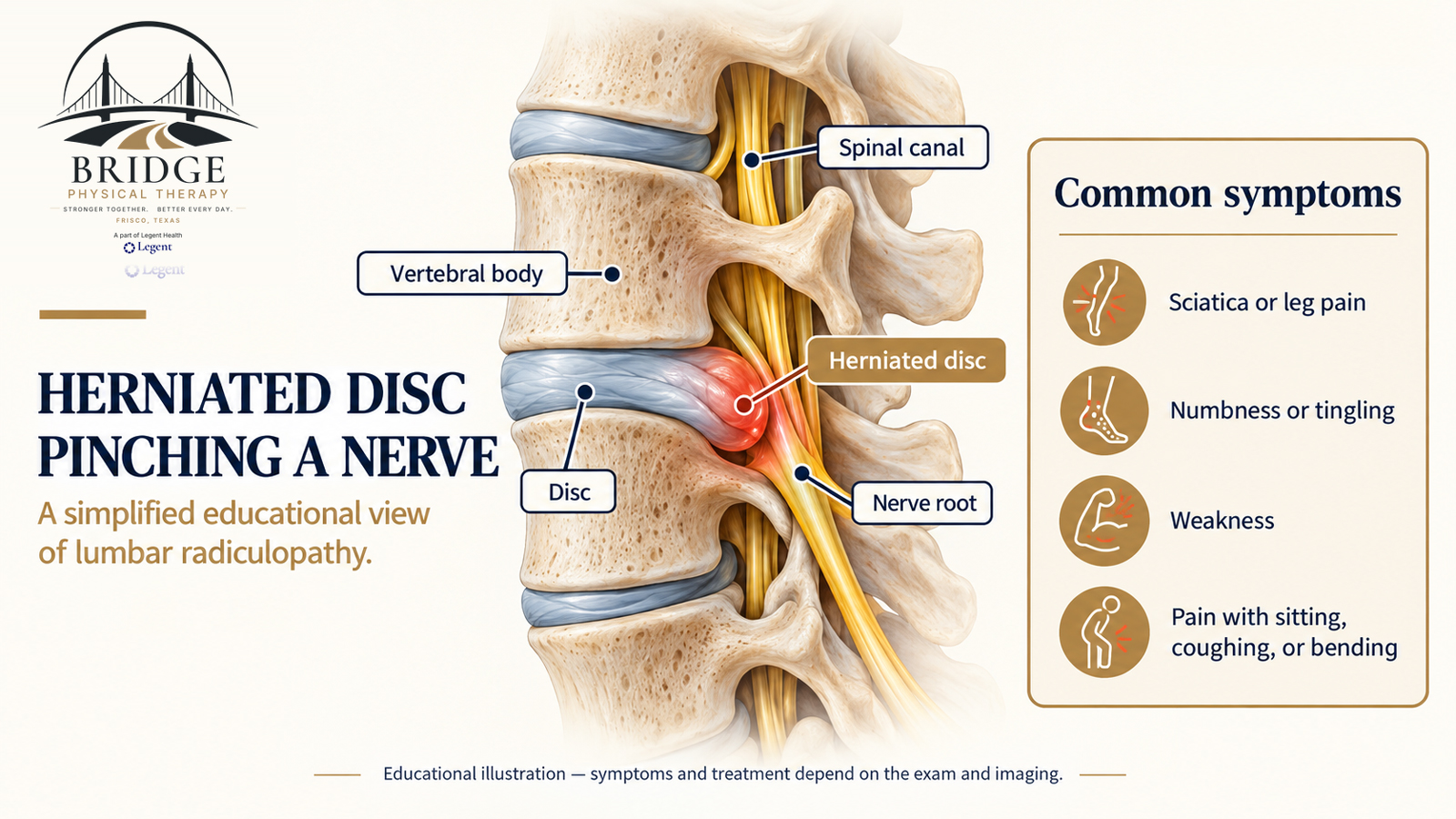
The lumbar spine contains vertebrae separated by discs that help absorb load and allow motion. When disc material protrudes or herniates, it can irritate or compress a nearby nerve root. This may cause sciatica: pain traveling from the lower back or buttock into the leg, sometimes accompanied by tingling, numbness, or weakness. Not every disc herniation requires surgery, and symptoms must be interpreted alongside a clinical examination and imaging.
When surgery is appropriate, microdiscectomy removes the offending disc fragment to reduce nerve compression. Leg pain may improve promptly, but irritated nerves can take longer to recover. Numbness or weakness may resolve slowly or incompletely; a favorable surgical result does not mean every symptom disappears on the day of the operation.
Microdiscectomy vs. Lumbar Fusion: Why Rehabilitation Is Different
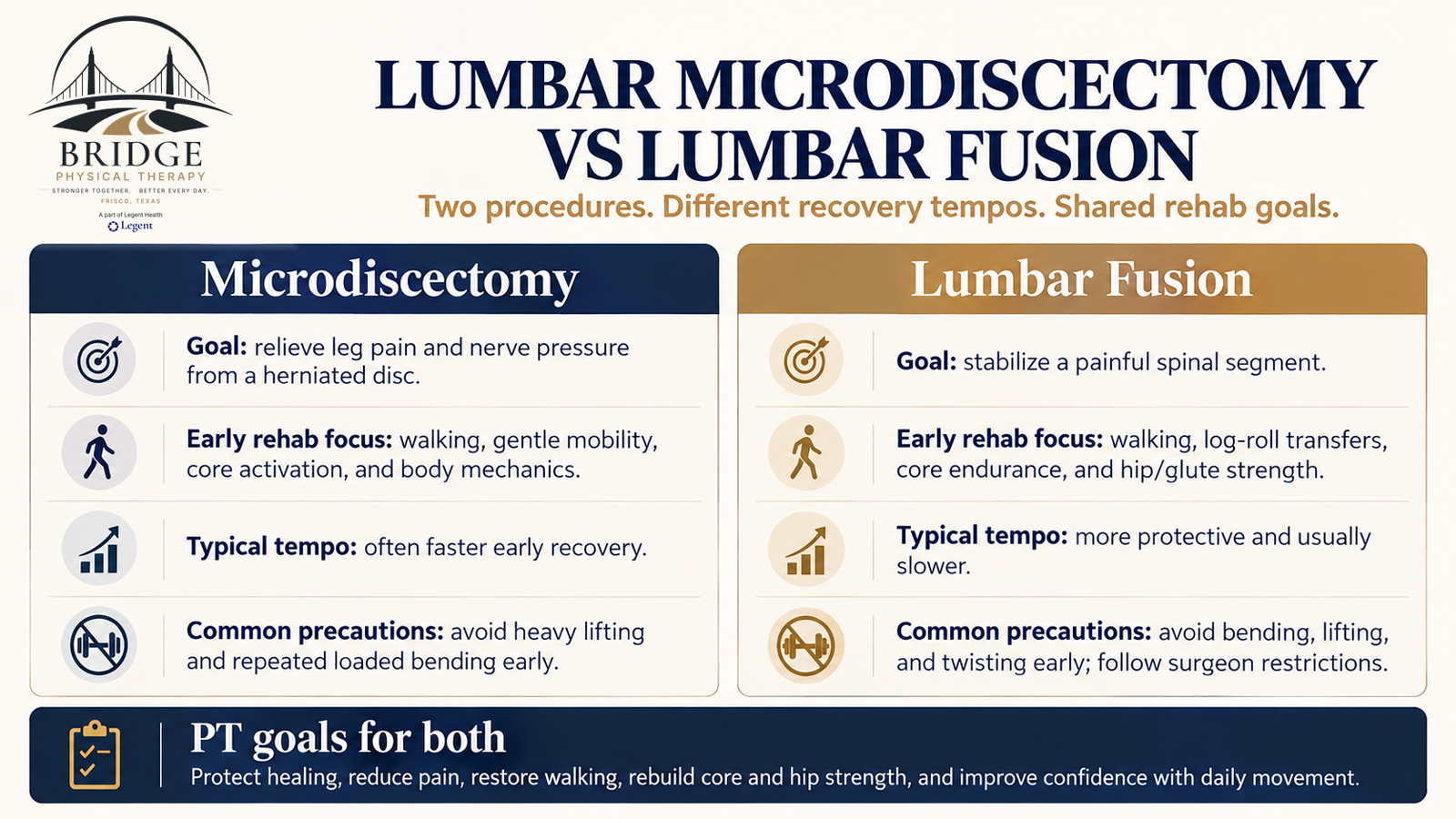
Microdiscectomy is primarily a decompression operation. Its principal goal is to relieve radiating leg symptoms by removing disc material pressing on a nerve. Because a fusion is not being constructed, many uncomplicated microdiscectomy patients resume ordinary movement and walking relatively quickly, with exercise advanced according to symptoms and surgeon guidance.
Lumbar fusion is a stabilization operation. It may be used for selected cases of instability, deformity, spondylolisthesis, or other conditions in which joining vertebrae is expected to address the underlying problem. Fusion relies on the healing of bone across the operated segment. Hardware may support the spine while that process occurs, but it does not make unrestricted loading appropriate immediately.
That distinction changes the therapy conversation. Microdiscectomy recovery often prioritizes gradual reconditioning and nerve-symptom monitoring. Fusion recovery gives greater weight to protecting healing structures, gradually increasing tolerated activity, and waiting for surgeon clearance before heavier strengthening, bending, or lifting.
What Does the Peer-Reviewed Evidence Support?
Research supports active rehabilitation after lumbar disc surgery, although no single exercise sequence is superior for every patient. A 2025 synthesis of 55 randomized controlled trials involving more than 4,300 patients found that postoperative physical therapies generally improved pain and function. A separate 2025 meta-analysis also reported benefits of exercise after lumbar disc herniation surgery. These findings support progressive movement—not aggressive training through pain. [1,2]
Routine activity restrictions after an uncomplicated microdiscectomy have also been questioned. A randomized study published in 2026 found no significant one-year outcome difference between restricted and unrestricted activity groups. That does not eliminate individualized precautions, particularly for complicated procedures or patients with new neurological findings; the operating surgeon’s instructions still govern. [6]
Fusion is more nuanced. A 2022 meta-analysis of 18 randomized trials found low-certainty, short-term benefits from exercise and additional gains from combining exercise with behavioral approaches, while long-term superiority was less certain. A 2023 review highlighted inconsistent timing recommendations, with many structured programs beginning around two to three months depending on the operation and surgeon. A consensus pathway supports education, early mobilization, and individualized rehabilitation, but consensus is not the same as definitive trial evidence. [3–5,7]
Physical Therapy After Lumbar Microdiscectomy
Early recovery usually begins with short, frequent walks, comfortable position changes, and instruction in everyday movement. Many patients benefit from pacing their sitting, learning to get out of bed without unnecessary twisting, and increasing walking distance gradually. A therapist can screen for persistent leg symptoms, gait changes, deconditioning, or weakness and communicate concerning findings to the surgical team.
When cleared, treatment progresses toward low-load abdominal control, hip strength, endurance, and functional movement. Return to work depends on job demands: desk-based work, prolonged driving, repetitive bending, and heavy lifting create different challenges. The goal is confident function, not achieving a specific exercise on a predetermined date.
Symptoms that travel farther down the leg or progressively worsen after activity deserve reassessment. Mild postoperative discomfort is common, but increasing neurological symptoms should never be dismissed as a normal part of “working through” therapy.
Physical Therapy After Lumbar Fusion
Following a fusion, early priorities generally include walking, safe transfers, sleep positioning, posture, and understanding restrictions related to bending, lifting, and twisting. Some surgeons prescribe a brace; others do not. The need for a brace, the permitted activity level, and the timing of formal outpatient therapy depend on the specific approach, number of levels, bone quality, and postoperative course.
Patients may feel better before the fusion has healed enough to tolerate more challenging exercise. Therapy should therefore progress with the surgeon’s plan, not just the patient’s pain score. As clearance is granted, rehabilitation can address trunk endurance, hip and gluteal strength, balance, walking tolerance, and safe lifting mechanics. Return to demanding physical work often requires a longer progression than return to everyday self-care.
For both procedures, skilled rehabilitation is most valuable when it identifies actual barriers—persistent weakness, poor walking endurance, fear of movement, or difficulty with stairs—and uses a realistic home program to address them.
Evidence-Based Exercise Categories After Lumbar Spine Surgery
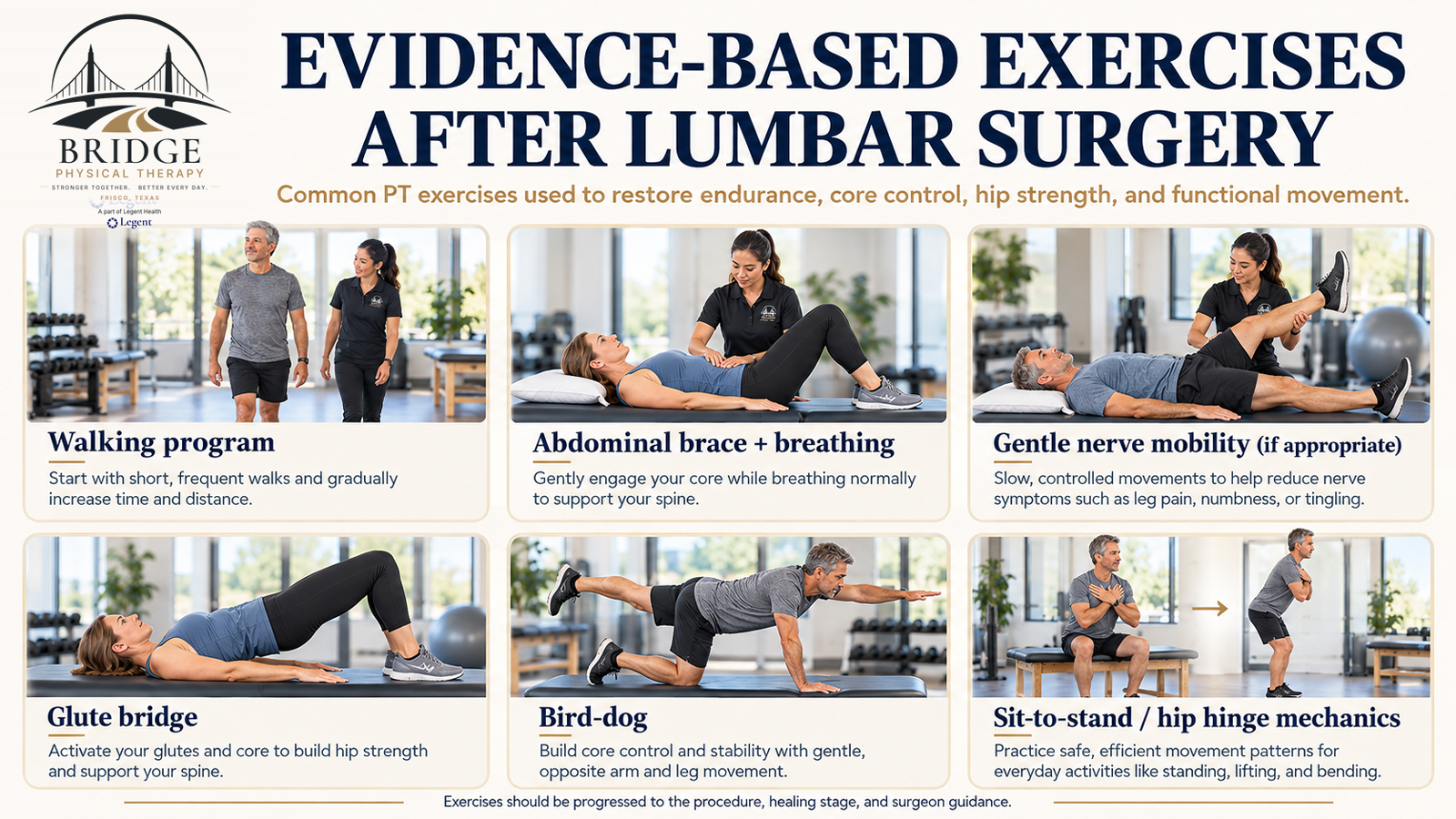
Walking: Short, tolerable walks with gradual increases in time or distance are a practical early cornerstone. Walking supports conditioning and promotes independence without requiring advanced spinal loading.
Gentle abdominal bracing with relaxed breathing: Once permitted, low-load trunk activation helps patients regain control without holding their breath or forcing lumbar motion. Quality matters more than the number of repetitions.
Hip and gluteal strengthening: Exercises such as supported sit-to-stands, step-ups, and later bridging can help rebuild strength for climbing stairs and getting out of a chair. After fusion, bridges and other exercises that load the lumbar area belong in the later, surgeon-cleared progression.
Bird-dog and controlled hip-hinge practice: These can train coordination and functional movement in appropriately selected patients after sufficient healing. They are not automatic exercises for the first few postoperative weeks.
Neural mobility when indicated: Gentle nerve movement may occasionally be selected for persistent symptoms after decompression, but evidence is inconsistent and aggressive stretching of an irritated nerve can aggravate pain. Neural mobilization is not a universal requirement after microdiscectomy or fusion. [1]
The exercise graphic is educational, not a prescription. A therapist should choose the exercise, starting load, frequency, and progression based on surgical clearance, neurological status, symptoms, and function.
Typical Phases of Recovery: A Roadmap, Not a Countdown
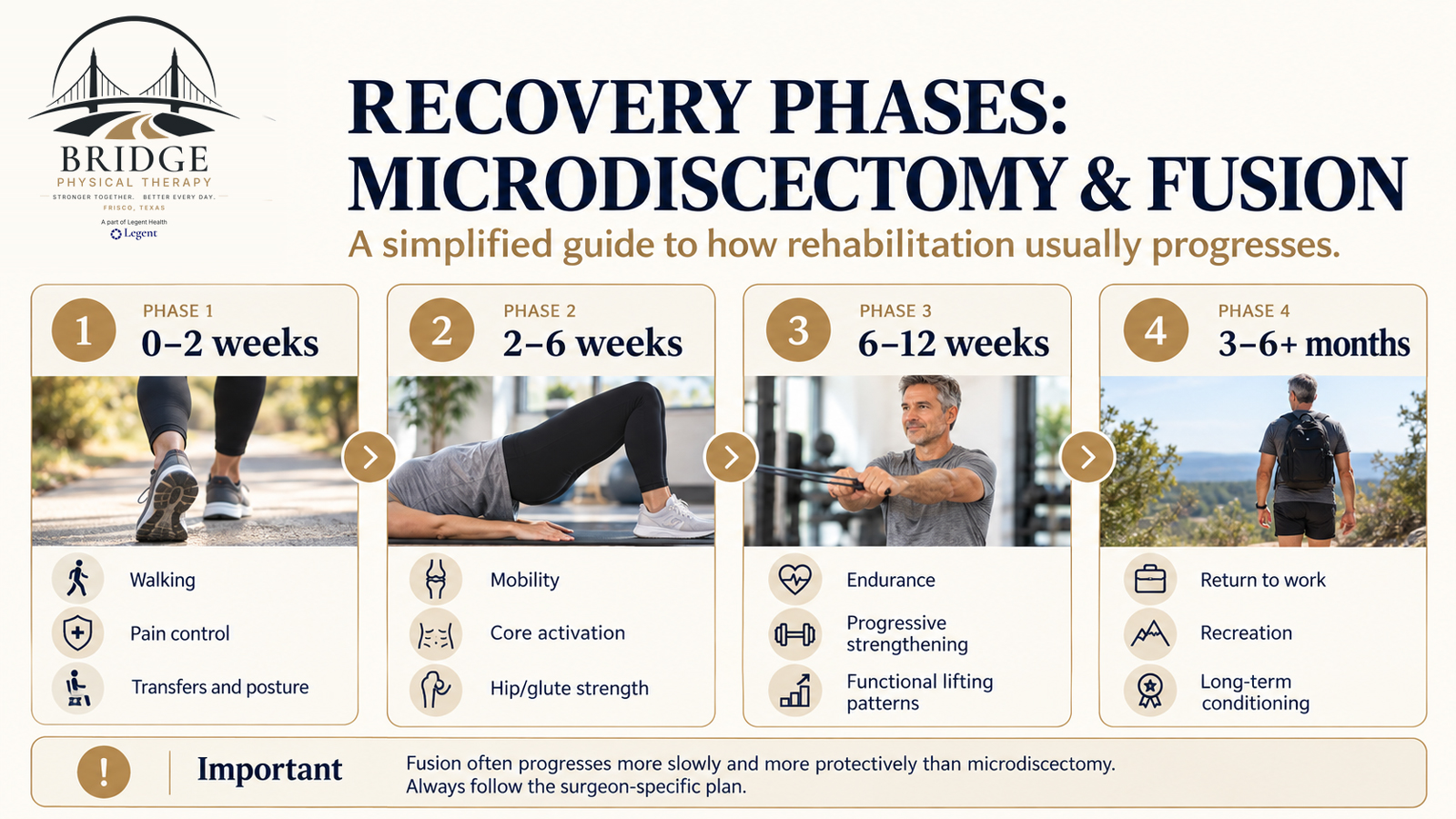
In the first days to weeks, both groups generally emphasize walking, pain control, safe transfers, and learning their individual restrictions. After an uncomplicated microdiscectomy, some patients begin more formal graded strength and conditioning in the ensuing weeks, often around the four-to-six-week period when cleared. After fusion, formal progressive strengthening may begin later, frequently around eight to twelve weeks or beyond, depending on healing and surgeon preference.
Over subsequent months, therapy can build endurance and control for work, lifting, travel, and recreation. The timeline graphic offers broad recovery categories, not identical phases or permissions for both operations. A patient who underwent a multilevel fusion, revision, or experienced neurological complications may follow a substantially different course. [4,5,7]
When Should You Call Your Surgeon?
New or progressive leg weakness, rapidly increasing radiating pain, fever, incision drainage, or a major change in sensation should prompt contact with the surgical team. New difficulty controlling the bladder or bowels, new saddle numbness, or severe rapidly progressive neurological deficits require emergency evaluation. Chest pain or shortness of breath is also an emergency.
These concerns are medical issues, not problems to solve by increasing exercise intensity. Physical therapy should remain coordinated with the surgeon throughout recovery.
Why Choose Bridge Physical Therapy in Frisco?
Patients recovering from microdiscectomy or fusion need a rehabilitation plan matched to their operation, current function, and personal goals. At Bridge Physical Therapy, our goal is a clear, patient-friendly progression focused on walking, trunk and hip function, safe daily movement, and a sustainable return to activity.
If you are looking for physical therapy after lumbar spine surgery in Frisco, Texas, request an evaluation and bring your surgeon’s postoperative orders. The right next step begins with knowing what was done, what has healed, and what you want to do again.
Frequently Asked Questions
When should I start physical therapy after lumbar microdiscectomy?
Walking and basic safe movement often begin shortly after surgery. A supervised strengthening program may be added in the following weeks when the surgeon allows it. Timing depends on symptoms, the operation, and individual restrictions.
When can I start PT after lumbar fusion?
Walking usually begins early, but formal progressive strengthening may be delayed for several weeks or months to respect the fusion process. The operating surgeon should determine the start date and lifting precautions.
Will physical therapy help sciatica after microdiscectomy?
Physical therapy can help restore walking, strength, endurance, and confidence. Nerve symptoms sometimes improve gradually, and worsening pain, numbness, or weakness must be discussed with the surgical team.
Are core exercises safe after spinal fusion?
Selected low-load activation may be appropriate when cleared. Higher-load movements such as bridges, bird-dog, and lifting-pattern exercises should be introduced only at the appropriate healing stage, not automatically during the early weeks.
How long does recovery take after microdiscectomy compared with fusion?
Many uncomplicated microdiscectomy patients regain everyday function faster. Fusion generally has a longer biological healing process, and improvements can continue over many months. Neither procedure has a guaranteed recovery timetable.
What should I avoid after lumbar surgery?
Restrictions vary. Your surgeon may limit lifting, repeated bending, twisting, or strenuous activity for a period of time, especially after fusion. Follow your specific postoperative plan rather than generic internet restrictions.
To discuss a personalized recovery plan in Frisco, Texas, request an evaluation with Bridge Physical Therapy and bring your surgeon’s postoperative instructions.
References and Further Reading
- Brotis AG, et al. Physical therapies after surgery for lumbar disc herniation: Evidence synthesis from 55 randomized trials. Brain Spine. 2025. PMID: 40165991. https://pubmed.ncbi.nlm.nih.gov/40165991/
- Jin H, et al. Effects of Exercise on Pain and Disability After Lumbar Disc Herniation Surgery: A Systematic Review and Meta-analysis of Randomized Controlled Trials. Am J Phys Med Rehabil. 2025. PMID: 39774110. https://pubmed.ncbi.nlm.nih.gov/39774110/
- Rehabilitation to improve outcomes of lumbar fusion surgery: A systematic review with meta-analysis. 2022. PMID: 35258644. https://pubmed.ncbi.nlm.nih.gov/35258644/
- Rehabilitation after cervical and lumbar spine surgery: A review. 2023. PMCID: PMC10441252. https://pmc.ncbi.nlm.nih.gov/articles/PMC10441252/
- Best practice rehabilitation pathway for the management of single- and double-level lumbar fusion surgery: A modified Delphi study. 2023. PMCID: PMC10272932. https://pmc.ncbi.nlm.nih.gov/articles/PMC10272932/
- Lumbar Microdiscectomy and Postoperative Activity Restrictions: A Randomized Controlled Trial. Spine. 2026. PMID: 42023774. https://pubmed.ncbi.nlm.nih.gov/42023774/
- Unveiling Timetable for Physical Therapy after Single-Level Lumbar Surgery: Systematic Review and Meta-Analysis. J Clin Med. 2024;13:2553. PMID: 38731082. https://pubmed.ncbi.nlm.nih.gov/38731082/