


You have a new hip. Now the goal is to make the most of it. For many adults in their 60s, 70s, and 80s, success after total hip replacement is not measured by how quickly they return to a gym. It is measured by walking comfortably through the grocery store, getting out of a favorite chair, climbing the stairs safely, enjoying a family trip, or keeping up with the grandchildren.
At Bridge Physical Therapy in Frisco, Texas, recovery is centered on those everyday goals. A well-designed rehabilitation plan helps patients regain strength, improve their walking pattern, build balance, and return to independent living at a pace that respects the surgery and the individual.
Why Walking Again Is Only the Beginning
Total hip replacement, also called total hip arthroplasty, replaces the damaged hip joint with artificial components. It is commonly performed for painful arthritis when other treatments have not provided adequate relief. The procedure addresses the painful joint, but muscles weakened by months or years of limping do not instantly recover.
It is common to notice a shorter stride, difficulty standing from a low seat, hesitation on stairs, or reduced endurance after surgery. Rebuilding hip and thigh strength—and relearning efficient movement—helps translate surgical pain relief into meaningful function. The goal is not simply walking more steps; it is walking more confidently and safely.
Your First Steps After Surgery
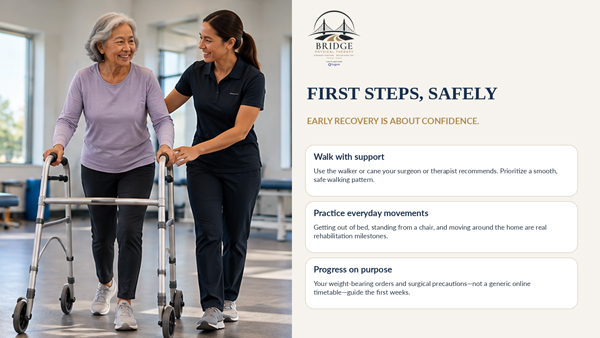
Many patients begin standing and walking with assistance on the day of surgery or the following day, depending on their medical stability and care pathway. Physical therapists and surgical staff help patients practice bed transfers, standing, walking with an appropriate assistive device, and sometimes stairs before leaving the hospital or surgery center.
Your surgeon determines how much weight you may put through the new hip. Many uncomplicated replacements allow weight bearing as tolerated, but that instruction is not universal. A walker or cane is a tool for safe recovery, not a setback. The right time to reduce support is when walking quality, strength, balance, and clinician guidance support it. [1]
Short, frequent walks are often more helpful early than one exhausting outing. It is reasonable to expect fatigue and some soreness, but increasing pain, substantial swelling, dizziness, or a deteriorating walking pattern should prompt a change in activity and a conversation with the care team. Recovery should steadily build capacity, not create a cycle of overdoing it and then spending days recovering.
Hip Replacement Precautions: Anterior vs. Posterior
Patients commonly ask whether an anterior hip replacement heals faster than a posterior one. The surgical approach may influence which movements are limited early, but there is no single set of restrictions that applies to every patient. Some surgeons recommend avoiding certain combinations of hip bending, twisting, or leg crossing; others use fewer routine precautions. Additional procedures or medical factors can change the plan.
Follow the specific written instructions from your surgeon rather than borrowing another patient’s protocol. Bridge therapists can reinforce safe positioning, getting in and out of bed, dressing, and everyday movements while respecting those orders. [2]
Rebuilding Strength for Everyday Independence
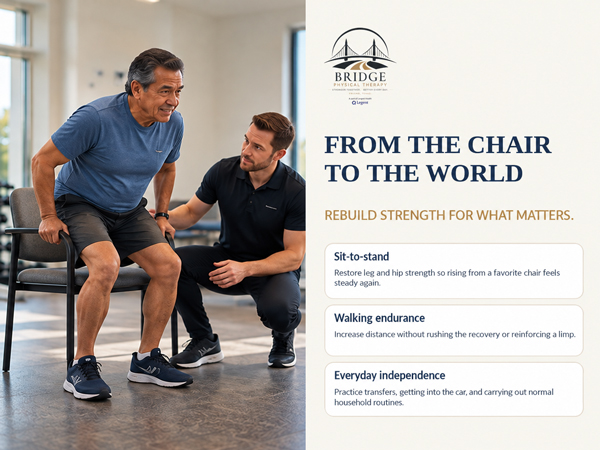
Getting out of a chair, stepping into a vehicle, and walking without a limp all require hip muscles to work together. Rehabilitation commonly progresses from gentle ankle pumps and basic muscle activation to standing exercises, sit-to-stand practice, hip and thigh strengthening, and walking endurance.
The gluteal muscles on the side of the hip are especially important for keeping the pelvis level as you walk. Progressive exercise is helpful when it is challenging enough to build capacity without causing unnecessary pain or swelling. The precise exercise, resistance, and timing should be individualized—not copied from a generic workout video.
A good program also measures what matters. A therapist may assess how you rise from a chair, how far you can walk comfortably, whether your pelvis drops when stepping, or how confidently you change direction. Simple functional reassessments help distinguish normal recovery from lingering weakness or poor movement habits. For an older adult who wants to stay independent, those measures are often more useful than the number of repetitions completed in a therapy session.
Stairs, Balance, and Fall Prevention
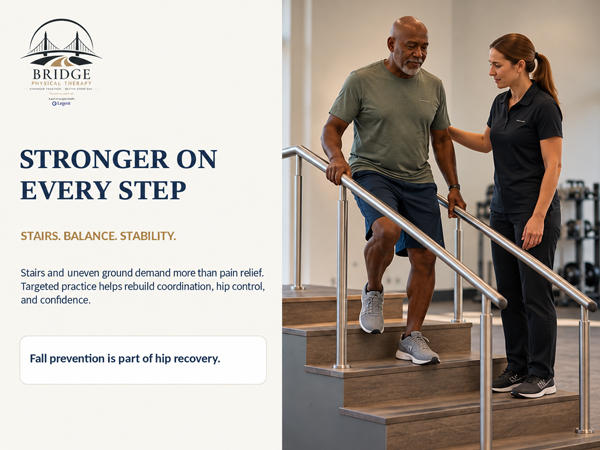
For an older adult, success on stairs can be as important as success on a walking path. Physical therapy addresses handrail use, step sequencing, single-leg control, turning, and the transition from smooth clinic floors to uneven real-world surfaces.
Fall prevention also starts at home. Remove loose rugs and clutter, improve nighttime lighting, use a stable chair with armrests, and consider grab bars or other equipment if recommended. Patients with dizziness, neuropathy, poor vision, or prior falls may need an especially deliberate balance and safety plan. [3]
A Practical Hip Replacement Recovery Timeline
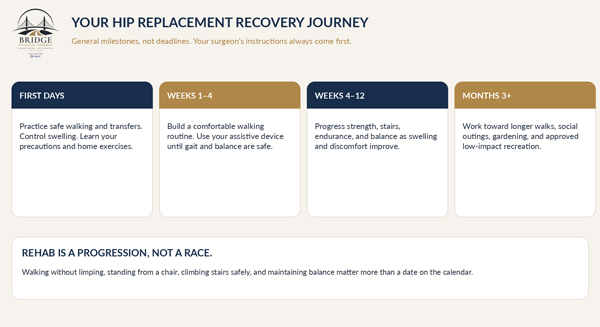
First days: Learn safe walking and transfers, follow wound and swelling instructions, start approved exercises, and use assistance as needed.
Weeks 1–4: Gradually increase comfortable walking, maintain hip precautions when prescribed, and practice everyday movement with an appropriate device.
Weeks 4–12: Many patients build more endurance and progress strengthening, balance, stairs, and community mobility. Your physical therapist adjusts the program to healing and performance.
Three months and beyond: With surgeon clearance, the focus can shift to longer outings, gardening, travel, golf, swimming, or other low-impact activities. Strength, stamina, and confidence may keep improving well beyond this point.
These phases are examples—not deadlines. Age, baseline strength, general health, surgical approach, complications, and support at home all affect the pace of recovery. [4]
Do You Need Outpatient Physical Therapy After Hip Replacement?
Not every patient needs the same rehabilitation setting or number of visits. The American Academy of Orthopaedic Surgeons recognizes both supervised physical therapy and appropriately guided home exercise after hip replacement for osteoarthritis. Some patients who are mobile, confident, and supported at home recover well with a structured independent program.
Outpatient therapy can be particularly useful for persistent limping, weakness, limited endurance, difficulty climbing stairs, balance concerns, or uncertainty about exercise progression. The point is to address deficits that matter to you—not to schedule sessions simply because surgery occurred. [5]
What Does the Peer-Reviewed Evidence Actually Show?
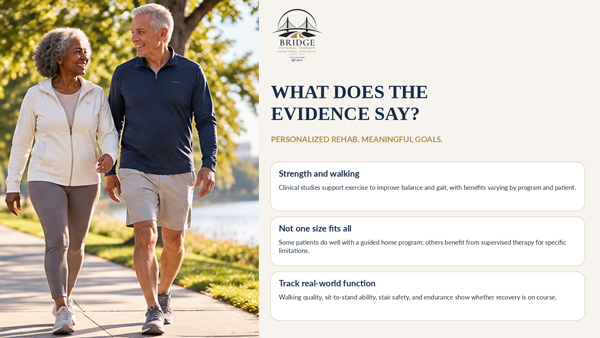
A 2023 systematic review and meta-analysis of randomized studies found that exercise therapy after hip replacement improved balance and gait measures on average. A 2024 randomized trial also found benefits from combining progressive strength work before and after surgery in selected patients.
The evidence is not uniformly favorable for every exercise program or every outcome. A major 2021 review found that additional exercise programs did not consistently improve patient-reported physical function over usual care. More recent analyses suggest benefits may be most apparent in particular strength measures and early recovery. That is why Bridge emphasizes assessment, individualized progression, and functional milestones rather than promising one protocol will work better for everyone. [6] [7] [8]
When to Contact Your Surgical Team
Contact your surgeon promptly for increasing wound redness or drainage, fever, markedly worsening hip pain, or new concerning leg swelling. A painful swollen calf warrants urgent assessment for a possible blood clot. Sudden shortness of breath, chest pain, fainting, or new severe symptoms require emergency medical attention.
Follow your surgeon’s medication, blood-clot prevention, incision-care, and activity instructions. Physical therapy supports recovery; it never replaces postoperative medical supervision. [9]
Physical Therapy After Hip Replacement in Frisco, Texas
At Bridge Physical Therapy, the central question is simple: What would make life easier and more enjoyable again? It may be walking without a cane, shopping without resting, navigating the stairs, visiting family, or getting back to an active retirement. We build rehabilitation around safe movement, measurable progress, and those individual goals.
If you are recovering from total hip replacement in Frisco or North Texas, request an evaluation to discuss how a personalized rehabilitation plan may help you move into your next chapter with more confidence.
Frequently Asked Questions
How soon can I walk after hip replacement?
Many patients begin walking with assistance on the day of surgery or the next day. Your care team determines when it is safe and which assistive device to use.
How long will I need a walker or cane?
There is no fixed timeline. The decision depends on balance, walking quality, pain, strength, and your surgeon’s instructions. Do not rush to discard support if you are limping or unsteady.
Do I need physical therapy if I had an anterior hip replacement?
The surgical approach does not automatically determine whether outpatient PT is needed. Your actual strength, mobility, balance, and functional goals are more useful guides.
When can I climb stairs after surgery?
Many patients practice stairs before discharge if their home requires them. Early stair use should follow the method and assistance level taught by the care team.
When can I drive or travel?
Driving depends on the operated side, medication use, reaction time, physical control, and surgeon clearance. Travel requires planning for comfort and clot prevention; ask your surgeon first.
What exercises help most after hip replacement?
Exercises often include progressive walking, sit-to-stand training, hip and thigh strengthening, and balance work. The best combination depends on your operation, precautions, and current abilities.
Can I return to golf, gardening, or swimming?
Many people return to low-impact interests once healing and strength permit. Your surgeon should approve the timing and movements, especially for swimming while the incision is healing.
To discuss your specific recovery needs, request an evaluation with Bridge Physical Therapy in Frisco, Texas.
Selected peer-reviewed and clinical references
- American Association of Hip and Knee Surgeons (AAHKS). Total Hip Replacement — walking, assistive devices, driving, and therapy. https://hipkneeinfo.org/hip-care/total-hip-replacement/
- American Academy of Orthopaedic Surgeons (AAOS). Activities After Total Hip Replacement — patient-specific precautions. https://www.orthoinfo.org/recovery/activities-after-hip-replacement
- MedlinePlus. Hip replacement — discharge; fall prevention and home safety. https://medlineplus.gov/ency/patientinstructions/000169.htm
- AAOS. Total Hip Replacement Exercise Guide; gradual strength and mobility progression. https://www.orthoinfo.org/recovery/total-hip-replacement-exercise-guide
- AAOS. Management of Osteoarthritis of the Hip Clinical Practice Guideline update; postoperative physical therapy versus home exercise. https://www.aaos.org/aaos-home/newsroom/press-releases/aaos-updates-management-of-hip-osteoarthritis-guideline/
- Park S-J, Kim B-G. Effects of exercise therapy on balance and gait after total hip arthroplasty: systematic review and meta-analysis. J Exerc Rehabil. 2023;19:190–197. PMID 37662528. https://pubmed.ncbi.nlm.nih.gov/37662528/
- Chen G, et al. Pre- and postoperative progressive resistance training after total hip arthroplasty: randomized controlled trial. Clin Interv Aging. 2024;19:745–760. PMID 38736563. https://pubmed.ncbi.nlm.nih.gov/38736563/
- Evaluation of Exercise Interventions and Outcomes After Hip Arthroplasty: systematic review and meta-analysis. 2021. PMID 33635329. https://pubmed.ncbi.nlm.nih.gov/33635329/
- AAOS. Total Hip Replacement — recognizing infection, blood clots, and falls. https://www.orthoinfo.org/treatment/total-hip-replacement/