


Hip arthroscopy is a minimally invasive operation used to treat certain causes of hip and groin pain. Patients often hear terms such as hip labral tear, femoroacetabular impingement (FAI), cam lesion, or hip scope. After surgery, the next question is usually practical: How do I walk normally again, regain strength, and return to the activities I enjoy?
At Bridge Physical Therapy in Frisco, Texas, postoperative rehabilitation is about more than completing exercises. It is about protecting what was done in the operating room, restoring safe movement, rebuilding hip and trunk strength, and progressing toward work, fitness, or sport based on how the patient is actually recovering. The right plan begins with one simple question: What procedure did the surgeon perform?
What Is Hip Arthroscopy—and Why Does Physical Therapy Matter?
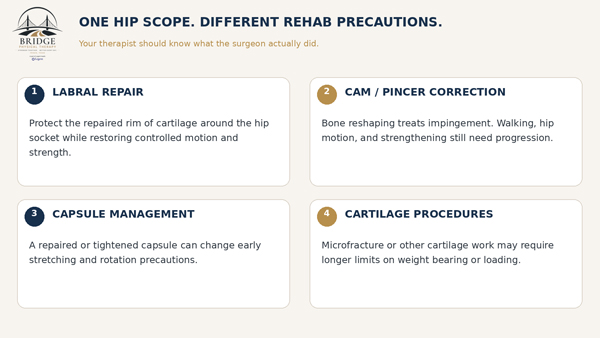
The hip is a ball-and-socket joint. A ring of cartilage called the labrum helps support the socket, while the joint capsule provides additional stability. During hip arthroscopy, a surgeon uses small incisions and a camera to evaluate or treat problems inside the joint. Common procedures include repairing or reconstructing the labrum, reshaping extra bone that contributes to impingement, addressing damaged cartilage, and repairing the capsule.
Surgery may address the structural source of symptoms, but it does not immediately restore strength, movement confidence, coordination, or tolerance for everyday activity. Those are the jobs of rehabilitation. A good physical therapy plan respects tissue healing while gradually restoring the ability to stand, walk, climb stairs, squat, lift, and—when appropriate—run or play sports.
The Most Important Difference: Your Exact Procedure Changes Your Rehab
A patient who had a simple labral debridement may have different restrictions from someone who underwent a labral repair with capsular closure. A patient with cartilage microfracture may need a longer period of protected weight bearing than someone with routine bone reshaping alone. Rehabilitation should never ignore those details.
Labral repair typically calls for controlled early movement and attention to positions that might stress the repair. Cam and pincer correction address extra bone that can pinch the hip during motion; gait and strength still need gradual retraining. Capsular repair or tightening may impose additional limits on rotation or extension. Cartilage procedures can alter both loading and activity progression. Patients should provide their operative instructions to the physical therapist, and the therapist should clarify anything that is ambiguous directly with the surgical team.
This is also why a generic “hip replacement rehab” protocol is not appropriate: hip arthroscopy and total hip replacement are different operations with different goals and precautions.
What Does the Peer-Reviewed Research Actually Say?
The evidence supports a structured, progressive approach, but it does not establish one universally superior postoperative timetable. The International Society for Hip Preservation (ISHA) published an international physiotherapy consensus addressing postoperative rehabilitation and return-to-sport decisions for femoroacetabular impingement syndrome. It emphasized clinical assessment, individual treatment planning, and staged progression. That is expert consensus, not proof that every element has been established by a randomized trial.
A 2023 systematic review of 24 hip-arthroscopy studies involving 2,231 patients found wide variation in weight-bearing restrictions and poor consistency in reporting rehabilitation details. The authors concluded that there was insufficient comparative evidence to recommend one specific postoperative weight-bearing restriction for everyone. A 2024 systematic review identified phase-based rehabilitation strategies using mobility work, strengthening, movement control, and sport-specific training, but also documented substantial differences among protocols.
The practical lesson is not that restrictions are unnecessary. It is that restrictions must be individualized to the procedure and surgeon's assessment. Good PT combines tissue-protection principles with measurable progress—not an arbitrary calendar and not overly aggressive stretching.
Recovery Phase 1: Protect the Hip and Restore Safe Movement
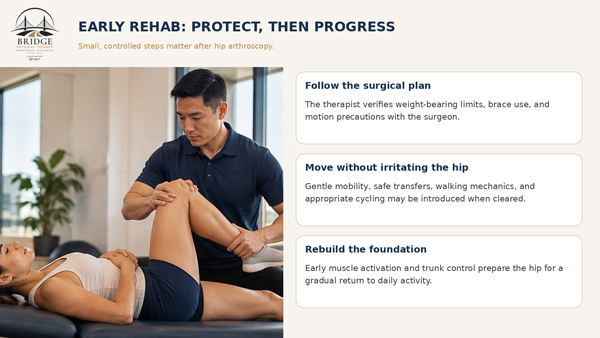
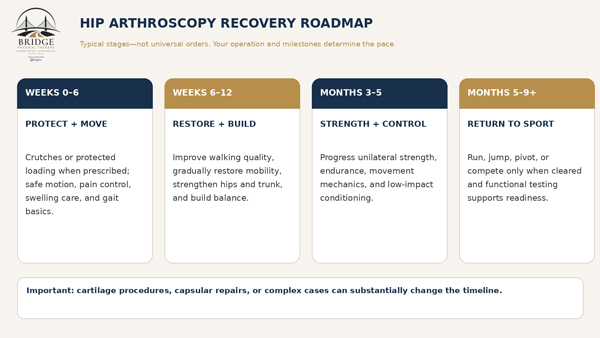
In the early weeks, the focus is protection, swelling and pain management, safe transfers, and walking with the prescribed assistive device. Depending on the operation, the patient may have crutches, specific limits on weight bearing, a brace, or precautions for certain hip positions. The therapist can help with gait training, education, safe movement in and out of bed or a car, gentle motion as allowed, and appropriate muscle activation.
Avoid guessing about early stretching. Deep hip flexion, rotation, and aggressive hip-flexor loading may be restricted after some procedures. Stationary cycling or other gentle activity is sometimes used early, but only within the postoperative plan. The goal is to keep recovery moving without asking healing tissues to do more than they should.
Recovery Phase 2: Walk Normally and Rebuild Strength
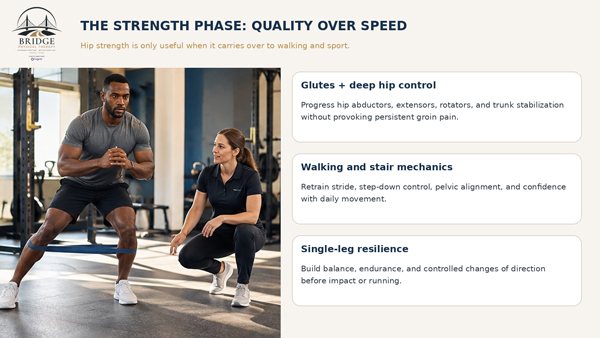
As the surgeon allows more loading, physical therapy usually focuses on eliminating a limp, restoring comfortable motion, and improving muscle endurance. Treatment may include progressive gluteal strengthening, trunk stability, bridges, controlled step-ups, balance work, and gradually more challenging functional activity. Exercises should be selected to avoid persistent groin irritation or a compensatory gait.
Patients sometimes feel better before their movement mechanics fully recover. That can lead to loading the lower back, opposite hip, or knee differently. A therapist should watch how the pelvis and trunk move during walking, stair climbing, and single-leg activities, not just measure how far the hip bends.
Recovery Phase 3: Strength, Endurance, and Real-World Function
Later rehabilitation typically includes progressively greater resistance, more demanding single-leg work, conditioning, and movement control. Some patients are working toward standing through a full workday or playing with their children; others are preparing to run, lift weights, golf, or return to competitive sport. The program should reflect those goals.
Return to higher activity also depends on symptom response. Sharp groin pain, repeated swelling or irritation, or increasing discomfort after exercise may mean the hip is not ready for that load. Rather than pushing through indiscriminately, the therapist should reassess exercise technique, total training volume, and whether the progression still matches the surgeon's restrictions.
When Can I Run or Return to Sports?
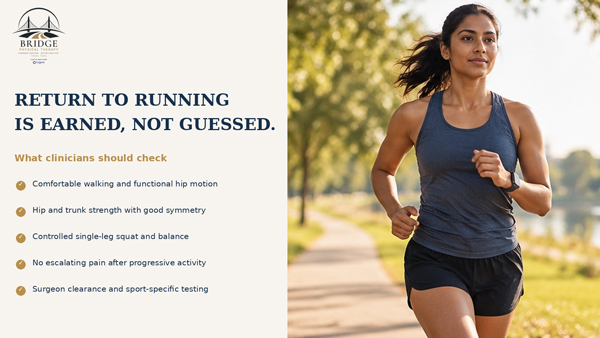
There is no single return-to-running date after hip arthroscopy. Many protocols consider a graded impact program only after several months, when walking is comfortable and objective strength and control benchmarks are met. Cutting, jumping, contact sports, and higher-demand athletic activity may take substantially longer. In many cases, the full progression takes six months or more; cartilage work, symptoms, and sport demands can extend that timeline.
Published return-to-sport recommendations emphasize hip range of motion, strength, single-leg control, functional testing, patient-reported confidence, and sufficient healing time. A 2023 clinical commentary proposed a criteria-based testing framework, but this was expert guidance rather than a validated guarantee against reinjury. Being able to jog is not the same as being ready to sprint, pivot, or play a full game.
At Bridge, a useful conversation is not merely 'How many weeks has it been?' but 'Can you demonstrate the strength, balance, and movement quality your activity requires?' The final decision should be coordinated with the treating surgeon.
Common Problems Physical Therapy Can Help Address
Hip stiffness, a persistent limp, gluteal weakness, reduced endurance, difficulty with stairs, and discomfort with prolonged sitting can all complicate the recovery process. Some patients also experience irritation at the front of the hip when they increase activity too quickly. Physical therapy can help identify movement compensations, adjust exercise dosage, and build a practical home program.
Not every symptom should be treated as ordinary soreness. New or worsening calf swelling, chest pain, shortness of breath, fever, drainage from incisions, or severe escalating pain requires prompt medical evaluation. Rehabilitation works alongside postoperative surgical follow-up, not in place of it.
Why a Surgeon-Directed PT Plan Matters in Frisco and DFW
Frisco and the broader Dallas–Fort Worth community include runners, dancers, students, recreational athletes, active professionals, and people simply trying to move without pain. Their goals are different, and hip arthroscopy procedures are different. A useful rehabilitation program connects the surgery to the patient's own daily demands, rather than giving everyone the same list of exercises.
When choosing physical therapy after hip arthroscopy in Frisco, Texas, ask whether the therapist reviews the actual operative restrictions, tracks gait and hip strength over time, develops a progressive home program, and communicates concerns to the surgeon. Those habits matter more than having a large menu of exercises.
The Bottom Line: Protect the Repair. Rebuild the Movement.
Successful rehabilitation after hip arthroscopy balances two priorities: respecting healing tissues and restoring the strength and coordination needed for life beyond surgery. Labral repair, impingement correction, capsule management, and cartilage procedures may all call for different precautions. A phase-based, surgeon-directed program can help patients progress thoughtfully from protected movement toward walking, exercise, and sport.
For patients seeking postoperative hip physical therapy in Frisco or North Texas, Bridge Physical Therapy focuses the conversation on what matters: your procedure, your progress, and your functional goals. Request an evaluation to discuss a personalized plan consistent with your surgeon's instructions.
Frequently Asked Questions
How soon should I start physical therapy after hip arthroscopy?
Many patients receive early rehabilitation instructions soon after surgery, but the timing of supervised visits depends on the operative plan. Follow your surgeon’s specific instructions.
Will I need crutches after a hip labral repair?
Some patients use crutches or restricted weight bearing early after labral repair, and the duration varies. Cartilage procedures may require longer restrictions. Do not discontinue crutches without clearance.
Is hip arthroscopy the same as hip replacement?
No. Hip arthroscopy treats selected problems inside the natural hip joint through small incisions; a total hip replacement replaces the joint surfaces. Their rehabilitation instructions are different.
When can I return to running after hip arthroscopy?
Running is usually a later-stage milestone rather than an early goal. Timing depends on surgery, symptoms, strength, gait, and surgeon clearance; progression should be gradual and criteria-based.
What if my groin still hurts during rehab?
Some soreness can occur as activity increases, but repeated or worsening deep groin pain deserves reassessment by your therapist and, when appropriate, the surgeon.
Can physical therapy help me return to sports after a labral repair?
PT can guide progressive strength, control, endurance, and sport-specific testing, but a return date and outcome cannot be guaranteed. Clearance should incorporate the surgeon’s recommendations.
Evidence and Further Reading
- Takla A, et al. The 2019 International Society of Hip Preservation (ISHA) physiotherapy agreement on assessment and treatment of femoroacetabular impingement syndrome. J Hip Preserv Surg. 2021. PMID 34377507. https://pubmed.ncbi.nlm.nih.gov/34377507/
- Hemstock R, et al. Postoperative weight-bearing restrictions and rehabilitation protocols after hip arthroscopy for femoroacetabular impingement: a systematic review. J Hip Preserv Surg. 2023. PMID 38162279. https://pubmed.ncbi.nlm.nih.gov/38162279/
- State of the Art in Rehabilitation Strategies After Hip Arthroscopy for Femoroacetabular Impingement Syndrome: A Systematic Review. J Clin Med. 2024;13:7302. PMID 39685760. https://pubmed.ncbi.nlm.nih.gov/39685760/
- Hugenberg G, et al. Clinical Commentary: A Criteria-Based Testing Protocol for Return to Sport Post Hip Arthroscopy for Impingement. Int J Sports Phys Ther. 2023. PMID 37795325. https://pubmed.ncbi.nlm.nih.gov/37795325/
- Rehabilitation and return to play following hip arthroscopy in young athletes. Narrative clinical review. PMCID PMC12088164. https://pmc.ncbi.nlm.nih.gov/articles/PMC12088164/