


Neck surgery can relieve pressure on an irritated nerve or spinal cord, but the operation itself does not immediately restore strength, movement confidence, balance, or comfortable daily function. For many patients, the next challenge is understanding when to move, what to protect, and how to become active again without provoking symptoms.
At Bridge Physical Therapy in Frisco, Texas, rehabilitation after cervical spine surgery starts with the exact diagnosis and procedure. A person recovering from a cervical microdiscectomy for arm pain has different priorities from someone who underwent anterior cervical discectomy and fusion (ACDF). Someone recovering from surgery for cervical myelopathy may also need dedicated walking, balance, and hand-function retraining. Effective rehabilitation begins by respecting those differences.
What Causes Neck and Arm Symptoms?
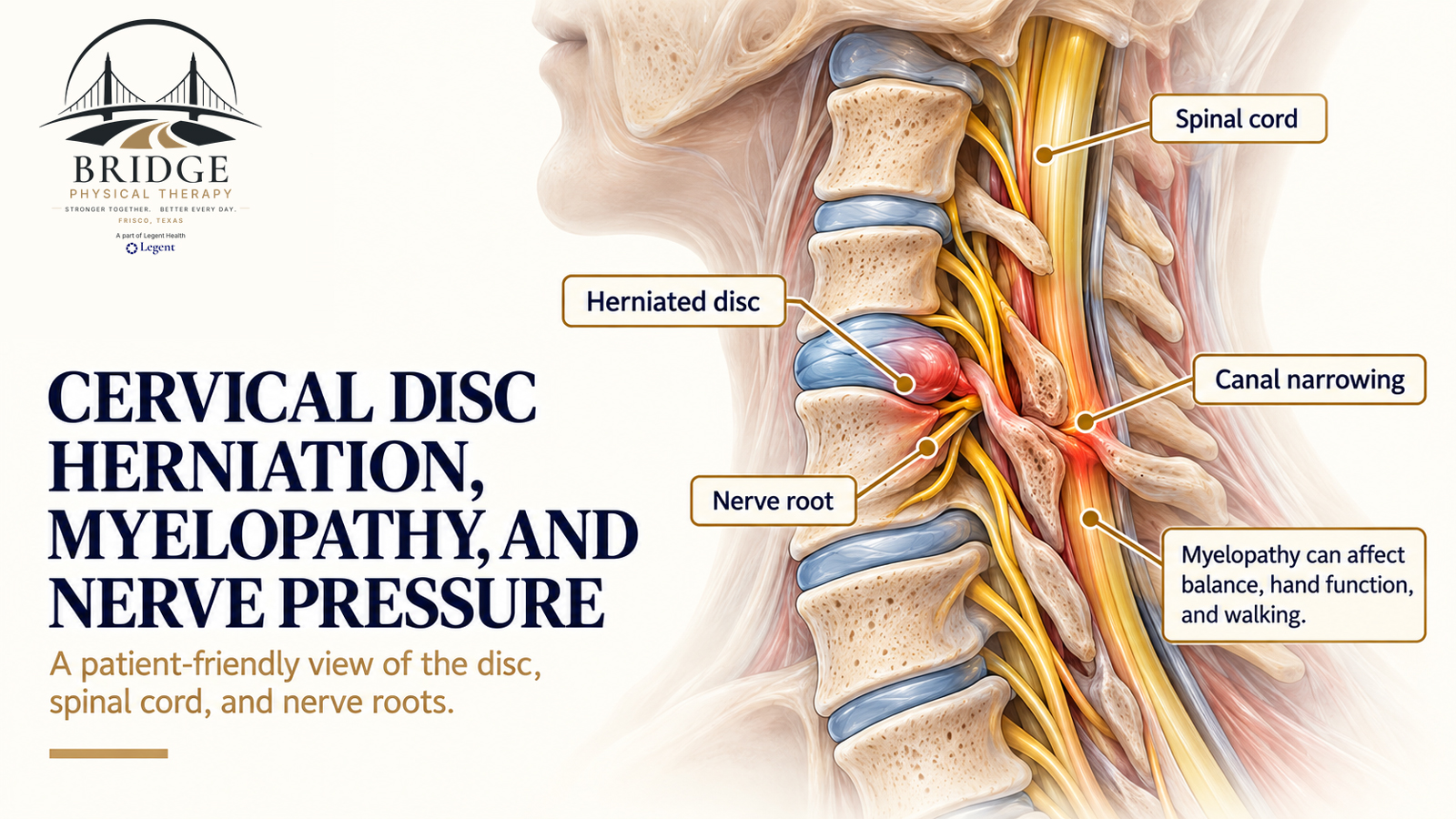
The cervical spine contains vertebrae, cushioning discs, nerve roots, and the spinal cord. A damaged or herniated disc can irritate a nerve root, producing pain that travels into the shoulder or arm, sometimes with tingling, numbness, or weakness. This pattern is called cervical radiculopathy. Disc degeneration, bone spurs, and narrowing of the nerve openings can contribute.
Cervical myelopathy is different: it reflects dysfunction of the spinal cord itself, often from degenerative narrowing of the spinal canal. Patients may notice hand clumsiness, difficulty fastening buttons, changes in handwriting, unsteady walking, leg stiffness, or frequent falls—not just neck pain. New or progressing symptoms deserve prompt medical assessment. Physical therapy cannot substitute for decompression when the spinal cord is deteriorating.
Three Different Clinical Pathways: Microdiscectomy, ACDF, and Myelopathy
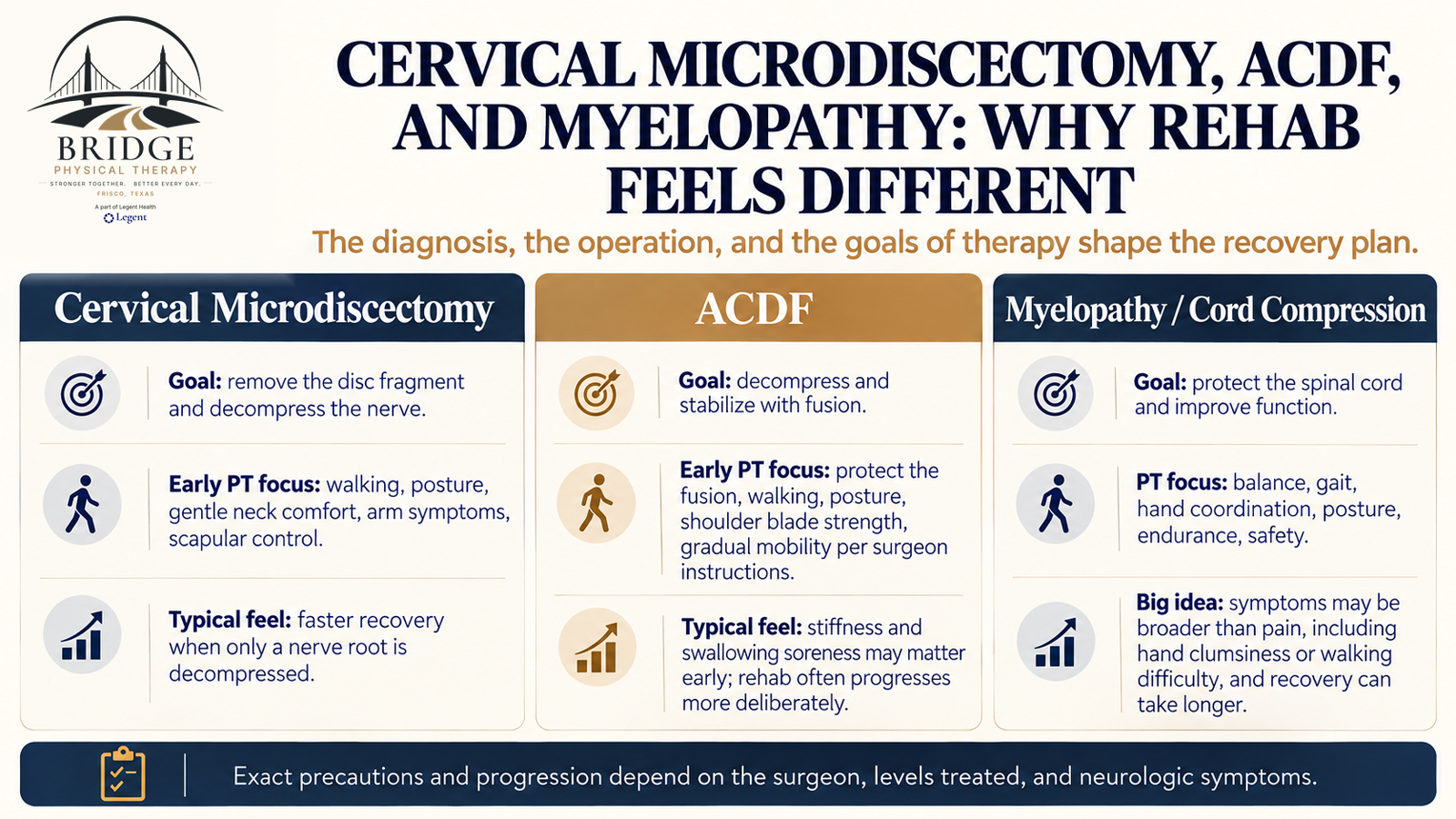
Cervical microdiscectomy or targeted nerve-root decompression: In selected patients, a surgeon removes disc material or bone compressing a nerve. Some procedures are performed through a posterior approach, such as a foraminotomy/discectomy, and may preserve motion; other cervical disc operations are performed through the front of the neck. The operative approach determines which tissues are healing and what motions are allowed.
Anterior cervical discectomy and fusion (ACDF): A disc is removed from the front of the neck, the affected neural structures are decompressed, and the segment is stabilized to allow fusion. Physical therapy must protect the construct and respect the surgeon’s specific collar, lifting, motion, and return-to-work instructions. A swallowing sensation or temporary throat soreness may occur after an anterior approach; concerning or persistent swallowing or breathing symptoms require surgical review.
Degenerative cervical myelopathy: This is a diagnosis, not one specific operation. Treatment may involve anterior or posterior decompression, sometimes with fusion. When spinal cord function has been affected, therapy priorities expand to include gait, fall risk, hand dexterity, coordination, and safe independence. Recovery can be slow or incomplete because neurological healing is not the same as ordinary muscle soreness.
What the Peer-Reviewed Evidence Actually Shows
Research supports thoughtful postoperative activity, but the evidence does not establish one superior PT schedule for everyone. A randomized study of patients having surgery for cervical radiculopathy found that a structured program of neck-specific exercises and behavioral support yielded only modest additional benefits at six months compared with usual postoperative care; both groups generally improved. This supports tailoring supervised visits to actual deficits and patient goals rather than prescribing more treatment automatically.
Another randomized trial comparing ACDF plus rehabilitation with rehabilitation alone for cervical radiculopathy found better long-term improvement in neck disability and neck pain in the surgery-plus-PT group. That trial helps explain the role of decompression and rehabilitation together, but it does not mean every postoperative exercise or visit frequency has been proved superior.
For degenerative cervical myelopathy, clinical guidelines recommend surgery for moderate or severe disease, rather than relying on exercise to decompress the cord. A 2026 systematic review of 10 postoperative rehabilitation studies (766 participants) found encouraging results for multimodal, goal-oriented rehabilitation, but most studies had substantial risk of bias. The appropriate conclusion is promising—not guaranteed—benefit, with a need for stronger trials.
Early Recovery: Walking, Protection, and Practical Movement
In the first days and weeks, most patients benefit from regular short walks, comfortable positioning, safe transfers, and education about restrictions. After fusion, loading and neck range-of-motion limits may be more protective; the surgeon determines whether a collar is needed and when active neck exercises begin. After selected nonfusion decompressions, some patients regain basic mobility sooner.
A therapist can coach getting in and out of bed, choosing a comfortable workstation setup, improving shoulder-blade support, and avoiding repeated positions that irritate healing structures. Exercise should never require pushing through increasing neurological symptoms. Direct neck traction, high-velocity manipulation, forced end-range stretching, and heavy resisted neck work are inappropriate unless specifically assessed and cleared by the surgical team—and are often avoided early after fusion or cord compression.
Evidence-Informed Exercise Progression After Cervical Surgery
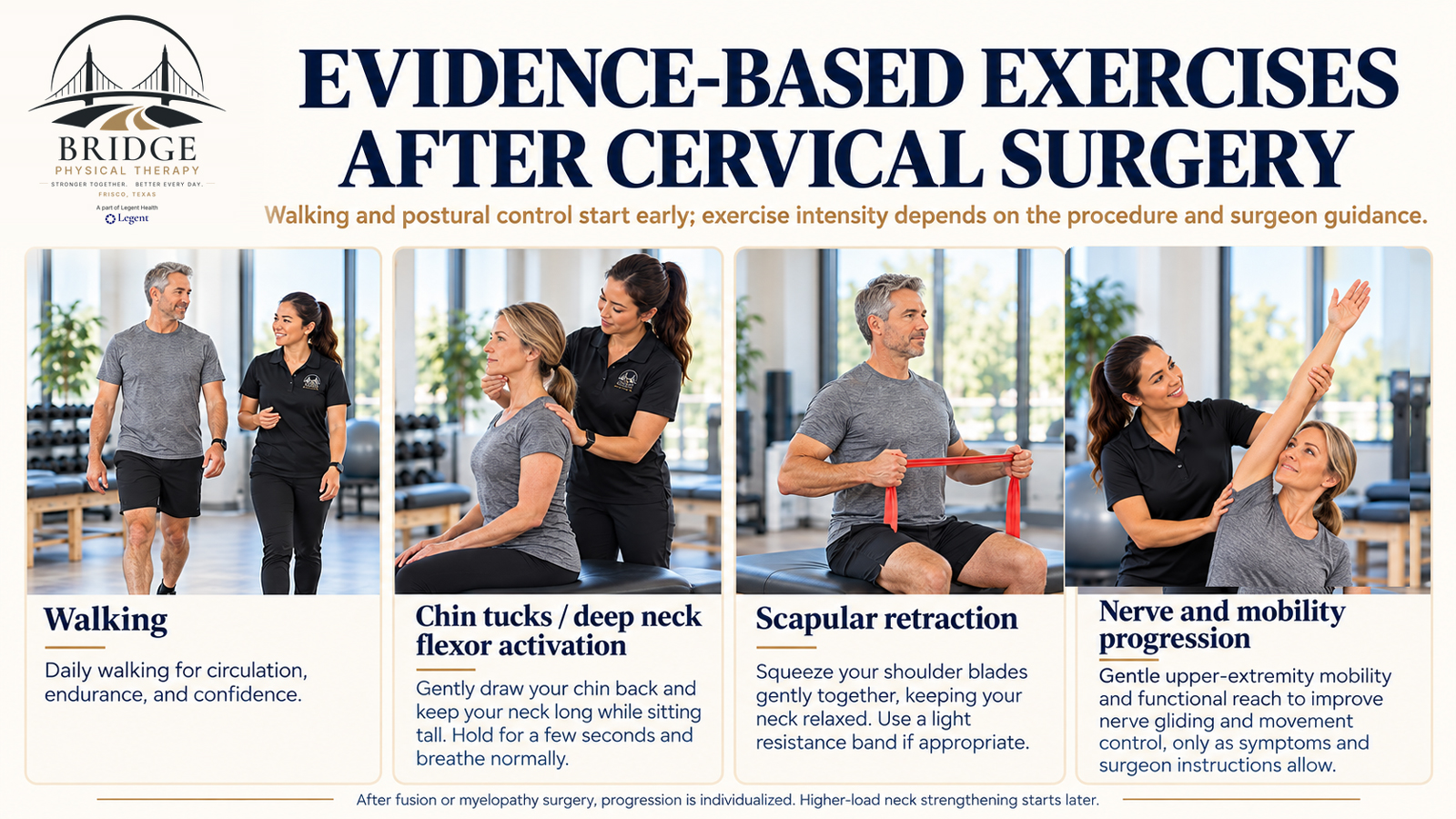
Walking: Short, frequent walks support circulation, conditioning, and confidence. Progress time and distance when symptoms remain stable, and add a walking aid or supervision if balance is impaired.
Posture and shoulder-blade control: Gentle scapular setting or low-load rowing can help reduce shoulder shrugging and improve upper-back endurance once cleared. Keeping the thorax and shoulders moving appropriately does not require aggressive cervical stretching.
Deep neck flexor activation: Small, comfortable chin-nod or chin-tuck movements may be introduced after surgeon approval in appropriate patients. The goal is control, not force. This is not an instruction to perform resisted neck exercise during the fusion-protection phase.
Arm mobility and nerve symptoms: Gentle shoulder, elbow, wrist, and hand exercises maintain function. If a nerve root was compressed, carefully dosed neural-mobility work may be considered for selected patients; it should not reproduce or worsen radiating symptoms.
Myelopathy-specific training: Progressive balance, supported stepping, gait practice, sit-to-stand control, and hand coordination may be more valuable than isolated neck exercise. Tasks are individualized to fall risk, strength, sensation, and neurologic examination. Occupational therapy can complement PT for dressing, writing, and fine-motor tasks.
These are examples of exercise categories—not a home protocol or a universal starting date. Exercises should be advanced according to the operation, wound healing, neurological findings, symptoms, and surgeon clearance.
What Does the Recovery Timeline Look Like?
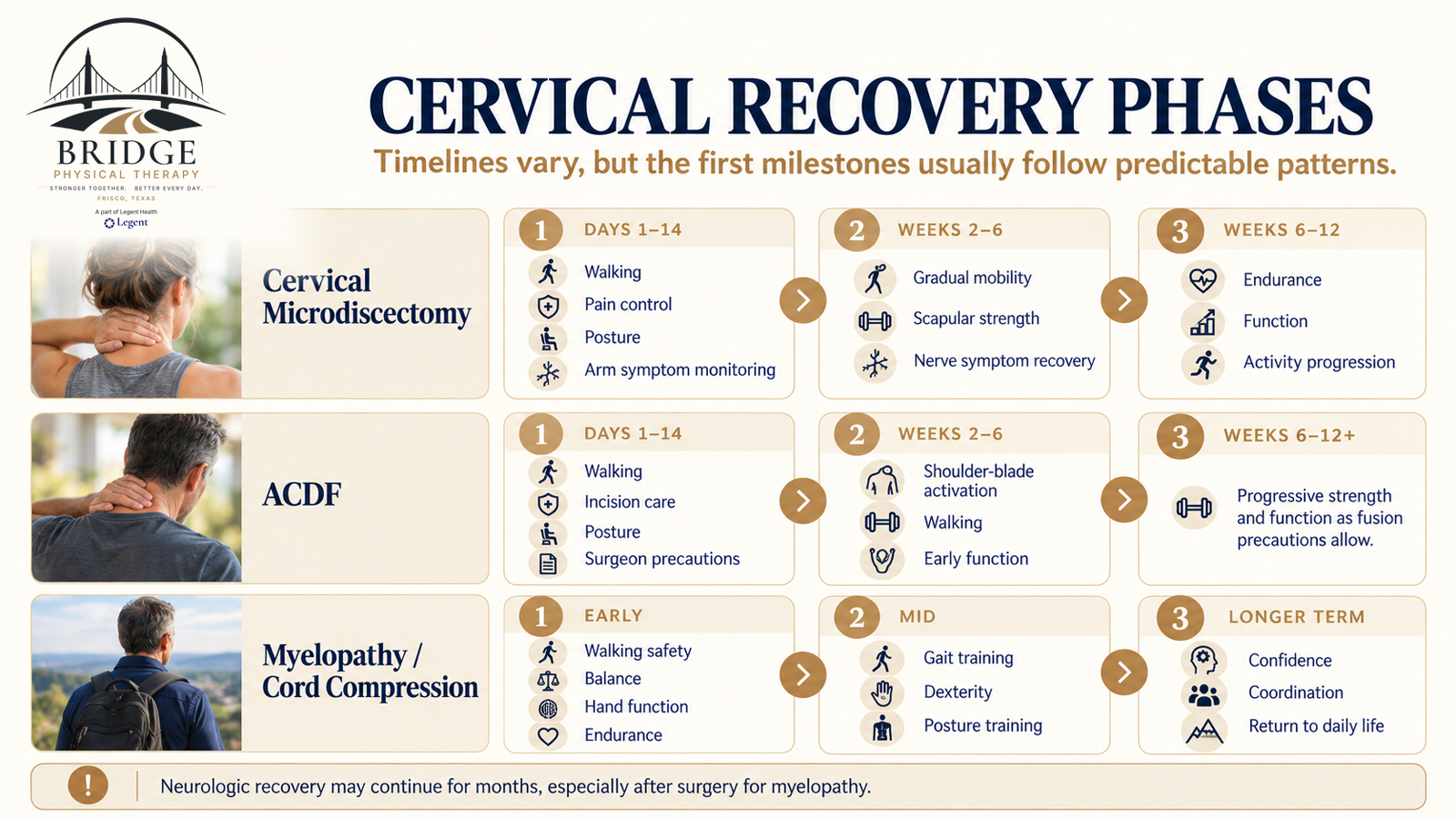
First two weeks: Many plans emphasize walking, pain control, wound and collar instructions where applicable, position changes, and gentle general movement. Arm symptoms may improve quickly after nerve decompression, but residual numbness can take longer and may not resolve fully.
Weeks two through six: Depending on the operation, activities may include progressively longer walking, posture training, low-load shoulder-blade work, and increasingly independent daily function. Patients with fusion should not assume that the passage of time means they can resume unrestricted bending, lifting, driving, or neck rotation.
Weeks six through twelve and beyond: Once medically cleared, the program can gradually expand toward endurance, functional lifting, upper-extremity strength, and return-to-work demands. Bone fusion continues to mature over months; higher-load exercise and sport need individualized clearance.
Following surgery for myelopathy: Balance, gait, and hand function may improve over many months. Some neurological deficits can persist, especially when symptoms were severe or longstanding. Milestones should be measured against the patient’s starting point, not only the calendar.
What Makes PT Worthwhile After Cervical Surgery?
The most useful physical therapy is measurable. A therapist should evaluate the things that actually matter to the patient: how far they can walk safely, how their arm feels during ordinary tasks, whether they can stand and turn without losing balance, whether they can return to desk work, and how confidently they manage activities at home.
Visits may include exercise instruction, gait and balance training, careful conditioning, ergonomic counseling, and progression of a home program. Not everyone needs the same number of visits. A person recovering smoothly after an uncomplicated nerve-root decompression may need relatively little formal PT, whereas a patient with persistent weakness, fusion-related deconditioning, or myelopathy may need substantially more individualized support.
Red Flags: When to Contact the Surgeon
Call the surgical team promptly for new or worsening limb weakness, progressive hand clumsiness, increasing gait instability, a new significant loss of balance, wound drainage, fever, or severe escalating pain. New bowel or bladder dysfunction, rapidly progressive neurological loss, difficulty breathing, or substantial trouble swallowing after anterior neck surgery warrants urgent medical evaluation. Therapy should never delay assessment of concerning postoperative symptoms.
Cervical Spine Rehabilitation in Frisco and North Texas
Bridge Physical Therapy in Frisco, Texas, focuses on helping patients translate their surgical recovery into better everyday function. A clear plan can address more than neck soreness: walking endurance, arm strength, comfortable sitting, postural control, safe balance, and the confidence to return to work, family activities, and recreation.
Whether you are recovering after cervical discectomy, ACDF, or decompression for cervical myelopathy, the right next step is a procedure-specific evaluation coordinated with your surgeon’s instructions. Protect what has healed. Rebuild what matters. Return to life with confidence.
Frequently Asked Questions
When can I start physical therapy after ACDF?
The timing depends on the levels fused, the surgeon’s protocol, symptoms, and healing. Walking and basic activity education often begin early, while formal neck exercises and strengthening may wait until surgical clearance.
Is cervical microdiscectomy recovery faster than ACDF?
Selected nonfusion nerve-root decompressions may have a faster early recovery, but approach, number of levels, symptoms, and baseline function matter. Do not compare timelines without knowing the exact procedure.
Will PT fix numbness or weakness after cervical surgery?
Therapy may help rebuild strength and practical function, but nerve or spinal cord recovery depends on the severity and duration of compression. Numbness or weakness may resolve slowly or may persist.
How is rehabilitation for cervical myelopathy different?
Myelopathy may impair walking, balance, hand dexterity, and coordination. Rehab often emphasizes safe gait, fall prevention, hand tasks, and strength alongside surgeon-directed postoperative precautions.
Are chin tucks safe after cervical fusion?
Not automatically. Deep neck flexor exercises may be useful later, but they should only start when the surgeon or therapist confirms that the fusion and symptoms permit them.
Can I receive neck manipulation or traction after surgery?
Do not pursue forceful neck manipulation or traction without explicit surgical approval. They are often inappropriate during early healing, particularly after fusion or in patients with spinal cord involvement.
How long does it take to recover from cervical myelopathy surgery?
Improvement may continue over many months, and some neurological changes may not reverse completely. Recovery is individualized and should be assessed with walking, balance, hand function, and daily-life goals.
To discuss postoperative rehabilitation at Bridge Physical Therapy in Frisco, Texas, request an evaluation after obtaining your surgical team’s guidance.
Peer-Reviewed References
- Wibault J, et al. Structured postoperative physiotherapy in patients with cervical radiculopathy: 6-month outcomes of a randomized clinical trial. J Neurosurg Spine. 2018;28:1-9. https://pubmed.ncbi.nlm.nih.gov/29087809/
- Peolsson A, et al. Postoperative structured rehabilitation in patients undergoing surgery for cervical radiculopathy: a 2-year follow-up of a randomized controlled trial. J Neurosurg Spine. 2019;31:60-69. https://pubmed.ncbi.nlm.nih.gov/30901755/
- Engquist M, et al. A 5- to 8-year randomized study on the treatment of cervical radiculopathy: anterior cervical decompression and fusion plus physiotherapy versus physiotherapy alone. J Neurosurg Spine. 2017;26:19-27. https://pubmed.ncbi.nlm.nih.gov/27564856/
- Fehlings MG, et al. Clinical practice guideline for degenerative cervical myelopathy. Global Spine J. 2017;7(3 Suppl):70S-83S. https://pubmed.ncbi.nlm.nih.gov/29164035/
- Montpetit C, et al. The effect of postoperative rehabilitation on outcomes in patients with degenerative cervical myelopathy: a systematic review. Brain Spine. 2026;6:105956. https://pubmed.ncbi.nlm.nih.gov/41693706/
- Smith TO, et al. Rehabilitation for degenerative cervical myelopathy: systematic review and scoping review of UK patient information. Spinal Cord. 2025. https://pubmed.ncbi.nlm.nih.gov/40696144/