


Physical therapy after ankle fracture surgery helps restore walking, ankle motion, strength, balance, and confidence while the bone and soft tissues heal. For appropriately selected patients with stable fixation, modern evidence supports earlier weight-bearing than the traditional six-week period of complete unloading. Some surgeons permit protected weight-bearing immediately after surgery; others delay loading because of the injury or repair. Your surgeon's written instructions—not a generic online timeline—determine what is safe for your ankle.
A broken ankle changes an ordinary day in seconds. One misplaced step off a curb, a fall on the trail, or a twisting sports injury can leave you unable to stand. Surgery may restore the alignment of the bones, but it cannot instantly restore the way you walk, climb stairs, balance, or trust your leg.
At Bridge Physical Therapy in Frisco, Texas, the objective after ankle fracture fixation is bigger than getting out of a boot. It is helping you regain comfortable movement and return to work, exercise, family activities, and the things that make life yours. Effective rehabilitation balances protection of the surgical repair with the right amount of activity at the right time.
What Is Ankle ORIF Surgery?
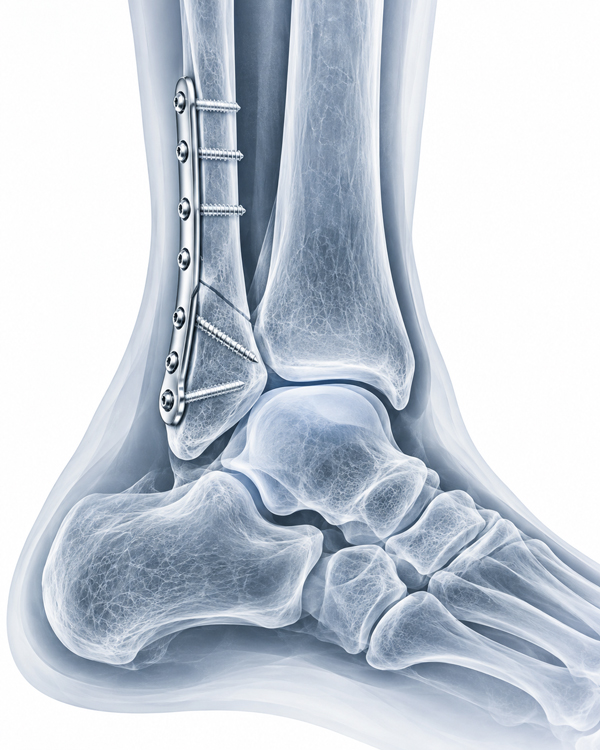
ORIF means open reduction and internal fixation. During surgery, the orthopedic surgeon realigns displaced fracture fragments and secures them with hardware—often a plate and screws along the distal fibula (outside ankle), sometimes with fixation of the medial or posterior malleolus or the syndesmosis. The goal is to restore a stable, well-aligned ankle mortise so the fracture can heal.
A fibular plate does not mean every ankle fracture is the same. A relatively simple lateral malleolus fracture differs from a bimalleolar or trimalleolar fracture, a fracture-dislocation, a substantial posterior malleolar injury, or a syndesmotic disruption. Those differences may change your restrictions and recovery progression. The postoperative plan should reflect what was actually repaired.
Why Is Physical Therapy Important After a Broken Ankle?
Even when the bones heal uneventfully, the ankle can remain stiff, swollen, weak, and difficult to trust. Calf strength declines with reduced use. Dorsiflexion may be limited, making stairs and squats difficult. Patients may avoid loading the injured leg and develop a limp long after the original pain has improved.
Physical therapy evaluates more than the ankle joint. A therapist looks at gait, swelling, foot and ankle mobility, calf capacity, hip control, single-leg balance, and the activities you need to recover. Treatment can include education, therapeutic exercise, gait training, progressive loading, balance work, and a practical home program. Your clinical needs—not an automatic visit count—determine how much supervised therapy is appropriate.
When Can You Walk After Ankle Fracture Surgery?
It depends on your fixation and your surgeon's clearance. Historically, many ankle ORIF protocols required approximately six weeks without weight-bearing. Contemporary practice is increasingly individualized, and selected patients may begin protected loading far sooner.
In many instances, weight-bearing may be permitted as early as postoperative day zero in many selected ankle fracture cases when he judges fixation sufficiently stable and the fracture and soft-tissue conditions appropriate. This is a surgeon-specific practice approach, not an instruction for all patients who have undergone ORIF. It does not mean walking without support, abandoning a boot, or beginning ankle exercises before clearance.
The surgeon must consider stability of the ankle mortise, any syndesmotic fixation, fracture comminution, posterior malleolar involvement, wound condition, bone quality, nerve sensation, associated injuries, and the patient's ability to follow restrictions. An individual may be allowed to put weight through a protective boot yet still be told to avoid certain ankle movements. Weight-bearing permission and range-of-motion permission are separate decisions.
What Does the Research Say About Early Weight-Bearing?
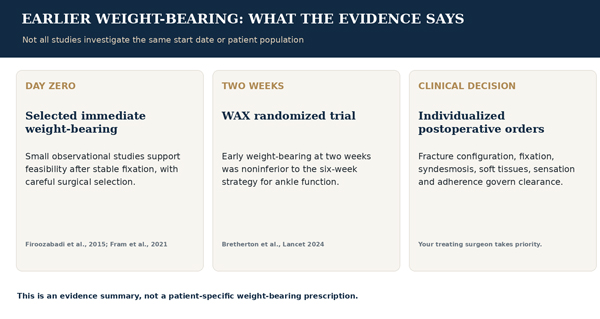
The evidence has moved meaningfully beyond the assumption that every surgically repaired ankle must remain unloaded for six weeks. The 2024 WAX trial, a multicenter randomized trial of 561 adults after surgery for unstable ankle fractures, compared weight-bearing beginning at two weeks with the traditional six-week strategy. Earlier weight-bearing was noninferior for ankle function at four months and was judged likely cost-effective. This trial supports an earlier pathway in eligible patients, but it did not test weight-bearing on surgery day.
Separate studies have examined truly immediate weight-bearing. A 2015 study by Firoozabadi and colleagues reported immediate weight-bearing as tolerated in a small, selectively chosen ankle-fracture cohort using a protective CAM boot. Twenty-five of 26 patients maintained reduction; the one failure involved a missed syndesmotic injury. Because it was a small observational series with exclusions, it supports careful selection rather than a universal day-zero recommendation.
A later comparative study by Fram and colleagues evaluated immediate weight-bearing and ankle motion after fixation of selected malleolar injuries. It found no statistically significant increase in complications in the evaluated cohort, while retaining the limitations of nonrandomized evidence. Recent systematic reviews generally find better early function with earlier loading and similar complication rates in appropriate patients; differences in longer-term outcomes are smaller or absent.
The practical lesson is not “everyone should walk immediately.” It is that stable surgery plus appropriately supervised rehabilitation may permit earlier functional recovery. Your therapist should follow your surgeon's exact loading and motion orders rather than substituting a generic six-week protocol.
When Should You Start Physical Therapy After ORIF?
Physical therapy can begin before an ankle is ready for unrestricted exercise. A first visit may focus on safe transfers, walking aids, edema control, hip and knee strength, education, and review of your postoperative restrictions. Hands-on work around the incision or active ankle motion may need to wait until wound healing and surgical clearance.
Bring your discharge instructions, boot or brace, assistive device, medication list, and any updated surgeon protocol. Tell the therapist whether the fracture involved the syndesmosis, multiple malleoli, or additional procedures. If the surgeon's instructions are unclear, the therapist should clarify them before progressing load or movement.
Four Stages of Rehabilitation After Ankle Fracture Fixation
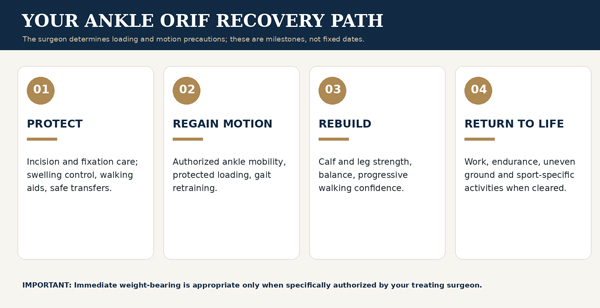
Stage 1: Protect the Repair and Manage Swelling
Early priorities are protecting the incision and fixation, controlling swelling, moving safely at home, and maintaining conditioning in areas not restricted. Elevation and appropriately prescribed compression may help. The therapist can teach crutch or walker use, stair navigation, and protected walking when permitted. A CAM boot or splint may be required even when weight-bearing is allowed.
Stage 2: Regain Motion and Improve Walking
Once approved, ankle dorsiflexion and plantarflexion exercises, gentle mobility work, and gradual gait retraining help restore efficient walking. The therapist may assess how the foot loads, how the knee advances over the foot, and whether you are shortening your stance time on the injured side. Patients progress from assistive devices based on restrictions, pain, balance, and gait quality—not impatience.
Stage 3: Rebuild Strength and Balance
Later rehabilitation introduces progressive calf raises, ankle resistance exercises, foot-intrinsic strengthening, hip and core work, and increasingly challenging balance drills. Balance matters because an ankle fracture can leave deficits in joint position awareness and confidence even after the X-ray looks reassuring. Exercises are dosed to tissue tolerance and healing status.
Stage 4: Return to Work, Fitness, and Sport
A retail employee standing all day, a parent carrying a toddler, a runner, and a golfer need different end-stage programs. Functional training may include step-downs, uneven surfaces, single-leg loading, endurance, agility, hopping, or running—but impact training belongs only after sufficient healing, strength, and surgical clearance. Return-to-sport is a functional decision, not simply a date on a calendar.
How Long Does Recovery Take After Ankle ORIF?
Healing and functional recovery are related but not identical. Initial fracture healing often progresses over weeks; stiffness, swelling, weakness, and confidence may improve for months. Complex injuries, cartilage damage, syndesmotic injury, age, smoking, and medical conditions can change the pace of recovery. Early weight-bearing may speed some short-term milestones, but it does not erase the biology of fracture union or guarantee a particular return date.
A useful rehabilitation plan tracks practical markers: gait without an avoidable limp, improving ankle motion, calf strength, ability to manage stairs, standing tolerance, and balance. Comparing performance with the uninjured leg can identify deficits that pain alone does not reveal.
What Symptoms Require a Call to Your Surgeon?
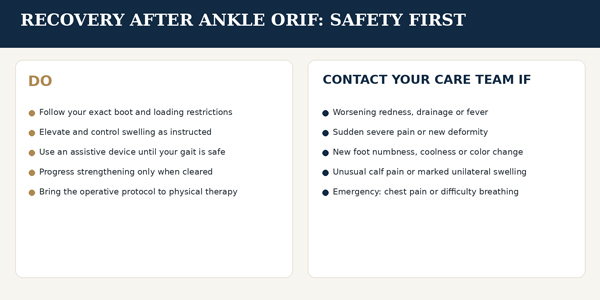
Call your surgical team promptly for increasing incision redness or drainage, fever, wound breakdown, sudden worsening pain, a new deformity, unexpected inability to bear weight despite prior progress, or new numbness or color change in the foot. New calf pain or significant one-sided swelling requires prompt assessment for a possible blood clot. Chest pain, severe shortness of breath, or symptoms concerning for a pulmonary embolism require emergency care. Do not use physical therapy or online exercises to delay evaluation of these problems.
Why Bridge Physical Therapy in Frisco?
Patients recovering from ankle fracture surgery need a therapist who understands that radiographic stability is not the same as full functional recovery, and that postoperative instructions differ from case to case. Bridge Physical Therapy provides an individualized rehabilitation approach with a focus on movement, strength, walking mechanics, and the goals that matter to the patient. Patients from Frisco, Plano, McKinney, Allen, and surrounding North Texas communities can contact Bridge to discuss an evaluation and scheduling.
Whether you were instructed to walk in a boot immediately or to remain non-weight-bearing for a period of time, the aim is the same: protect what was repaired and rebuild what the injury took away. Request a physical therapy evaluation to discuss rehabilitation after ankle ORIF and bring your surgeon's postoperative protocol to the visit.
Frequently Asked Questions About PT After Ankle Fracture Surgery
Can I put weight on my ankle the day after surgery?
Some patients are cleared for immediate protected weight-bearing; others must remain non-weight-bearing. The fracture, fixation, soft tissues, and surgeon's written orders determine which applies to you. Never advance loading based solely on someone else's recovery story.
Is physical therapy painful after ankle ORIF?
Mild discomfort or temporary soreness can occur with progressive movement. Therapy should not involve forcing through severe pain or ignoring a new symptom. Your therapist should adjust the program to your stage of healing and tolerance.
Do plates and screws have to be removed before PT?
No. Internal fixation commonly remains in place while rehabilitation proceeds. Hardware removal is not routine for every patient and is a separate surgical decision when symptoms or other indications warrant it.
Why is my ankle still swollen months after surgery?
Activity-related swelling may persist during recovery, but worsening or unusual swelling deserves clinical review. A therapist can help with graded activity, movement, and surgeon-approved edema-management strategies.
When can I stop wearing my walking boot?
Boot discontinuation depends on surgeon clearance, soft-tissue and fracture healing, and how safely you walk. Being permitted to bear weight does not automatically mean the boot can come off.
When can I return to running or playing sports?
Return depends on healing, motion, calf strength, balance, tolerance for impact, and the demands of your sport. Your therapist and surgeon should establish functional milestones rather than promise one universal week.
Do I need PT if my surgeon allows immediate weight-bearing?
Possibly. Early walking does not necessarily restore dorsiflexion, calf strength, balance, or efficient gait. Some patients do well with limited visits and an effective home program; others benefit from closer supervision based on deficits and goals.
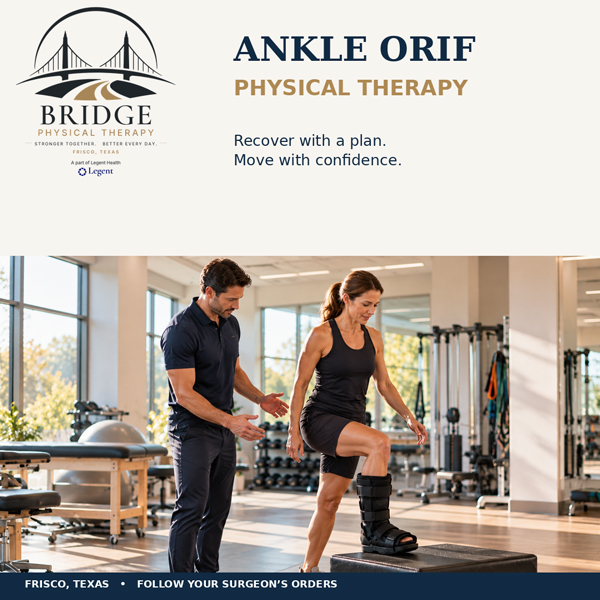
Medical disclaimer: This article is general education, not individual postoperative clearance. Your orthopedic surgeon's protocol takes precedence over any examples on this page. Illustrative images do not show an actual Bridge patient or individual surgical result.
Clinical Evidence & Sources
WAX trial — Bretherton CP et al. — Early versus delayed weight-bearing following operatively treated ankle fracture: WAX, a non-inferiority randomized controlled trial. Lancet. 2024;403:2787–2797. https://pubmed.ncbi.nlm.nih.gov/38848738/
RELEVANCE: 561 adults; 2-week versus 6-week weight-bearing. Supports early (not postoperative day-zero) loading.
Firoozabadi R, Harnden E, Krieg JC. — Immediate Weight-Bearing after Ankle Fracture Fixation. Adv Orthop. 2015;2015:491976. https://doi.org/10.1155/2015/491976
RELEVANCE: Small carefully selected immediate-weight-bearing cohort in CAM boots; observational study; missed syndesmotic injury was a failure.
Fram BR et al. — Immediate Weight-Bearing and Range of Motion After Internal Fixation of Selected Malleolar Fractures: A Retrospective Controlled Study. J Orthop Trauma. 2021;35:308–314. https://pubmed.ncbi.nlm.nih.gov/33177430/
RELEVANCE: Immediate-loading comparative evidence with selection and nonrandomized limitations.
Sernandez H et al. — Do Early Weight-Bearing and Range of Motion Affect Outcomes in Operatively Treated Ankle Fractures? A Systematic Review and Meta-Analysis. J Orthop Trauma. 2021. https://pubmed.ncbi.nlm.nih.gov/33512860/
RELEVANCE: Systematic review assessing early load/motion benefits and complications.
2023 randomized-trial meta-analysis — Early Versus Delayed Weight Bearing and Mobilization After Ankle Fracture Fixation Surgery: A Systematic Review and Meta-analysis of Randomized Controlled Trials. Orthopedics. https://pubmed.ncbi.nlm.nih.gov/37561102/
RELEVANCE: Better early function; no clearly established year-one superiority, nuances for movement complications.
2026 evidence synthesis — Weightbearing after ankle fracture fixation; a systematic review and meta-analysis of randomised controlled trials, a modern perspective. https://pubmed.ncbi.nlm.nih.gov/42386456/
RELEVANCE: Reported short-term functional advantages of early loading with similar complication rates; included for up-to-date context.