

Myofascial release is a hands-on soft-tissue treatment that uses carefully directed pressure and movement to address discomfort and movement limitations involving muscles and connective tissue. It may offer short-term pain relief for some people, especially as part of an individualized physical therapy program. At Bridge Physical Therapy in Frisco, Texas, the goal is not simply to provide temporary relief—it is to pair the right manual techniques with exercise, education, and practical strategies that help you move confidently in daily life.

A stiff neck after a long workday. A nagging tightness between your shoulder blades. A painful back that makes exercise or travel harder. If you have searched for “myofascial release near me,” you are probably looking for an explanation—and, more importantly, a way to feel better that lasts beyond an appointment.
The term myofascial release is widely used, but not every online description is scientifically accurate. Here is what the technique involves, what the research actually supports, how it fits into modern physical therapy, and when a different medical evaluation is the smarter first step.
What Is Myofascial Release?
“Myofascial” refers to muscle (myo) and fascia, the connective tissue that surrounds and interconnects muscles and other structures. Fascia helps tissues move relative to one another and transmit force. In clinical practice, myofascial release is a broad label for manual techniques in which a clinician applies sustained or slowly moving pressure to sensitive or restricted soft-tissue regions.
A physical therapist may use their hands to apply pressure, guide gentle movement, or combine these approaches. The intensity should be adapted to your comfort, symptoms, health history, and treatment goals. Some clinicians use terms such as soft-tissue mobilization, manual therapy, or trigger-point treatment for overlapping techniques.
Importantly, treatment does not have to “break up” fascia, physically tear apart adhesions, or force muscles into permanent length changes to be useful. Those explanations are often overstated. The precise mechanisms of benefit are not fully established; changes in pain sensitivity, muscle guarding, movement tolerance, and the overall therapeutic context may contribute.
What Can Myofascial Release Help With?
When an examination identifies a relevant soft-tissue component, a therapist may consider hands-on treatment for discomfort or limited movement involving the neck and shoulders, upper or lower back, hips, thighs, or calves. It may also be considered as an adjunct within rehabilitation after an injury or a period of reduced mobility, when tissues have healed sufficiently for manual care.
The best candidates are not defined by a list of diagnoses. They are identified through an assessment of symptoms, irritability, strength, mobility, and function. Pain that feels like “tight muscles” may sometimes reflect a joint, tendon, nerve, or another medical condition. A skilled examination matters more than guessing which tissue needs to be “released.”
A few common goals include: moving the neck more comfortably, tolerating desk work or travel, returning to exercise, improving confidence with bending or reaching, and making a strengthening program easier to perform. The objective is better function, not simply the elimination of every tender spot.
Does Myofascial Release Really Work? What the Evidence Says
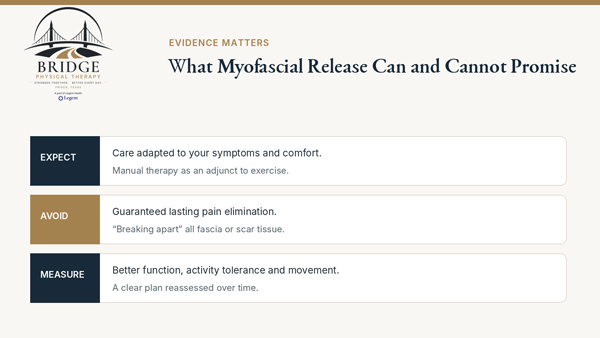
Research supports a measured answer: it may help selected patients, particularly with short-term symptoms, but it is not a stand-alone cure or a substitute for exercise-based rehabilitation.
The American Physical Therapy Association's 2021 low back pain clinical practice guideline, published in the Journal of Orthopaedic & Sports Physical Therapy, states that physical therapists may use soft-tissue mobilization or massage for short-term relief in acute low back pain. For chronic low back pain, the guideline says these techniques may be used alongside other treatments to reduce pain and disability in the short term. It does not recommend a passive-only treatment plan.
A 2021 systematic review of eight randomized trials involving 375 people with chronic low back pain reported improvements in pain and physical function with myofascial release, while emphasizing limitations in study quality and sample size. A separate 2021 meta-analysis of eight trials involving 386 participants found an improvement in back-related disability but no statistically significant reduction in pain intensity. These differences are a reminder to avoid promises of guaranteed results.
The National Institutes of Health's National Center for Complementary and Integrative Health likewise reports that evidence for massage and related soft-tissue treatment in low back pain is often low quality and that benefits, when present, may be short-lived. The more defensible goal is to use manual treatment selectively so you can participate more comfortably in the activities and exercises that support recovery.
What Happens During a Myofascial Release Physical Therapy Visit?
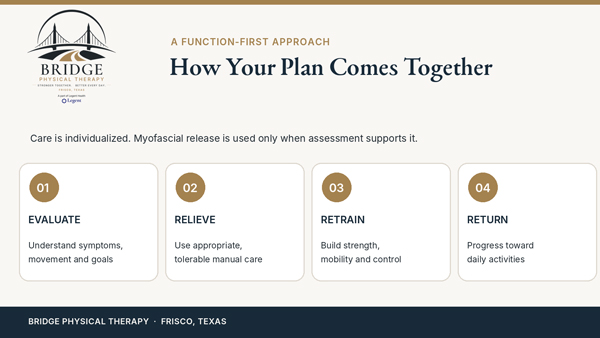
1. Evaluation Before Treatment
Your therapist asks where symptoms occur, how they began, what makes them better or worse, and which activities have become difficult. The examination may include joint movement, strength, balance, posture-related tasks, neurological screening when indicated, and functional activities such as sitting, lifting, or walking.

2. Targeted, Tolerable Hands-On Care
If appropriate, the therapist applies controlled pressure or soft-tissue movement to selected areas. Pressure is not a competition: more discomfort does not mean a better treatment. You should be able to communicate easily, and the therapist should modify or stop any technique that causes significant pain, numbness, dizziness, or concerning symptoms.
3. Movement and Strengthening
Manual treatment may be followed immediately by mobility exercises, resistance training, movement retraining, or a graded return to activity. This is often the most important transition. If hands-on care makes an activity temporarily easier, the rehabilitation program should help you use that window to build capacity.
4. A Clear Home Strategy
You may receive a brief home program emphasizing movement breaks, targeted strengthening, comfortable stretching where appropriate, or modification of aggravating activities. The plan should have measurable goals and evolve as you improve.
Myofascial Release vs. Deep-Tissue Massage vs. Trigger-Point Therapy
These terms overlap, but they are not interchangeable in every setting. Myofascial release generally describes targeted hands-on soft-tissue work intended to improve comfort or movement. Deep-tissue massage often emphasizes firmer pressure through muscle layers, but deeper does not automatically mean more effective. Trigger-point treatment targets tender, sometimes referred-pain areas in muscle. Clinicians may use more than one approach within a broader treatment session.
Physical therapy differs from a relaxation-oriented massage in its clinical evaluation, screening, objective functional goals, and integration of progressive exercise. That distinction does not mean every person needs myofascial release; some will do as well or better with active treatment alone.
Can I Do Self-Myofascial Release With a Foam Roller or Massage Ball?
Self-myofascial release often refers to using a foam roller or ball for comfortable, self-directed pressure. Some people find it useful before or after activity. A reasonable approach is to use gentle pressure over muscular areas, remain able to breathe comfortably, and stop if symptoms worsen.
Avoid aggressive pressure over the spine, joints, bony prominences, recently injured tissues, swollen or inflamed areas, open wounds, or regions with unexplained numbness. Foam rolling is not required for everyone, and repeated intense pressure should not become the main treatment for ongoing pain. Your therapist can advise whether it is suitable for your specific condition.

Does It Hurt? How Many Sessions Are Needed?
Treatment should generally feel tolerable. Mild temporary soreness can occur, but severe pain or significant bruising should not be the goal. Tell your therapist if you have fragile skin, osteoporosis, a bleeding disorder, take anticoagulants, or have had a recent operation or injury.
There is no evidence-based universal number of myofascial release sessions. Some people experience short-term relief quickly; others may not respond. Progress should be judged by meaningful changes in movement, sleep, work tolerance, walking, exercise, and function. If a treatment repeatedly provides only a brief change without functional progress, the plan deserves reassessment.
When Should You Avoid Myofascial Release or Seek Medical Evaluation First?
Do not begin routine manual treatment over a suspected fracture, active skin infection, open wound, or a region of suspected blood clot. New unexplained severe swelling, fever, significant injury, or rapidly progressive weakness requires medical assessment. Sudden severe back pain with new bowel or bladder dysfunction or saddle numbness warrants emergency evaluation.
People with a history of cancer, vascular disease, recent surgery, anticoagulant use, or reduced sensation may require a modified approach or clearance from the treating clinician. A physical therapist should screen for these issues and explain why a technique is or is not appropriate.
Frequently Asked Questions About Myofascial Release
Is myofascial release the same as massage?
Not exactly. Both can involve manual soft-tissue techniques, but physical therapy incorporates medical screening, movement assessment, exercise progression, and individualized functional goals. The hands-on techniques themselves can overlap.
Can myofascial release help lower back pain?
It may provide short-term relief for some people. Clinical guidelines support considering soft-tissue mobilization as an adjunct, particularly when combined with exercise and education. Long-term results depend on the overall condition and rehabilitation plan.
Does myofascial release break up scar tissue or fascia?
Claims that routine manual pressure mechanically “breaks apart” deep scar tissue or permanently lengthens fascia are not well established. Treatment may still change how you feel and move, but the explanation should not exceed the evidence.
What is the difference between myofascial release and dry needling?
Myofascial release is performed externally with manual pressure or movement. Dry needling involves inserting a fine needle into tissue and is a separate procedure with different risks, training requirements, and indications. It is not synonymous with myofascial release.
Is myofascial release covered by insurance?
Coverage depends on your insurance plan, medical necessity, referral rules, and the services provided. When clinically appropriate, hands-on manual therapy may be one component of a physical therapy visit; it should not be assumed to be covered as a separately advertised service. Ask the clinic to verify your benefits.
How do I find myofascial release physical therapy near me?
Look for a licensed physical therapist who begins with an evaluation, explains reasonable goals, and integrates exercise rather than offering unlimited passive treatment. Patients in Frisco and nearby Plano, McKinney, and Allen can contact Bridge Physical Therapy to ask whether this approach is appropriate and available for their needs.
Personalized Physical Therapy in Frisco, Texas
Bridge Physical Therapy, a part of Legent Health, serves patients in Frisco and surrounding North Texas communities. Whether you are managing recurring muscle discomfort, recovering from an injury, or looking for a smarter approach to persistent stiffness, the first step is a proper evaluation.
If myofascial release is appropriate, it can be integrated into a plan focused on movement, strength, and getting back to what matters. If it is not the right approach, your therapist can recommend a more suitable direction or medical assessment.
Request a physical therapy evaluation to discuss your symptoms and develop a personalized next step.
Educational information only. This article does not diagnose a condition, establish a specific course of treatment, or guarantee benefit. Individual recommendations require professional assessment.

Clinical References
- George SZ, Fritz JM, Silfies SP, et al. Interventions for the Management of Acute and Chronic Low Back Pain: Revision 2021. J Orthop Sports Phys Ther. 2021;51(11):CPG1-CPG60. https://doi.org/10.2519/jospt.2021.0304
- Wu Z, Wang Y, Ye X, et al. Myofascial Release for Chronic Low Back Pain: A Systematic Review and Meta-Analysis. Front Med (Lausanne). 2021;8:697986. https://pubmed.ncbi.nlm.nih.gov/34395477/
- Chen Z, Wu J, Wang X, Wu J, Ren Z. The effects of myofascial release technique for patients with low back pain: A systematic review and meta-analysis. Complement Ther Med. 2021;59:102737. https://pubmed.ncbi.nlm.nih.gov/33984499/
- National Center for Complementary and Integrative Health. Massage Therapy: What You Need To Know. https://www.nccih.nih.gov/health/massage-therapy-what-you-need-to-know
- National Center for Complementary and Integrative Health. Complementary Health Approaches for Chronic Pain: What the Science Says. https://www.nccih.nih.gov/health/providers/digest/complementary-health-approaches-for-chronic-pain-science