

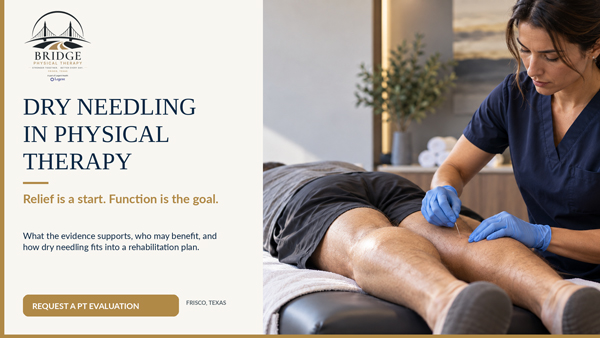
Dry needling uses very thin, solid needles, without medication, to stimulate selected tissues during musculoskeletal care. Research suggests some people experience short-term pain relief, but benefits vary by condition, and long-term improvement usually depends on exercise, education, and progressive activity. It is an optional treatment—not a replacement for a thorough physical therapy evaluation.
If a tight shoulder makes reaching uncomfortable or persistent muscle pain limits your workday, dry needling can sound like a shortcut to relief. The name is memorable, and the procedure is increasingly discussed in sports medicine and physical therapy. But what is it, who benefits, and how strong is the research? This guide explains the treatment without hype and shows how an evaluation determines whether it deserves a place in your care.
What Is Dry Needling?
Dry needling is a clinical technique in which a trained healthcare professional inserts a sterile, single-use, thin solid needle into or near selected muscle or connective tissue. There is no medication, steroid, or anesthetic in the needle. The word “dry” distinguishes it from an injection that delivers fluid.
Physical therapists may consider dry needling for certain musculoskeletal pain and movement problems, particularly when symptoms appear associated with sensitive muscles or painful areas sometimes called myofascial trigger points. These tender spots can exist alongside weakness, limited motion, poor sleep, stress, or an underlying joint problem. Finding a tender point alone does not prove it caused the problem.
A needle is a tool, not the diagnosis. The important question is whether reducing discomfort helps a patient move, train, work, or participate more effectively—and whether the benefit is meaningful enough to justify the procedure.
How Does Dry Needling Work?
The mechanism is still being studied. Researchers propose that needle stimulation can temporarily change local muscle activity, sensory input, and how the nervous system processes pain. A brief involuntary muscle contraction—sometimes called a local twitch response—may occur. That response is not required for treatment success.
Dry needling should not be described as mechanically “breaking up scar tissue,” permanently releasing fascia, detoxifying the body, or correcting structural damage. The evidence does not justify those promises. A patient may experience a short-term decrease in pain or sensitivity; an effective rehabilitation program then uses that window to improve movement and capacity.
What Conditions Might Benefit?
Dry needling has been studied for several conditions, but the strength of the evidence is not uniform. Patients with mechanical neck pain, some shoulder conditions, and chronic low back pain are common research populations. It may also be considered for selected regional muscular pain patterns after appropriate examination. It should not be presented as a proven solution for every headache, nerve problem, tendon injury, or chronic pain syndrome.
For patients with shoulder pain, neck stiffness, or low back discomfort, the assessment matters more than the popularity of a procedure. A clinician should rule out serious pathology, review strength and mobility, and determine whether needling adds value to an active program.
What Does the Scientific Evidence Actually Show?
The most useful way to interpret dry needling research is by condition and outcome—not by the number of positive testimonials. Pain, disability, range of motion, and return to activity are different outcomes, and improvement in one does not guarantee improvement in another.
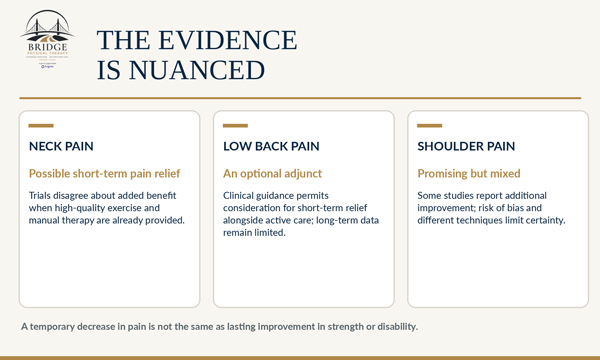
NECK PAIN. Some systematic reviews, including analyses published in 2025 and 2026, report short-term reductions in pain or modest changes in movement measures. Yet two randomized trials in the Journal of Orthopaedic & Sports Physical Therapy found no consistent meaningful added benefit in disability when dry needling was compared with sham treatment or combined with a guideline-based physical therapy program. For many patients, exercise and manual treatment already provide substantial improvement.
LOW BACK PAIN. The APTA-linked 2021 low back pain clinical practice guideline states that physical therapists can consider dry needling in conjunction with other treatment for short-term pain and disability reduction in chronic low back pain. That is a cautious recommendation, not proof of long-term superiority.
SHOULDER PAIN. A systematic review of subacromial pain syndrome found benefits when dry needling was combined with conservative treatment; however, several studies had unclear or high risk of bias and the interventions varied substantially. Results cannot automatically be generalized to every shoulder condition or to postoperative repairs.
THE TAKEAWAY. Dry needling may help selected patients feel better in the short term. Durable recovery is better judged by restored movement, strength, endurance, and meaningful activity. Those goals remain central regardless of whether a needle is used.
What Happens During a Dry Needling Appointment?
A good appointment begins with a conversation, not a needle. Your therapist should review your symptoms and medical history, explain why the technique might or might not be useful, identify reasonable alternatives, and obtain informed consent. Blood-thinning medication, a bleeding disorder, current infection, immune compromise, pregnancy-related precautions, needle anxiety, prior adverse reactions, and the body region being treated can change the risk assessment.
If appropriate and accepted, the clinician cleans the area, uses a sterile single-use needle, and applies the technique to the selected location. You may notice a brief pinch, ache, or muscle twitch. A temporary sense of soreness or heaviness afterward is possible. The procedure is generally brief, but the full appointment should also include follow-up assessment and a plan for movement or exercise.
Not every patient needs dry needling, and more needles or more sessions do not necessarily mean better treatment. If it is not helping a meaningful goal, the plan should change.

Is Dry Needling Safe? What Are the Risks?
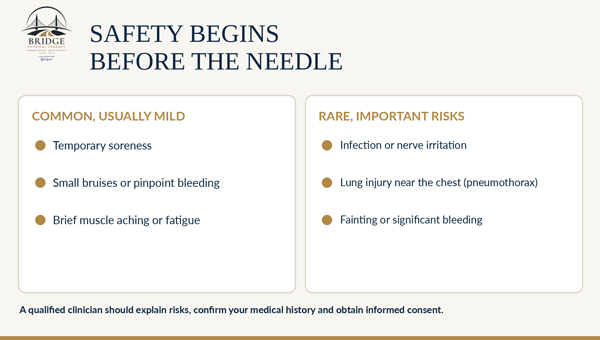
Most reported reactions are mild and temporary: soreness, a small amount of bleeding, or bruising. In a prospective study of more than 20,000 treatments, these minor events were common. A 2026 systematic review concluded that major events are uncommon but can be serious.
Rare complications include infection, nerve injury, significant bleeding, and pneumothorax—a collapsed lung—particularly when needling near the chest or upper back. Safe practice requires anatomical knowledge, clean technique, informed consent, appropriate screening, and training specific to the procedure and region. Chest pain, new shortness of breath, or other serious symptoms after treatment require urgent medical evaluation.
A patient should never be pressured to undergo needling. It is reasonable to choose exercise-based therapy without it. Discuss concerns and disclose relevant medications or medical conditions before any invasive intervention.
Dry Needling Versus Acupuncture, Massage, and Trigger Point Injections
DRY NEEDLING AND ACUPUNCTURE both commonly use thin, solid needles; there is overlap in the tools and some treatment practices. Clinicians may use different diagnostic frameworks and terminology. The professional scope and training requirements vary by state and discipline, so a patient should ask about the individual practitioner’s credentials rather than assuming the procedures are either identical or completely unrelated.
MASSAGE AND MANUAL THERAPY use hands or instruments rather than piercing the skin. They can also reduce symptoms temporarily. TRIGGER POINT INJECTIONS involve fluid injected through a hollow needle, sometimes with an anesthetic or other medication. Dry needling does not inject a drug. The correct option depends on the person’s goals, risk profile, and response—not an assumption that one technique is universally stronger.
Why Exercise Still Matters More Than the Needle
A patient who can comfortably turn the head today but still cannot tolerate desk work next month has not achieved the outcome that matters. Physical therapy should connect short-term relief to durable capacity.
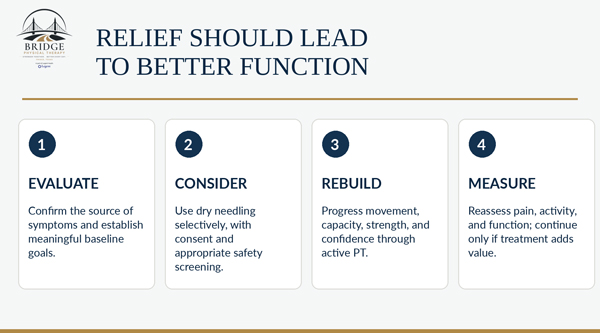
An individualized plan might pair education with progressive strengthening, mobility work, balance, gradual activity exposure, or ergonomics relevant to the patient’s work and sport. The therapist can track a pain rating, range of motion, task tolerance, a validated disability questionnaire, or performance goals. Any needling should earn its place by adding something measurable to that plan.
The most helpful question is not “Did the needle hit a knot?” It is “Can I do more of what matters to me, safely and consistently?”
When Should You Avoid or Reconsider Dry Needling?
If pain is new, severe, unexplained, associated with fever, progressive weakness, loss of bowel or bladder function, chest symptoms, or other concerning signs, medical assessment takes priority over a routine elective modality. Needling should not be performed through infected skin or without an appropriate clinical screening. Some patients should avoid it; others need added precautions or their prescribing clinician’s input.
This is also not a technique to perform at home or by someone whose training is unclear. The decision, anatomical site, needle handling, and response monitoring belong with appropriately qualified healthcare professionals.
Dry Needling Physical Therapy in Frisco and North Texas
People searching “dry needling near me,” “dry needling in Frisco,” or “physical therapy for muscle tightness” usually want two things: relief and a path back to normal activity. A thoughtful PT evaluation can clarify whether dry needling is a sensible optional component or whether another treatment is more appropriate.
Bridge Physical Therapy serves Frisco and surrounding North Texas communities, including Plano, McKinney, and Allen. Patients can request a physical therapy evaluation to discuss symptoms, goals, and appropriate rehabilitation options. Before describing dry needling as an available in-clinic service, confirm current scheduling availability and the qualifications of the clinician who would perform it.
Request a Physical Therapy Evaluation to begin with an individualized assessment rather than a preselected treatment.
Frequently Asked Questions About Dry Needling
Does dry needling hurt?
Some patients feel a quick pinch, dull ache, or brief muscle twitch. Temporary soreness is common. Discomfort varies by person, location, and technique, and the clinician should stop if you want the procedure stopped.
How many dry needling sessions will I need?
There is no evidence-based universal number. The clinician should reassess a meaningful outcome after a limited trial and discontinue or change course if it adds no value.
Can dry needling help back pain?
For chronic low back pain, the 2021 physical therapy guideline says dry needling can be considered alongside other care for short-term relief. It should not replace graded activity, strengthening, and education.
Is dry needling the same as acupuncture?
They share the use of thin needles and can overlap, but practitioners may use different assessment frameworks and training pathways. Ask your clinician about credentials and treatment goals.
Is dry needling safe near the shoulder or upper back?
The region matters: needling near the thorax carries a rare risk of pneumothorax. A qualified clinician should explain site-specific risk and alternatives before treatment.
Can I do dry needling if I take blood thinners?
Tell the treating clinician about all anticoagulants and antiplatelet medicines. These can affect bleeding risk and may require extra precautions or choosing another treatment. Do not stop prescribed medication without your prescribing clinician’s direction.
Does Medicare or insurance cover dry needling?
Coverage varies by payer and benefit design. Medicare generally does not reimburse the dry needling procedure codes 20560 and 20561. Verify coverage, any direct patient cost, and billing arrangements with the clinic before treatment.
Can dry needling fix tight muscles permanently?
No procedure has been shown to permanently remove every “knot.” Some people experience short-term symptom relief; durable results depend on the larger diagnosis and a plan that improves function.
Where can I ask about dry needling near Frisco, Plano, McKinney, or Allen?
Start with an evaluation at Bridge Physical Therapy in Frisco to discuss the appropriate plan. Confirm whether dry needling is currently offered and which clinicians are trained to perform it.
A Better Next Step: Evaluation Before Technique
The goal is not to collect procedures. It is to identify what is limiting you and build a plan you can measure. At Bridge Physical Therapy in Frisco, request a physical therapy evaluation to discuss your symptoms, activity goals, and whether dry needling—or a different approach—belongs in that plan. Treatment availability and insurance benefits should be verified when scheduling.
Medical disclaimer: This article is for general education only and is not a diagnosis, an individualized treatment plan, or a promise of benefit. Procedures require appropriate clinical training, patient consent, and screening. Seek urgent care for new chest pain, breathing difficulty or other acute concerning symptoms.
Peer-reviewed references and regulatory sources
APTA. Dry Needling. Scope, professional qualifications and payer guidance.
https://www.apta.org/patient-care/interventions/dry-needling
de Sire A et al. Effects of dry needling on functioning and pain relief in chronic nonspecific neck pain. Disabil Rehabil. 2026;48:51–64. PMID 40627465.
https://pubmed.ncbi.nlm.nih.gov/40627465/
Gattie E et al. Dry Needling Adds No Benefit to the Treatment of Neck Pain: sham-controlled RCT. J Orthop Sports Phys Ther. 2021;51:37–45. PMID 33383999.
https://pubmed.ncbi.nlm.nih.gov/33383999/
Stieven FF et al. Dry Needling Combined With Guideline-Based Physical Therapy Provides No Added Benefit in Chronic Neck Pain. JOSPT. 2020;50:447–454. PMID 32272030.
https://pubmed.ncbi.nlm.nih.gov/32272030/
George SZ et al. Interventions for Acute and Chronic Low Back Pain: Revision 2021 Clinical Practice Guideline. JOSPT. 2021;51:CPG1–CPG60.
https://doi.org/10.2519/jospt.2021.0304
Griswold D et al. Dry Needling for Subacromial Pain Syndrome: systematic review and meta-analysis. Pain Med. 2023;24:285–299. PMID 36018263.
https://pubmed.ncbi.nlm.nih.gov/36018263/
Rabanal-Rodríguez G et al. Frequency and severity of adverse events associated with dry needling: systematic review/meta-analysis. Phys Ther. 2026;106:pzag050. PMID 42096510.
https://pubmed.ncbi.nlm.nih.gov/42096510/
Boyce D et al. Adverse Events Associated With Therapeutic Dry Needling. Int J Sports Phys Ther. 2020. PMCID PMC7015026.
https://pmc.ncbi.nlm.nih.gov/articles/PMC7015026/
Texas Board of Physical Therapy Examiners: current Acts and Rules / credential and scope review.
https://ptot.texas.gov/act-and-rules/
Texas Occupations Code §453.301 (including direct access provisions); verify clinic process.
https://statutes.capitol.texas.gov/GetStatute.aspx?Code=OC&Value=453.301
Evidence interpretation (clinical-review note)
- Neck-pain meta-analyses show possible short-term benefits, but high-quality trials report no meaningful added function/disability benefits over good guideline-based physical therapy. Retain both perspectives.
- The 2021 low back pain guideline recommendation is permissive (“can consider”) for short-term outcomes with other care; do not imply high-certainty long-term effects.
- Subacromial shoulder pain findings are encouraging but heterogeneous and include trials with unclear/high bias; do not market as treatment for every rotator cuff disorder.
- The 2026 safety meta-analysis included significant variation in adverse-event measurement. Do not use one incidence figure to promise risk-free treatment or apply clinician-career rates to a per-treatment risk.
- APTA supports dry needling where law permits with appropriate competencies. Verify Texas and clinic-specific requirements; the website does not itself establish legal compliance or that Bridge provides this procedure.