

Most uncomplicated lateral ankle sprains improve without surgery, but recovery involves more than waiting for swelling to disappear. Appropriate protection, progressive movement, strengthening, and balance training help restore walking and activity and can reduce the risk of another sprain. At Bridge Physical Therapy in Frisco, Texas, rehabilitation is individualized to the injury, the patient's examination, and the activities they want to return to.

You step off a curb, turn on the pickleball court, or land awkwardly after a jump. Your ankle rolls, pain sets in, and swelling follows. A few days later you may be able to walk again—but does that mean the ankle is ready for work, running, or sport?
Ankle sprains are common, and they are often underestimated. Returning to activity before strength, balance, and confidence have recovered can leave an ankle feeling weak or unpredictable. The right rehabilitation program does not simply make the ankle feel better; it helps you trust it again.
What Is an Ankle Sprain?
An ankle sprain occurs when one or more ligaments—the strong bands of tissue stabilizing a joint—are stretched or torn. Most involve the ligaments on the outside of the ankle after the foot turns inward. The anterior talofibular ligament (ATFL) is frequently involved; the calcaneofibular ligament (CFL) may be injured in more substantial sprains.
A high ankle sprain is different. It injures the syndesmotic ligaments between the tibia and fibula, often from a twisting or external-rotation mechanism. These injuries may require different protection, imaging, specialist assessment, and a longer rehabilitation course. Pain above the ankle joint or persistent difficulty bearing weight deserves medical evaluation rather than a generic lateral-sprain routine.
How Severe Is My Ankle Sprain?
Clinicians often describe ankle sprains in three grades. A Grade I injury involves mild ligament fiber damage with limited instability. Grade II indicates a partial ligament tear, generally with greater tenderness, bruising, and swelling. Grade III is a complete tear and may produce substantial swelling and mechanical instability.
These categories are helpful, but they do not by themselves dictate return-to-activity dates. Your examination, pain, capacity to walk, swelling, strength, prior injuries, and rehabilitation progress matter. A severe sprain can still be managed nonsurgically in many cases, provided the diagnosis is correct and protection and rehabilitation are appropriate.
When Should a Sprained Ankle Be Checked for a Fracture?
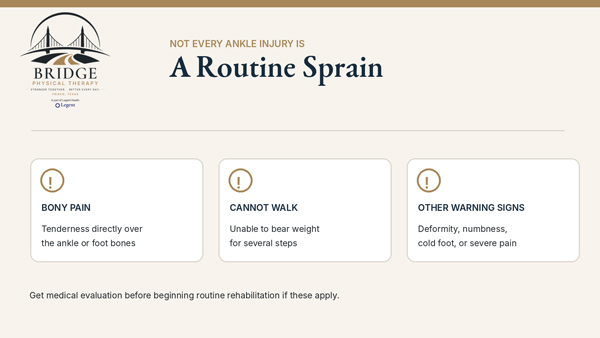
Seek prompt medical evaluation if you cannot take four steps, have pronounced tenderness directly over the ankle bones, notice deformity, have an open injury, or experience numbness, a cold foot, or worsening pain. These may indicate a fracture or another significant problem. Severe pain higher above the ankle, pain at the base of the fifth metatarsal, or persistent symptoms also merit assessment.
Clinicians may use the Ottawa Ankle Rules to decide whether X-rays are appropriate. These rules depend on the location of pain, specific bony tenderness points, and the ability to bear weight. They are not intended to be used as a self-diagnosis, and they do not apply equally to every patient, including some people with neuropathy. If the diagnosis remains uncertain, an orthopedic assessment may be necessary before PT begins.
What Should You Do in the First Few Days?
The immediate goals are protection, symptom control, and safe movement. Depending on severity, your clinician may recommend a brace, supportive footwear, crutches, or a short period in a walking boot. Elevation and intermittent cold therapy may help manage discomfort and swelling. Avoid repeatedly testing a painful ankle through sports, jumping, or uneven terrain before it has been assessed.
For uncomplicated lateral sprains, current physical therapy guidelines favor external support and progressively increased weightbearing as tolerated rather than prolonged complete rest. More severe injuries may need brief immobilization under medical direction. The right amount of movement is based on symptoms, stability, injury severity, and whether fracture or syndesmotic injury has been excluded.
How Does Physical Therapy Help an Ankle Sprain Heal?
Restore Comfortable Motion and Walking
Swelling and pain often limit dorsiflexion—the movement that lets the knee travel forward over the foot. Your therapist may begin with protected ankle motion, gentle mobility exercises, and gait retraining. Hands-on joint or soft-tissue treatment can be used when appropriate as an adjunct to exercise, not as the entire plan.

Rebuild Strength Throughout the Lower Limb
The calf muscles, peroneal muscles on the outside of the leg, and muscles controlling the foot and hip all contribute to stability. Treatment may progress from low-load ankle movements to resistance-band work, calf raises, step-downs, and functional strengthening. Progression depends on pain, swelling response, movement quality, and clinical findings.
Retrain Balance and Proprioception
Proprioception is the body's awareness of joint position and movement. After a sprain, balance and coordination can remain impaired even when the ankle no longer hurts. Your therapist may progress from stable two-leg tasks to supported single-leg standing, multidirectional reaching, and more challenging drills when appropriate. The 2021 ankle sprain clinical practice guideline recommends proprioceptive and balance-focused exercise to lower the risk of repeat sprains.
Prepare for Work, Running, or Sports
A return to activity is not the same for everyone. A person who wants to walk comfortably through the airport has different demands from a basketball player who must jump, land, and cut. Later rehabilitation may include controlled hopping, landing mechanics, agility work, or job-specific tasks. Your therapist assesses readiness instead of relying only on the calendar.
What Does Ankle Sprain Rehabilitation Look Like?
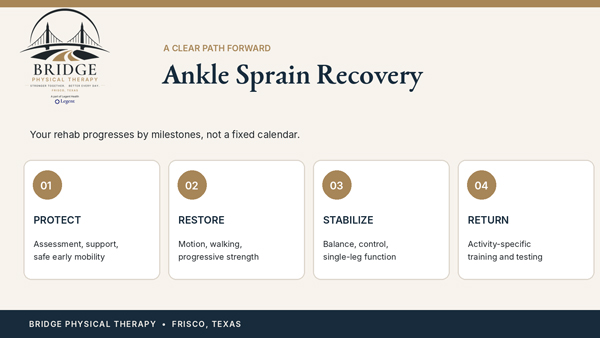
Phase 1 — Protect and settle symptoms. Confirm the diagnosis and appropriate level of support, manage swelling, and restore safe walking and gentle motion as tolerated. Bracing or a boot may be necessary depending on severity.
Phase 2 — Regain mobility and basic strength. Restore comfortable range of motion, improve gait mechanics, and begin progressive resisted ankle and lower-leg exercises without provoking an unacceptable symptom response.
Phase 3 — Build balance and functional control. Increase calf and peroneal strength, single-leg stability, step-up control, and confidence on everyday surfaces. The work becomes more demanding as the ankle tolerates it.
Phase 4 — Return to the activities that matter. Progress toward the physical demands of work, walking longer distances, running, pickleball, golf, or other sports. Use functional testing and your clinician's guidance to determine readiness.
These phases overlap and are milestone-based, not fixed weekly protocols. An illustrated exercise should never override a customized plan, particularly for severe sprains, high ankle sprains, fractures, or postoperative patients.
How Long Does Recovery Take?
A mild sprain may improve substantially over a couple of weeks, while more serious injuries can require six to twelve weeks or longer for full rehabilitation. Recovery times vary with ligament damage, associated injuries, prior sprains, activity demands, and the individual's response to treatment.
The better question is not simply, “How many weeks has it been?” It is, “Can the ankle handle what I need it to do?” Normalizing walking, regaining strength and motion, demonstrating good balance, and tolerating activity-specific tasks are more informative than swelling alone.
Why Does My Ankle Keep Rolling or Giving Way?
If the ankle repeatedly turns, feels unstable on uneven ground, or never regained confidence after the first injury, you may have chronic ankle instability. Some people have ligament laxity; others have lasting deficits in strength, neuromuscular control, or both.
Rehabilitation can address many of these deficits with progressive balance, strength, and task-specific training. A brace may help protect the joint during selected activities, but it should not replace rehabilitation. Repeated sprains, persistent swelling, catching or locking, or ongoing pain despite an appropriate program should prompt orthopedic reassessment for associated problems such as osteochondral injury, tendon pathology, or mechanical instability.
When Is It Safe to Return to Sports?
Return should be based on function, not just the absence of pain. An international sports-medicine consensus proposes evaluating five domains called PAASS: Pain, Ankle impairments (such as motion and strength), Athlete perception or confidence, Sensorimotor control (balance), and Sport/functional performance.
Depending on the sport, assessment may include single-leg balance, calf endurance, hopping, landing, changes of direction, and the ability to complete practice-specific tasks. Bracing or taping can be useful for selected athletes, especially those with a previous sprain. Your therapist and treating clinician should determine which tests and precautions fit your circumstances.
Frequently Asked Questions
Do I need physical therapy for a mild ankle sprain?
Not every mild sprain needs a long supervised program. However, even mild injuries benefit from appropriate mobility, progressive loading, and balance work. PT is particularly valuable if walking remains abnormal, you have a history of repeat sprains, or your return-to-activity demands are high.
Should I wear an ankle brace?
Bracing can provide early support and may help reduce recurrent injuries during higher-risk activities. The choice and duration should reflect injury severity and clinical advice. Bracing alone does not restore strength or balance.
Is it normal to have swelling weeks later?
Residual swelling may persist while activity increases, but it should generally trend in the right direction. Increasing swelling, unexplained severe pain, or persistent inability to progress warrants reassessment.
Can physical therapy help a high ankle sprain?
Yes, rehabilitation may be important, but high ankle sprains require careful diagnosis and often different loading restrictions. Do not treat suspected syndesmotic injury as a routine low ankle sprain without medical guidance.
Where can I get ankle sprain physical therapy near Plano, McKinney, or Allen?
Bridge Physical Therapy in Frisco, Texas serves patients from Frisco and surrounding North Texas communities, including Plano, McKinney, and Allen. Ask the clinic about appointments, insurance, referral requirements, and whether an orthopedic evaluation is needed first.
Get Back to What You Love with Bridge Physical Therapy
An ankle sprain can interrupt exercise, work, travel, and everyday movement—but you do not have to guess your way back. Bridge Physical Therapy, a part of Legent Health, in Frisco, Texas, provides individualized, evidence-informed rehabilitation focused on restoring motion, improving strength, rebuilding balance, and helping patients return to meaningful activities with confidence.
Request an ankle sprain physical therapy evaluation to discuss your injury, goals, and an appropriate recovery plan.
This article provides general education, not a diagnosis or individualized treatment prescription. Symptoms suggesting fracture, significant neurologic or vascular injury, infection, or syndesmotic injury require medical evaluation.
Clinical References
- Martin RL, Davenport TE, Fraser JJ, et al. Ankle Stability and Movement Coordination Impairments: Lateral Ankle Ligament Sprains Revision 2021. J Orthop Sports Phys Ther. 2021;51(4):CPG1–CPG80. https://doi.org/10.2519/jospt.2021.0302
- American Academy of Orthopaedic Surgeons. Sprained Ankle. OrthoInfo. https://orthoinfo.aaos.org/en/diseases--conditions/sprained-ankle/
- American College of Radiology. ACR Appropriateness Criteria: Acute Trauma to the Ankle. https://acsearch.acr.org/docs/69436/Narrative/
- Smith MD, Vicenzino B, Bahr R, et al. Return to sport decisions after an acute lateral ankle sprain injury: introducing the PAASS framework. Br J Sports Med. 2021;55:1270–1276. https://doi.org/10.1136/bjsports-2021-104087