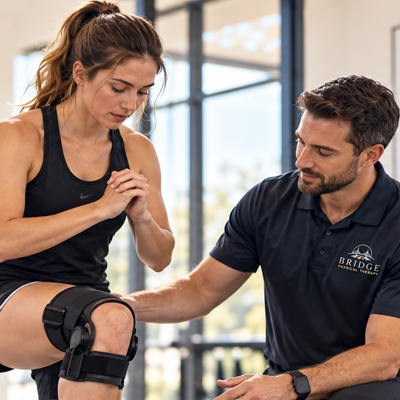
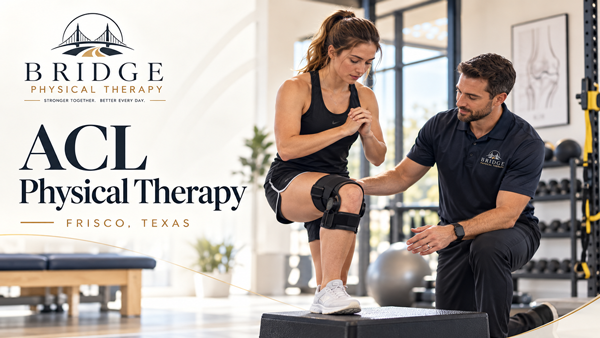
An ACL injury can feel like everything stops at once. Whether the tear happened during football, soccer, basketball, pickleball, skiing, or a simple twisting injury, most patients immediately want the same answers: What exactly happened to the knee? Will surgery be necessary? How long will rehab take? And most importantly, what is the safest and smartest path back to normal activity? At Bridge Physical Therapy in Frisco, Texas, ACL rehabilitation is approached with a clear, evidence-based plan designed to reduce pain, restore confidence, rebuild strength, and help patients return to the activities that matter most. We serve patients in Frisco, Plano, McKinney, Allen, Prosper, Little Elm, The Colony, Celina, and surrounding North Texas communities who want a higher level of orthopedic physical therapy.
Serving Frisco, Plano, McKinney, Allen, Prosper, Little Elm, The Colony, Celina, and surrounding North Texas communities.
What Is the ACL?
The anterior cruciate ligament, or ACL, is one of the major stabilizing ligaments in the knee. It helps control forward translation of the shinbone and provides rotational stability when the body cuts, pivots, lands, or changes direction. In practical terms, the ACL is a key reason the knee feels stable during athletic movement and many day-to-day functional activities. When the ACL is injured, patients often experience swelling, stiffness, pain, and a deep sense that the knee cannot be trusted. That feeling of instability is one of the main reasons proper physical therapy is so important.
Common Signs of an ACL Injury
Many patients report a popping sensation at the time of injury, followed by swelling within the first several hours. Others describe difficulty walking, trouble straightening the knee, pain with turning or twisting, or a sensation that the knee may buckle. Some ACL tears occur in isolation, while others happen alongside meniscus tears, cartilage injuries, bone bruises, or collateral ligament injuries. That is why a good recovery plan starts with an accurate diagnosis and an individualized rehabilitation strategy rather than a generic exercise handout.
Why Physical Therapy Matters
Physical therapy plays a major role after an ACL tear, whether the injury is managed surgically or nonoperatively. Evidence-based rehabilitation focuses on more than reducing pain. Good ACL rehab helps restore full knee extension, improve bending range of motion, re-establish quadriceps activation, normalize walking, rebuild lower-extremity strength, and improve balance, control, and coordination. Over time, rehab progresses toward more advanced strength, running, jumping, landing, and return-to-sport preparation when appropriate. At Bridge Physical Therapy, the goal is not just to help the knee feel better for a week. The goal is to help the entire lower extremity move better, feel stronger, and tolerate real-life demands with more confidence.
ACL Rehab Before Surgery
Many patients benefit from ‘prehab’ before ACL reconstruction surgery. Preoperative physical therapy can reduce swelling, improve motion, improve quadriceps strength, and establish a stronger baseline heading into surgery. Entering surgery with a stiff, swollen, or poorly functioning knee can make the recovery process more difficult. Prehab allows the therapist to prepare the patient physically and mentally, while also setting clear expectations for the stages of post-surgical rehabilitation. For many patients, this early phase helps reduce anxiety because the process becomes more understandable and structured.
ACL Rehab After Surgery
After ACL reconstruction, physical therapy becomes even more important. The early phase typically focuses on controlling swelling, reducing pain, restoring full knee extension, gradually improving flexion, activating the quadriceps, and normalizing gait. Depending on the procedure, there may be surgeon-specific precautions, especially if additional work was done such as a meniscus repair or cartilage procedure. As recovery progresses, treatment shifts toward strengthening the hips, quadriceps, hamstrings, calves, and core, while improving balance, dynamic stability, and movement mechanics. Later in the process, the program may include jogging progression, plyometric drills, change-of-direction work, and functional testing to determine readiness for higher-level activity.
What Makes a Good ACL Rehab Program?
The best ACL rehabilitation programs are individualized, criteria-based, and progressive. That means patients do not advance simply because a certain number of weeks has passed. Instead, progression is based on how the knee is responding, whether swelling is controlled, whether full extension has been restored, whether strength is improving, and whether movement quality is safe and efficient. A strong ACL rehab program also looks beyond the knee itself. Hip strength, trunk control, single-leg balance, and landing mechanics all influence how the knee is loaded during movement. At Bridge Physical Therapy, that whole-chain perspective is an important part of treatment.
How Long Does ACL Recovery Take?
ACL recovery takes time, and patients should be cautious about anyone promising a quick return to full sport without objective criteria. Some milestones improve relatively early, but true return to pivoting or cutting sports often takes months. The exact timeline depends on the severity of the injury, the presence of other knee damage, whether surgery was performed, the type of graft used, the patient’s goals, and how consistently the rehabilitation plan is followed. Most patients begin to feel better before they are actually ready for unrestricted higher-demand activity. That gap between ‘feeling better’ and ‘being truly ready’ is one of the most important reasons to work with a skilled physical therapist.
Nonoperative ACL Rehabilitation
Not every ACL tear is treated with surgery. Some patients, depending on age, activity demands, associated injuries, and functional goals, may be managed nonoperatively. For those patients, physical therapy still plays a central role. The rehab process focuses on improving strength, dynamic stability, balance, movement quality, and symptom control while building confidence in the knee. Even in the nonoperative setting, good therapy is not a one-size-fits-all protocol. It should be matched to the patient’s lifestyle, job demands, sport participation, and long-term goals.
Why Local Patients Choose Bridge
Patients looking for ACL physical therapy in Frisco want more than a basic exercise program. They want thoughtful care, measurable progress, and a team that understands orthopedic recovery. Bridge Physical Therapy was built around that model. Our clinic emphasizes individualized treatment, premium patient experience, and evidence-based progression. We work with active adults, student athletes, post-surgical patients, and motivated individuals who want a structured recovery plan that actually makes sense. For patients in Frisco and surrounding North Texas communities, Bridge offers a convenient, orthopedic-focused option for ACL rehab that aligns with both lifestyle goals and clinical standards.
When to Schedule an Evaluation
If you have recently torn your ACL, are preparing for ACL reconstruction, are already recovering after surgery, or continue to feel instability after a knee injury, now is the right time to schedule an evaluation. The sooner rehabilitation becomes organized, the easier it is to protect motion, improve strength, and create momentum in the right direction. At Bridge Physical Therapy, each ACL evaluation is designed to understand where you are in the recovery process, what your goals are, and what the next phase of treatment should look like. Whether your goal is returning to sport, returning to the gym, or simply trusting your knee again, the plan should be clear from the beginning.
Closing CTA
Bridge Physical Therapy is located at Baylor Frisco – Professional Building #1, 5575 Warren Parkway, Suite 115, Frisco, TX 75034. If you are searching for ACL rehab in Frisco, ACL physical therapy near Plano or McKinney, or post-surgical knee rehabilitation in North Texas, our team is ready to help. Request an appointment today to start a personalized, evidence-based ACL recovery plan.
Frequently Asked Questions
Q: Do I need physical therapy after an ACL tear?
A: Yes. Whether the ACL injury is treated surgically or nonoperatively, physical therapy helps restore motion, strength, stability, and function.
Q: How soon should I start ACL rehab?
A: Many patients start soon after diagnosis, and patients planning surgery often benefit from prehab before ACL reconstruction. After surgery, therapy usually begins according to the surgeon’s plan.
Q: How long does ACL physical therapy take?
A: Recovery varies, but ACL rehabilitation usually takes months rather than weeks. Progress should be based on symptoms, strength, movement quality, and function—not just time alone.
Q: Can Bridge Physical Therapy help after ACL surgery?
A: Yes. Bridge Physical Therapy provides post-surgical orthopedic rehabilitation, including ACL reconstruction rehab with progression based on the procedure, restrictions, and goals.
Q: Do you only treat athletes?
A: No. We treat athletes, active adults, surgical patients, and anyone who wants to recover better after an ACL injury or surgery.
Q: What areas do you serve?
A: Bridge Physical Therapy is based in Frisco and commonly serves patients from Plano, McKinney, Allen, Prosper, Little Elm, The Colony, Celina, and surrounding North Texas communities.
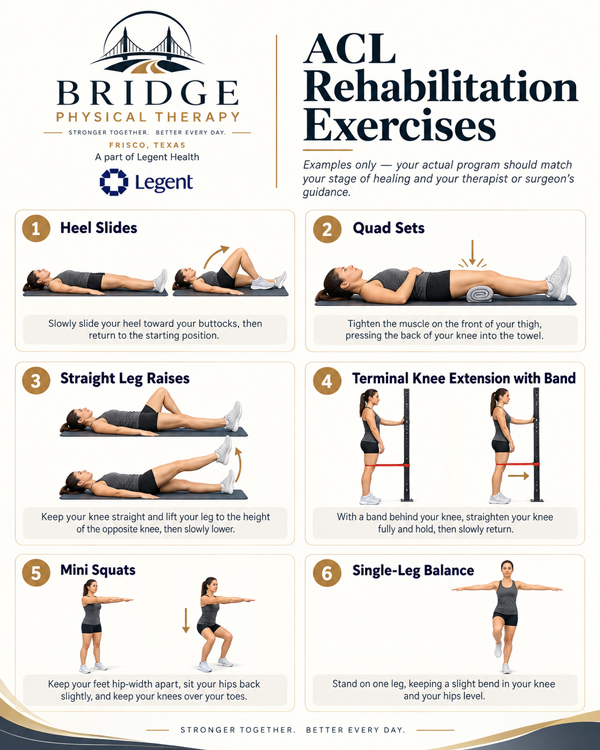
Example ACL Rehab Exercises
These example exercises are educational only. Actual ACL rehabilitation should be individualized based on stage of healing, symptoms, surgeon guidance, and clinical progression.