

A structured neuromuscular training program that includes jump-and-landing practice, leg and hip strength, balance, and agility can substantially reduce the risk of anterior cruciate ligament (ACL) injuries in female athletes. A 2025 systematic review found a 61% lower ACL injury rate among participants in the studied prevention programs compared with controls. This is a relative, group-level finding—not a promise that an individual athlete will avoid injury.

For a young athlete, a season is more than a schedule of games. It is teammates, confidence, competition, and the chance to keep improving. An ACL tear can interrupt all of it. But there is encouraging news for families and coaches: evidence-based prevention programs can be built into ordinary athletic training, often as a brief warm-up.
At Bridge Physical Therapy in Frisco, Texas, we believe injury prevention deserves the same thoughtful approach as rehabilitation. Instead of waiting for an injury, athletes can learn how to control their bodies during the demands of soccer, basketball, volleyball, lacrosse, field hockey, and other jumping or cutting sports. The following guide explains how jump training fits into that approach, what the evidence really says, and what to expect from a skilled physical therapy evaluation.
What Is ACL Injury Prevention Jump Training?
Jump training is a form of plyometric and neuromuscular training that helps athletes develop coordinated movement during takeoff, landing, deceleration, and changes of direction. Plyometrics use controlled, rapid muscle actions—such as hops and jumps—to prepare the body for athletic demands. But an effective ACL prevention program is not a series of jumps alone.
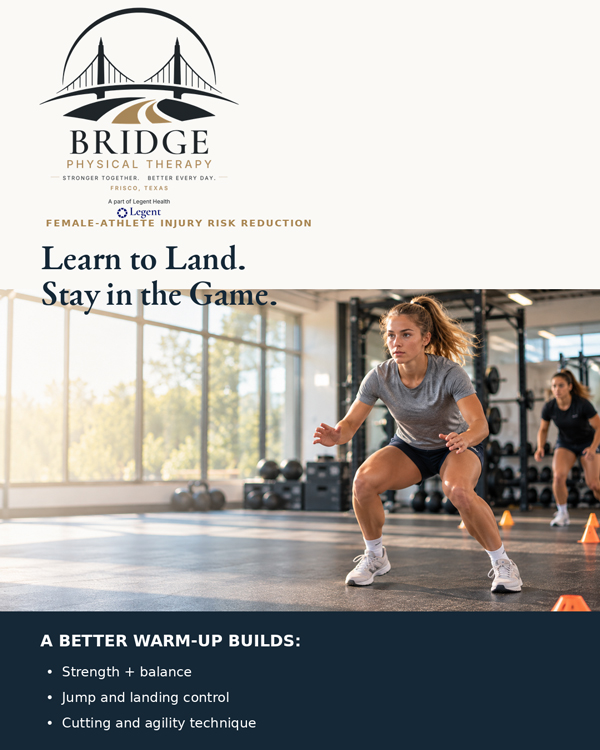
The better-studied programs combine multiple elements: lower-extremity and trunk strengthening; balance and single-leg control; technique coaching for landing and cutting; plyometric drills; and progressive sport-specific agility. The training teaches athletes to absorb force, maintain control through the hip, knee, and ankle, and transition smoothly into the next movement. [1–4]
Coaches may recognize programs inspired by established approaches such as the FIFA 11+ or PEP warm-up. Individual components differ, but the underlying theme is consistent: regular, supervised, well-performed movement training matters more than any one exercise.
Why Does ACL Prevention Matter Especially for Young Female Athletes?
Female athletes participating in pivoting and jumping sports experience an important burden of noncontact ACL injury. Mechanisms often involve landing, abruptly slowing down, or changing direction rather than a direct blow to the knee. Risk is multifactorial: sport exposure, strength, motor control, training load, prior injuries, and individual anatomy may all play roles. No single body type or movement pattern determines who will tear an ACL.
The encouraging part is that athletes can train several modifiable movement and strength factors. Practicing landing control, developing lower-body strength, and building agility can improve the physical skills required by sport. Importantly, the goal is not to tell female athletes that their bodies are defective or to blame an injured athlete for an injury. It is to provide an additional layer of preparation that can support both safety and performance.
The American Academy of Orthopaedic Surgeons (AAOS) clinical practice guideline states that injury-prevention training programs can be used to reduce the risk of primary ACL injuries in athletes in high-risk sports. [3]
What Does the Research Say About Preventing ACL Tears?
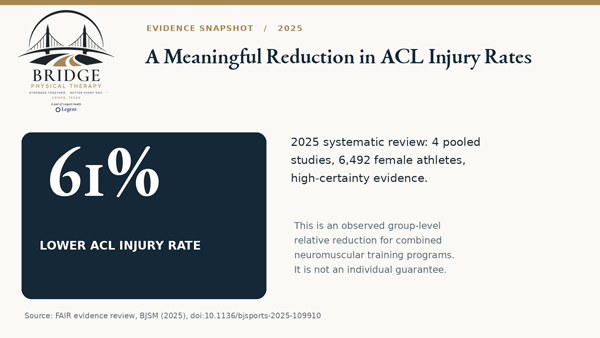
The strongest recent evidence is compelling. A systematic review and meta-analysis informing the FAIR consensus, published in the British Journal of Sports Medicine in 2025, pooled four studies involving 6,492 female athletes and found that neuromuscular training programs reduced ACL injury rates by approximately 61% (incidence rate ratio 0.39; 95% confidence interval 0.25–0.60). The researchers rated the ACL finding high-certainty evidence. [1]
Another meta-analysis, published in 2025, reported approximately 50% lower ACL injury risk across seven studies of female team-sport athletes. It also identified implementation and adherence as important considerations. [2]
These findings support multicomponent programs, not the claim that doing box jumps by themselves reduces ACL tears by 61%. The estimates also should not be used to calculate an individual athlete's personal injury probability. Program structure, athlete age, sport, coaching, and attendance all affect how research translates into practice.
The practical takeaway is straightforward: prevention works best when it is an ongoing training habit, not a one-time session before tryouts.
The Five Building Blocks of an Effective Program
1. Learn to Land With Control
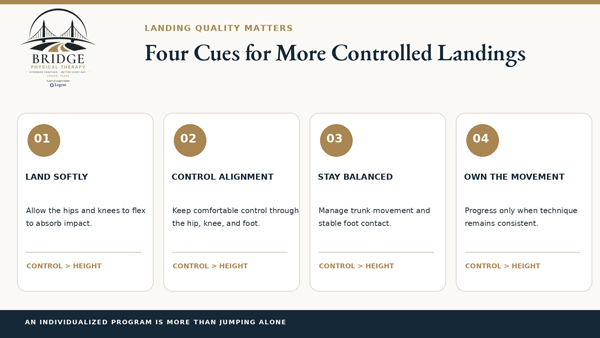
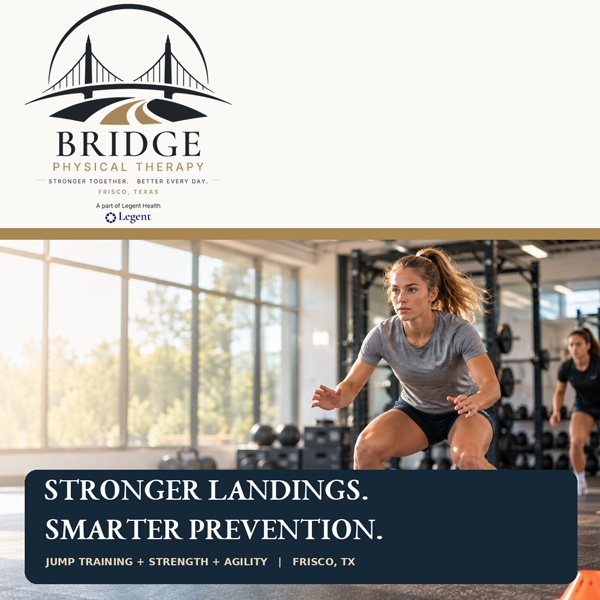
Athletes practice landing from small jumps with comfortable knee and hip flexion, balanced foot pressure, and controlled trunk positioning. Coaching emphasizes a soft, stable landing instead of a stiff-legged or uncontrolled impact. A therapist may use video feedback or verbal cues, but technique is individualized rather than forcing every body into an identical posture.
2. Build Hip, Thigh, and Calf Strength
Squats, step-downs, split squats, calf raises, and appropriately progressed resistance exercises develop the strength needed to decelerate and stabilize the lower extremities. Trunk and hip control contribute to managing the position of the entire leg, not just the knee.
3. Develop Single-Leg Balance and Control
Many sports movements occur on one leg. Athletes may practice single-leg stands, reaches, hops, and controlled landings. Challenges become more dynamic as strength and technique improve. The goal is maintaining quality when the task becomes less predictable.
4. Progress to Plyometrics and Deceleration
Drills can advance from small bilateral hops to single-leg hopping, lateral bounds, and more demanding landings. Quality, fatigue, symptoms, and training readiness guide progression. More height and more repetitions are not automatically better.
5. Integrate Cutting and Sport-Specific Agility
The last step connects rehearsed skills to game demands: changing direction, responding to visual cues, recovering balance after contact, and controlling speed. A volleyball player and soccer midfielder may have different final drills, even when their foundational program is similar.
What Does a Typical Jump Training Session Look Like?
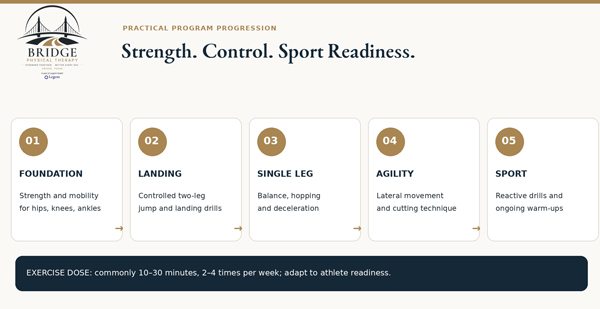
Prevention programs evaluated in the literature commonly use roughly 10–30 minutes, performed two to four times per week as part of a warm-up or training session. The 2025 FAIR review identified a practical minimum of about 10 minutes, twice weekly in the studied programs; the appropriate dose depends on the athlete and setting. [1]
A therapist-led starter session might include a brief dynamic warm-up; a few controlled squat-and-land repetitions; short sets of balance or single-leg control; strengthening; and a small amount of well-coached lateral movement. More advanced athletes may add reactive agility or sport-specific jumps.
This is not a universal home prescription. An athlete with pain, swelling, an unstable knee, or recent surgery needs an examination and a different plan. For a healthy athlete, the best prevention program is one that can be learned correctly and consistently repeated by the athlete and her team.
Is Jump Training Just for Athletes Who Have Already Had an ACL Injury?
No. The central purpose of a primary prevention program is to reduce risk before a first ACL tear. That is why it makes sense to introduce good movement habits in middle school and high school, with age-appropriate coaching. The International Olympic Committee (IOC) has recommended incorporating preventive neuromuscular exercise into youth sports and physical education. [4]
Athletes recovering from ACL reconstruction also need strength, landing control, and sport-specific testing. However, that is a different clinical pathway. Postoperative athletes should follow a surgeon- and rehabilitation-team-directed, criteria-based return-to-sport program. A general prevention warm-up does not replace ACL rehabilitation or clearance.
Which Athletes May Benefit Most?
Prevention is particularly relevant for girls and young women participating in soccer, basketball, volleyball, lacrosse, field hockey, and other sports with jumping, pivoting, cutting, and sudden deceleration. It can be useful for recreational players as well as competitive and club athletes.
Physical therapists can also help a parent, coach, or athletic trainer determine how to adapt the training to the athlete's age, experience, season, and current conditioning. A high school player returning from an ankle sprain may need a different starting point than an uninjured collegiate athlete. The program should fit the athlete—not the other way around.
Can Coaches Run ACL Prevention Warm-Ups?
Yes, once a suitable program is selected and proper instruction is established. Research-based prevention does not need to occur exclusively during a clinic visit. Consistent incorporation into team warm-ups may improve adherence and reach more athletes. Parents and coaches should look for progressive programming, demonstration of exercises, technique feedback, and a realistic schedule.
A physical therapist can provide a baseline movement evaluation, individualized modifications, and periodic quality checks. The goal is to empower the athlete and coaching staff rather than create dependence on repeated clinic visits.
When Should an Athlete Get a Medical Evaluation Instead?
Jump-training education is not appropriate as a substitute for evaluating an acute injury. A twisting incident followed by a pop, rapid knee swelling, inability to continue play, recurrent giving way, inability to bear weight, or loss of motion warrants prompt medical assessment. Sudden symptoms after an injury may reflect an ACL tear, fracture, meniscus injury, or another problem needing diagnosis.
Do not push through significant pain or swelling to complete a prevention drill. An athlete with a history of ACL reconstruction, substantial injury, or ongoing instability should have a tailored rehabilitation and clearance plan before higher-impact exercises.
Frequently Asked Questions About Jump Training and ACL Prevention
Does jump training really prevent ACL tears?
A properly implemented multicomponent neuromuscular prevention program can substantially lower ACL injury rates in studied groups of female athletes. Jump and landing drills are important elements, but the evidence does not establish the same risk reduction for jump exercises alone. [1,2]
What age should girls start ACL prevention training?
Age-appropriate technique and movement practice can begin during youth athletics, and programs should be adapted to physical and developmental maturity. The objective is building safe, positive habits—not imposing adult strength or jumping volumes on children. [4]
How often should an athlete do jump training?
Studied prevention programs often run at least twice weekly, frequently within regular team warm-ups. Attendance and exercise quality matter. A qualified clinician or coach should set an appropriate progression and avoid unnecessary fatigue. [1,2]
Does knee position matter when landing?
It does, but not as a single perfect angle. Coaching generally encourages controlled hip and knee flexion, knee alignment consistent with the athlete's anatomy and movement, and good trunk control. The athlete should absorb force without losing balance. [5]
Is this the same as ACL rehabilitation after surgery?
No. Preventive training for an uninjured athlete is different from postoperative ACL rehabilitation, which requires an individualized progression and medical clearance. Athletes recovering from ACL tears should not use a generic prevention routine as a replacement for their formal plan.
Can a soccer or volleyball team do this together?
Yes. Team warm-ups are an evidence-informed delivery model when coaches are trained and exercises are performed regularly. An initial physical therapy assessment can be helpful for athletes who need individualized modifications. [1,4]
Where can we ask about ACL prevention training near Frisco, TX?
Families, athletes, and coaches in Frisco, Plano, McKinney, Allen, and surrounding North Texas communities can contact Bridge Physical Therapy about evaluation and appropriate injury-prevention programming. Confirm current program availability, scheduling, and payment options directly with the clinic.
Move Better. Play Longer.
The best time to learn sound landing mechanics is before the knee is injured. Evidence-based prevention makes room for a smarter warm-up, stronger lower extremities, and more confident athletic movement. For parents and coaches, it offers a practical way to act on science without promising that every injury can be prevented.
Bridge Physical Therapy in Frisco, Texas can help athletes and families take the next step toward a personalized movement assessment and discuss how neuromuscular training could fit their goals. Request an athletic movement evaluation and ask about jump-and-landing training for your sport.
Educational content only. These recommendations do not replace medical assessment, and an injury-risk reduction program cannot guarantee prevention. Clinical program availability and suitability must be verified before scheduling.
References
- FAIR Consensus evidence review. Prevention strategies for lower extremity injury: a systematic review and meta-analyses for the Female, woman and/or girl Athlete Injury pRevention (FAIR) consensus. British Journal of Sports Medicine. 2025. https://doi.org/10.1136/bjsports-2025-109910
- Neuromuscular training for preventing knee injuries in female team athletes: a meta-analysis. 2025. PubMed PMID: 41175154. https://pubmed.ncbi.nlm.nih.gov/41175154/
- American Academy of Orthopaedic Surgeons. Management of Anterior Cruciate Ligament Injuries: Evidence-Based Clinical Practice Guideline. https://www.aaos.org/aclcpg
- International Olympic Committee. 2018 consensus statement on prevention, diagnosis and management of paediatric ACL injuries. https://pmc.ncbi.nlm.nih.gov/articles/PMC5876259/
- Hospital for Special Surgery. ACL Injury Prevention Tips and Exercises. 2023. https://www.hss.edu/health-library/conditions-and-treatments/acl-injury-prevention-stay-off-sidelines