


If you have torn your Achilles tendon and undergone surgery, the next chapter is not simply about healing the incision. It is about restoring motion, rebuilding calf strength, protecting tendon healing, and returning to life with confidence. At Bridge Physical Therapy in Frisco, Texas, rehabilitation after Achilles tendon repair is built around evidence, progression, and close communication with your surgeon.
This page is designed for patients recovering from Achilles tendon surgery, including standard open repair, modern minimally invasive repair techniques such as PARS (Percutaneous Achilles Repair System), and anchor-based double-row minimally invasive repairs. No matter which surgical technique was used, physical therapy plays a central role in protecting the repair while guiding the tendon, calf, and the rest of the lower extremity back to function.
How Achilles tendon ruptures happen
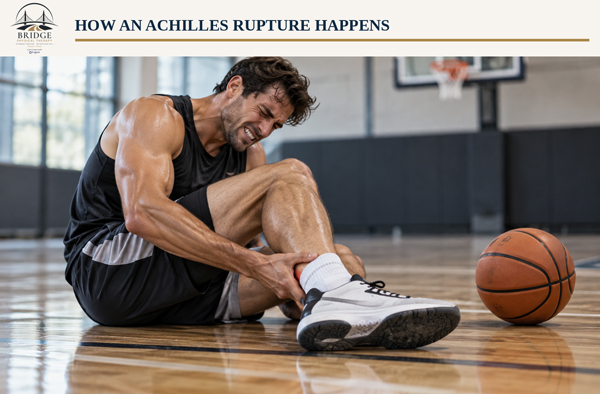
The classic Achilles rupture mechanism is sudden push-off. Many patients describe feeling as if someone kicked or hit them in the back of the ankle. This commonly happens during basketball, tennis, pickleball, soccer, sprinting, or jumping. A rapid change in direction, explosive acceleration, or landing sequence can overload the tendon.
Typical symptoms include a sharp pop, pain at the back of the ankle, weakness with push-off, difficulty walking, and trouble rising onto the toes. Even after a successful surgical repair, the body must recover from much more than the tear itself. Immobilization, swelling, pain, calf atrophy, gait changes, and loss of confidence all influence recovery. That is exactly why post-operative rehabilitation matters.
Surgical techniques: open repair, PARS, and double-row minimally invasive repair
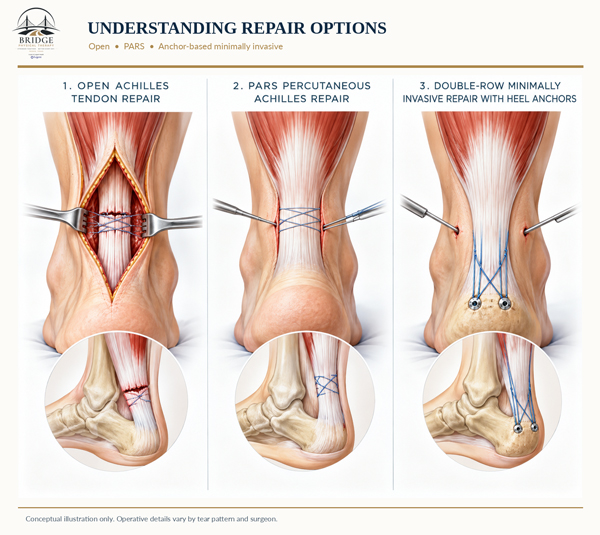
Traditional open Achilles tendon repair remains a common and reliable option. Through a larger incision, the surgeon directly visualizes the torn tendon ends and repairs them with strong sutures. This technique allows excellent visualization, but the incision is larger and soft-tissue management becomes especially important.
A newer option is PARS repair (Percutaneous Achilles Repair System). This is a minimally invasive technique that uses a smaller incision and percutaneous suture passage to approximate and secure the tendon. The goal is to reduce wound complications while preserving strong fixation.
Another modern option is anchor-based minimally invasive repair, including constructs sometimes described as double-row repair or midsubstance SpeedBridge-style repair. In selected tears, this technique uses suture anchor fixation and a low-profile minimally invasive approach to create a secure repair construct. The appropriate construct depends on tear location and quality; no single technique is established as best for every patient.
From a rehabilitation standpoint, the surgical approach matters, but it does not completely rewrite the principles of recovery. Whether the repair was open, PARS, or double-row minimally invasive, the key rehabilitation themes remain the same: protect the repair, avoid tendon elongation, progressively restore motion, build strength, and return patients to walking, exercise, work, and sport safely.
Why physical therapy matters after Achilles tendon repair
Patients often assume the tendon simply needs time. Time matters, but quality rehabilitation matters just as much. Without progressive therapy, patients may struggle with stiffness, calf weakness, abnormal gait, poor balance, reduced endurance, and loss of explosive push-off.
Physical therapy after Achilles repair helps address:
- protection of the surgical repair during early healing
- swelling management and scar mobility
- restoration of ankle range of motion within safe parameters
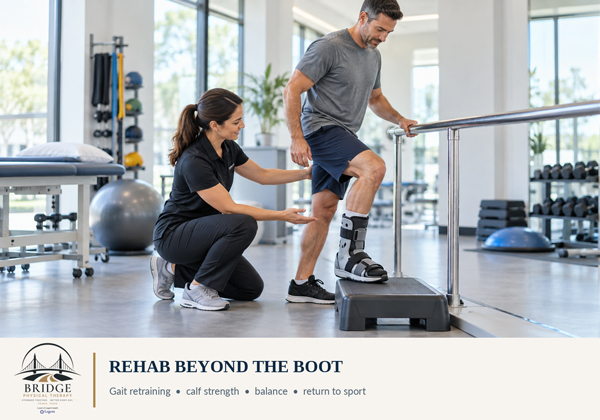
- gait retraining and progressive weight-bearing
- calf, foot, hip, and core strengthening
- balance, proprioception, and single-leg control
- sport-specific and return-to-running progression when appropriate
Current evidence increasingly supports early functional rehabilitation rather than prolonged rigid immobilization. Systematic reviews have found that earlier protected weight-bearing and motion can improve short-term recovery and patient satisfaction without increasing major complications when used appropriately. That does not mean every patient should move aggressively right away. It means the best protocols are structured, protected, and individualized.
What does evidence-based rehab look like?
Modern Achilles rehabilitation is moving toward earlier, smarter loading. The literature supports early functional rehabilitation as a combination of protected weight-bearing, progressive ankle motion, and staged strengthening. More recent return-to-sport guidance also emphasizes progressive loading, restoration of calf strength, tendon capacity, and movement quality—not just waiting for time to pass.
At Bridge Physical Therapy, a high-level, evidence-based Achilles program focuses on three big priorities:
- Protect healing while avoiding unnecessary stiffness and deconditioning.
- Load the tendon progressively so the calf–Achilles complex regains strength and spring.
- Use criteria-based progression whenever possible, not just a calendar date.
Phases of recovery after Achilles tendon repair
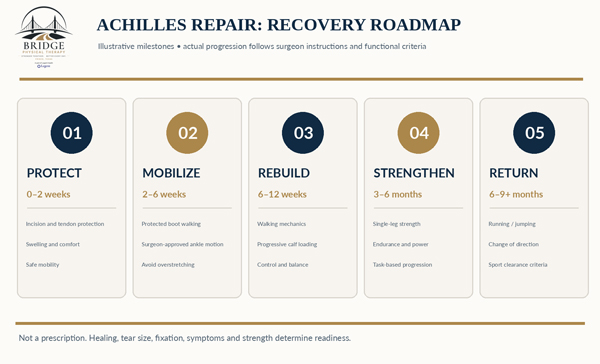
Every protocol is surgeon-specific, and details vary by tendon quality, tear location, fixation method, and patient factors. That said, most recovery plans follow recognizable phases.
Phase 1: protection and healing (roughly weeks 0-2)
Early recovery is focused on protection. Patients are often in a splint or boot in plantarflexion. Goals include incision protection, swelling control, pain reduction, safe mobility, and patient education. During this phase, therapy may focus on mobility of non-injured joints, circulation, general conditioning, and understanding weight-bearing restrictions.
Phase 2: early motion and protected weight-bearing (roughly weeks 2-6)
This is where modern protocols begin to differ from older, more conservative pathways. Selected patients may transition to a boot, begin protected weight-bearing, and start gentle range-of-motion work under surgeon guidance. Early stretching beyond the prescribed dorsiflexion limit can elongate the healing tendon. Early therapy focuses on normalization of gait in the boot, swelling management, and safe introduction of controlled ankle mobility. The goal is movement without overstressing the repair.
Phase 3: strength building and gait normalization (roughly weeks 6-12)
As protection decreases, the rehab emphasis shifts. Patients work toward better walking mechanics, improved ankle mobility, and progressive strengthening. Double-leg calf work, seated strengthening, balance work, and proximal-chain strengthening often begin to expand. This is also the phase where many patients realize that the calf has weakened significantly, even though the incision may look good. Rebuilding force production takes time.
Phase 4: higher-level strengthening and function (roughly 3-6 months)
Now the focus turns toward calf endurance, single-leg control, balance, and functional loading. Depending on progress, patients may begin more advanced strengthening, faster walking, incline work, and eventually a graded jog program. For athletic patients, this is often the most important phase. The tendon may be healed, but it is not yet ready for explosive demands unless strength, control, and confidence are rebuilt.
Phase 5: return to running, jumping, and sport (roughly 6-9+ months)
Return to sport is highly individualized, and readiness is determined by strength and function rather than time alone. Some patients recover faster, others need longer. For high-demand athletes, true return to full-speed cutting, jumping, and reactive play often requires many months of progressive loading. Return-to-sport decisions should consider calf strength, heel-rise performance, movement quality, confidence, symptoms, and sport demands—not just how many months have passed.
How long does recovery take?
Patients understandably ask for a timeline. A reasonable high-level expectation is:
- First 2 weeks: protection and wound healing
- 2 to 6 weeks: early boot-based progression and controlled mobility
- 6 to 12 weeks: transition toward normalized walking and strengthening
- 3 to 6 months: more advanced strength, endurance, and functional progression
- 6 to 9 months or longer: return to higher-level sport and explosive activity
Daily function often returns earlier than sports performance. A patient may walk relatively well by a few months but still lack single-leg calf strength, push-off power, or confidence. Studies on return to sport after Achilles rupture show that many athletes do return, but the timeline varies and performance recovery can lag behind basic healing.
Goals of recovery
At Bridge Physical Therapy, the goals of rehab after Achilles tendon repair go beyond “getting out of the boot.” Recovery goals include:
- protecting the repair and avoiding rerupture
- minimizing tendon elongation
- restoring ankle mobility safely
- normalizing walking mechanics
- rebuilding calf strength and endurance
- improving balance and single-leg control
- returning to exercise, work, and sport with confidence
For active patients, one of the biggest goals is to restore the power of push-off. This is what patients feel when climbing stairs, accelerating, jumping, and changing direction. Achilles rehab is not just about pain. It is about performance.
Why choose Bridge Physical Therapy in Frisco?
Physical therapy after Achilles tendon repair should not be generic. The surgical technique, fixation construct, healing response, and patient goals all matter. Bridge Physical Therapy in Frisco works closely with orthopaedic foot and ankle care and understands the difference between simply protecting a repair and truly restoring function.
Our program is individualized. A recreational walker recovering from open repair does not need the same progression as a competitive basketball player after PARS or a high-demand athlete after double-row minimally invasive repair. We meet patients where they are, follow surgeon guidelines carefully, and progress toward meaningful goals.
When should you contact your surgeon?
Contact your surgical team promptly for new wound drainage, worsening redness, fever, an unexpected sharp pop, sudden loss of push-off strength, or a marked increase in swelling or pain. New calf swelling and tenderness may require urgent evaluation for a blood clot; chest pain or shortness of breath requires emergency assessment. Do not begin a new stretching or running program without clearance.
Final takeaway
If you are searching for physical therapy after Achilles tendon repair in Frisco, Texas, the most important message is this: the best outcomes come from a thoughtful combination of surgical repair, protected early recovery, progressive loading, and high-quality rehabilitation. Open repair, PARS repair, and double-row minimally invasive techniques all benefit from evidence-based post-operative PT. With the right progression, patients can move beyond the boot, rebuild strength, and get back to the activities that matter.
Frequently Asked Questions
When should physical therapy start after Achilles tendon repair?
The exact timing depends on your surgeon’s protocol, but many patients begin some form of guided rehabilitation early in the recovery process, even while still protected in a splint or boot.
Is PARS repair different from open repair in physical therapy?
The overall rehab goals are similar. The incision, soft tissues, repair location, and fixation method can change restrictions, but a minimally invasive incision does not automatically justify accelerated exercises. Your therapist should coordinate progression with your surgeon.
How long before I can walk normally after Achilles tendon surgery?
Many patients improve substantially over the first few months, but normal walking mechanics may take time, especially if calf weakness persists.
How long before I can run or play sports again?
Return to jogging often begins only after strength and movement criteria are improving. Return to jumping, cutting, and full sport frequently takes 6 to 9 months or longer.
Why is calf strength so important after Achilles repair?
The calf-Achilles complex drives push-off. If calf strength does not recover well, patients may continue to limp, fatigue quickly, or struggle to regain athletic performance.
Ready to discuss your rehabilitation? Request a Physical Therapy Evaluation.
Evidence & Clinical Interpretation
• Marrone W et al. Rehabilitation and Return to Sports after Achilles Tendon Repair. Int J Sports Phys Ther. 2024. PMID 39246413. https://pubmed.ncbi.nlm.nih.gov/39246413/ — progressive loading and criteria-led return-to-sport discussion.• Gould HP et al. Postoperative Rehabilitation Following Achilles Tendon Repair: A Systematic Review. 2021. PMID 33972490. https://pubmed.ncbi.nlm.nih.gov/33972490/ — early protected weightbearing and short-term function.• Defining Components of Early Functional Rehabilitation for Acute Achilles Tendon Rupture: A Systematic Review. 2020. PMID 31803789. https://pubmed.ncbi.nlm.nih.gov/31803789/ — variability in functional rehabilitation definitions.• Zhao J-G et al. Early functional rehabilitation versus traditional immobilization for surgical Achilles tendon repair. Sci Rep. 2017. PMID 28054658. https://pubmed.ncbi.nlm.nih.gov/28054658/ — meta-analysis overview.• Clinical Outcomes and Complications of PARS Versus Open Technique for Acute Achilles Tendon Ruptures. Foot Ankle Int. 2015. PMID 26055259. https://pubmed.ncbi.nlm.nih.gov/26055259/ — retrospective cohort; not conclusive surgical superiority.• Peabody JJ et al. Complications Following Minimally Invasive Achilles Rupture Repair: PARS vs Midsubstance SpeedBridge Techniques. JAAOS. 2026. PMID 40939091. https://pubmed.ncbi.nlm.nih.gov/40939091/ — comparative evidence; review study populations and repair constructs.• Zellers JA et al. Return to play post-Achilles tendon rupture: meta-analysis. BJSM. 2016. PMID 27259751. https://pubmed.ncbi.nlm.nih.gov/27259751/ — return-to-play estimates vary by definitions and athletes.